


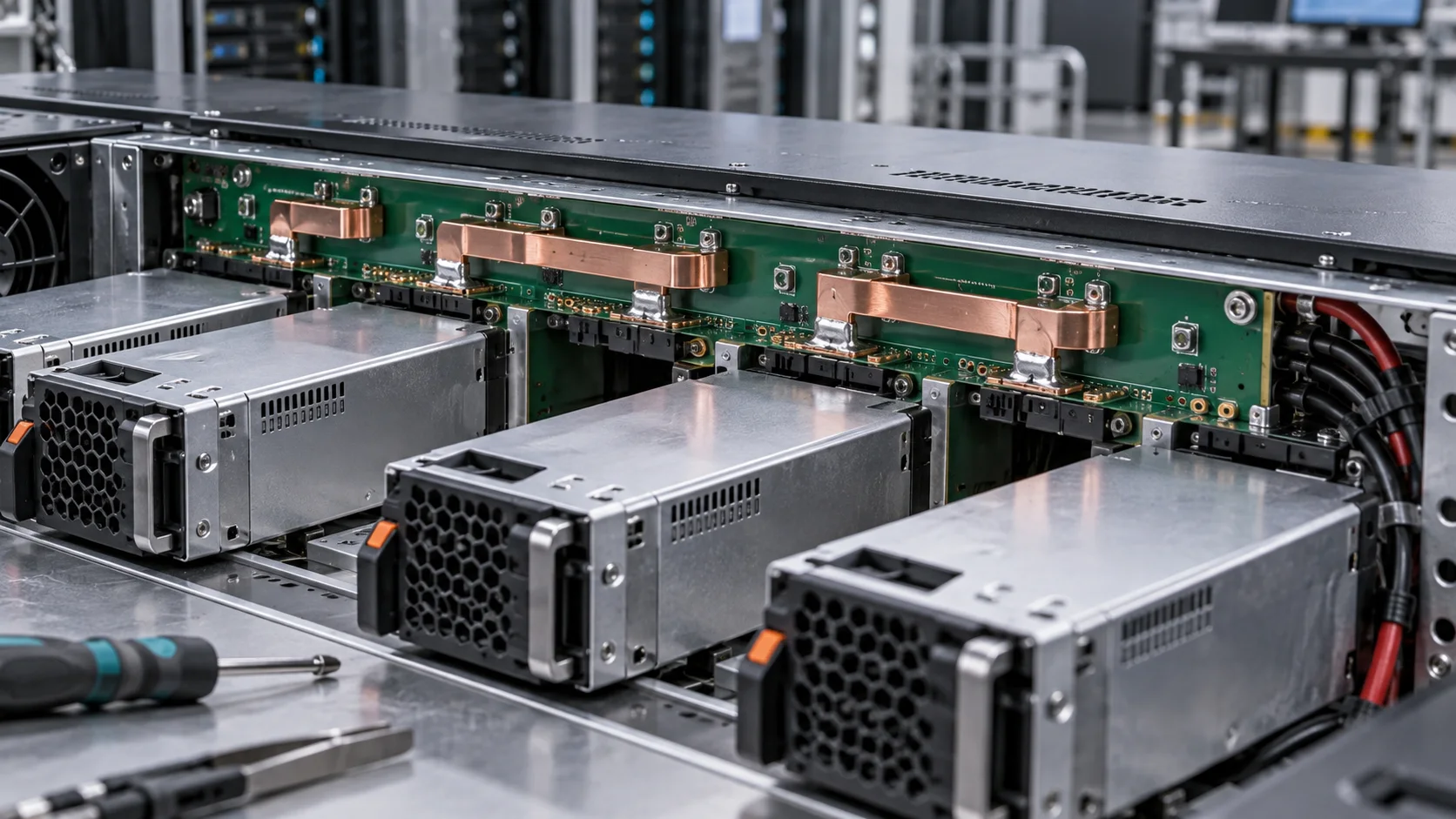
Quick answer: Select a SMD busbar for a 48V server hot-swap backplane by checking module sharing, low drop, connector temperature, backplane bending and reflow process. Section is only the starting point; review pad exits, vias, connector pins, branch length and airflow.
Questions answered on this page
- Why use an SMD busbar on a 48V hot-swap backplane?
- How should parallel power modules be checked?
- Which segment can heat: bar, connector or PCB copper?
- How should thick copper reflow avoid voids and offset?
- How can validation become production control?
Application context
A server power shelf inserts multiple AC-DC or DC-DC modules into one backplane, which combines their 48V outputs. SMD busbars provide short high-current paths between module sockets, capacitors, connectors and the system bus. Hongchuan supplies SMD busbars. Provide module current, count, hot-swap peak, stack-up, copper, connector and airflow for selection.
Backplane checkpoints
| Area | Confirm | Failure |
|---|---|---|
| Module socket | Pins, solder legs and contact pressure | Local drop and heat |
| Bar pad | Area, exit width and coverage | Exit hot spot |
| Parallel path | Length, layers, vias and junction | Current imbalance |
| Structure | Board, guide, support and insertion load | Bend or fatigue |
| Airflow | Fans, bar and device obstruction | Uneven temperature |
Sharing needs branch data
Total output current can look normal while one module carries more. Under different slot combinations and hot-swap states, record each branch current and segmented drop from socket to junction. Match length, layer, width, vias and connector pads where possible. When the pad exit heats, see SMD busbar pad-exit troubleshooting instead of simply increasing bar thickness.
Reflow and validation
Thick bars absorb heat and change pad wetting and profile. Validate stencil, paste volume, placement, fixture support, preheat and peak temperature. Use X-ray or cross-section for coverage and void location, then run insertion life, rated current, thermal cycling and vibration. See SMD busbar reflow inspection.
Validation matrix
| Stage | Test | Output |
|---|---|---|
| Layout | Paths, vias, spacing and support | Drop point map |
| Prototype | Sharing, stable rise and insertion | Branch baseline |
| Process | Stencil, reflow, X-ray and flatness | Solder window |
| Reliability | Thermal, vibration and repeated insertion | Drift and joint state |
FAQ
Is a thicker 48V busbar always better?
No. Recheck pad, stencil, reflow heat, board bend and connector clearance.
Why is one slot hotter during hot-swap?
Check connector contact, slot path, pad exit, airflow and module sharing with segmented drop.
How should samples be specified?
Provide module current, slot count, backplane copper, connector, pads and reflow conditions. Start with the high-current PCB hardware selection guide.