

Quick answer: A battery-swap copper-aluminum transition busbar must keep effective contact area, clamp force, insulation support and drainage stable after repeated connection. Select it by reviewing the interface, finish, washer, bolt torque, cycle count, thermal cycling, humidity and vibration, not by section alone.
Questions answered on this page
- Why is a transition busbar needed in a swap cabinet?
- How should a copper-aluminum interface survive repeated connection?
- How do washer, finish and torque affect contact resistance?
- How should condensation, corrosion and vibration be tested?
- How should the busbar match the cabinet support?
Application context
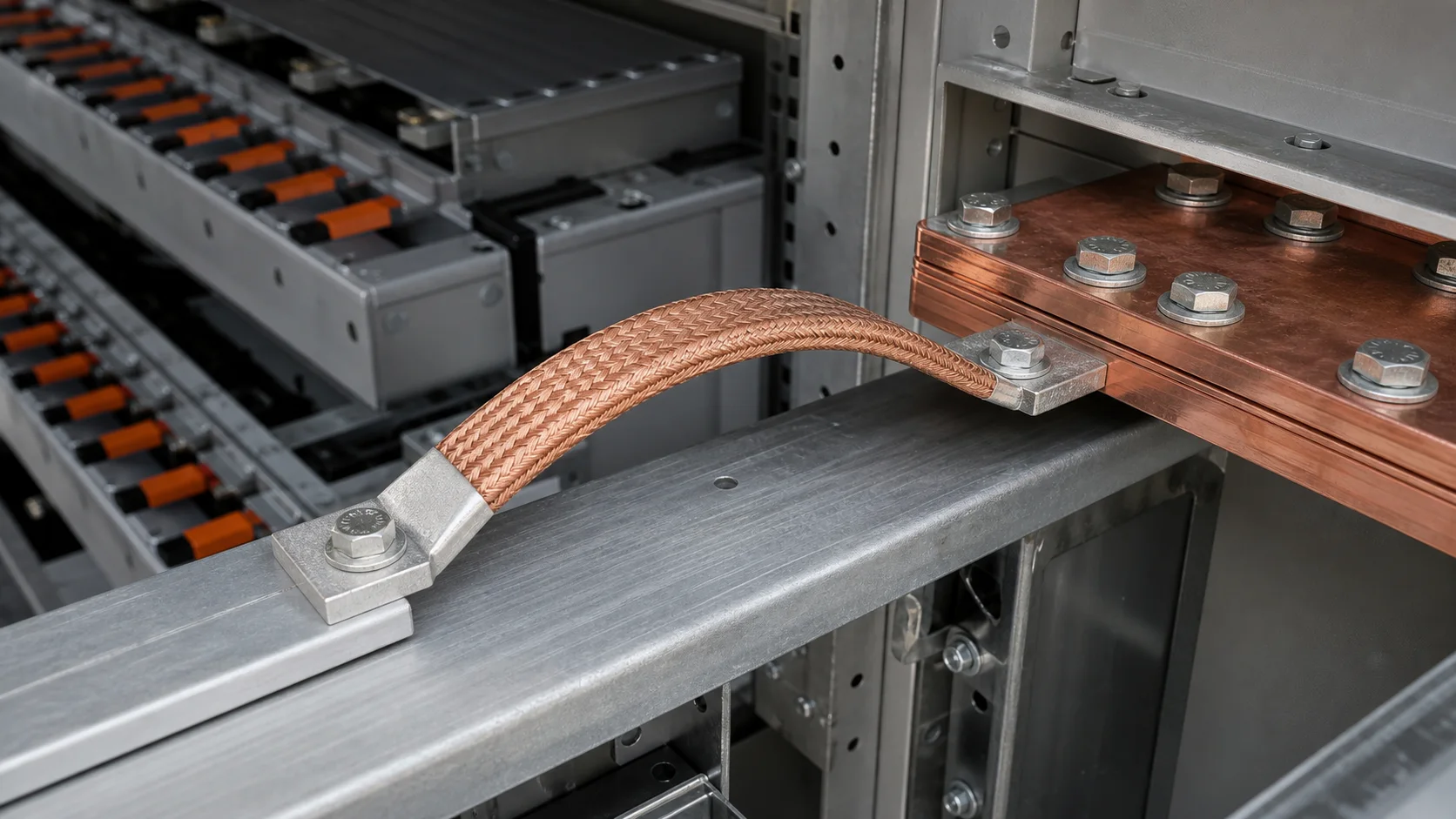
Swap cabinets repeatedly connect battery packs, fixed busbars, contactors and external cables. Aluminum rails or housings often meet copper battery or cable hardware, so a transition busbar controls the material interface. Hongchuan supplies copper-aluminum hardware for hole, thickness, length and mounting requirements.
Selection criteria
| Area | Confirm | Failure |
|---|---|---|
| Electrical | Section, length and interface drop | Rise and loss |
| Mechanical | Guide, stop, support and clamp | Wear, looseness or deformation |
| Material | Copper-aluminum pair, finish and washer | Oxide or galvanic corrosion |
| Environment | Condensation, humidity, salt and dust | Resistance drift |
Interface and washer control
Review oxide, hardness difference and thermal expansion. Keep the interface flat and free of burrs, oil and damaged finish. The washer must distribute pressure while preserving return, insulation and surface finish. Use a bracket or housing to carry swap impact and cable weight. See copper-aluminum bolted-joint contact resistance.
Mechanical and environmental validation
Run insertion life, misalignment, impact and vibration based on the real swap motion. Record wear, finish, torque, support deformation and resistance. Under rated and peak current, measure copper, aluminum, interface and adjacent insulation. After thermal cycling, humidity and condensation, repeat drop and inspect corrosion. Copper and aluminum emissivity differences require thermocouples or calibrated four-wire checks when needed.
Validation matrix
| Stage | Validation | Output |
|---|---|---|
| Design | Material, interface, support, drainage and spacing | Structure and material list |
| Prototype | Insertion, torque, drop and rise | Baseline |
| Reliability | Thermal, humidity, vibration and corrosion | Drift and appearance |
| Production | Dimensions, finish, torque and sampling | Control plan |
FAQ
Can a standard flat washer be used?
Only after material, pressure, finish and environment are checked. A standard washer does not automatically provide stable pressure or corrosion control.
What matters most with many swap cycles?
Guide error, face wear, micro-motion, clamp-force loss, corrosion and resistance change.
How can the product be specified?
Provide current, copper and aluminum materials, hole spacing, thickness, swap motion, environment and support. Start with the copper-aluminum hardware page.