


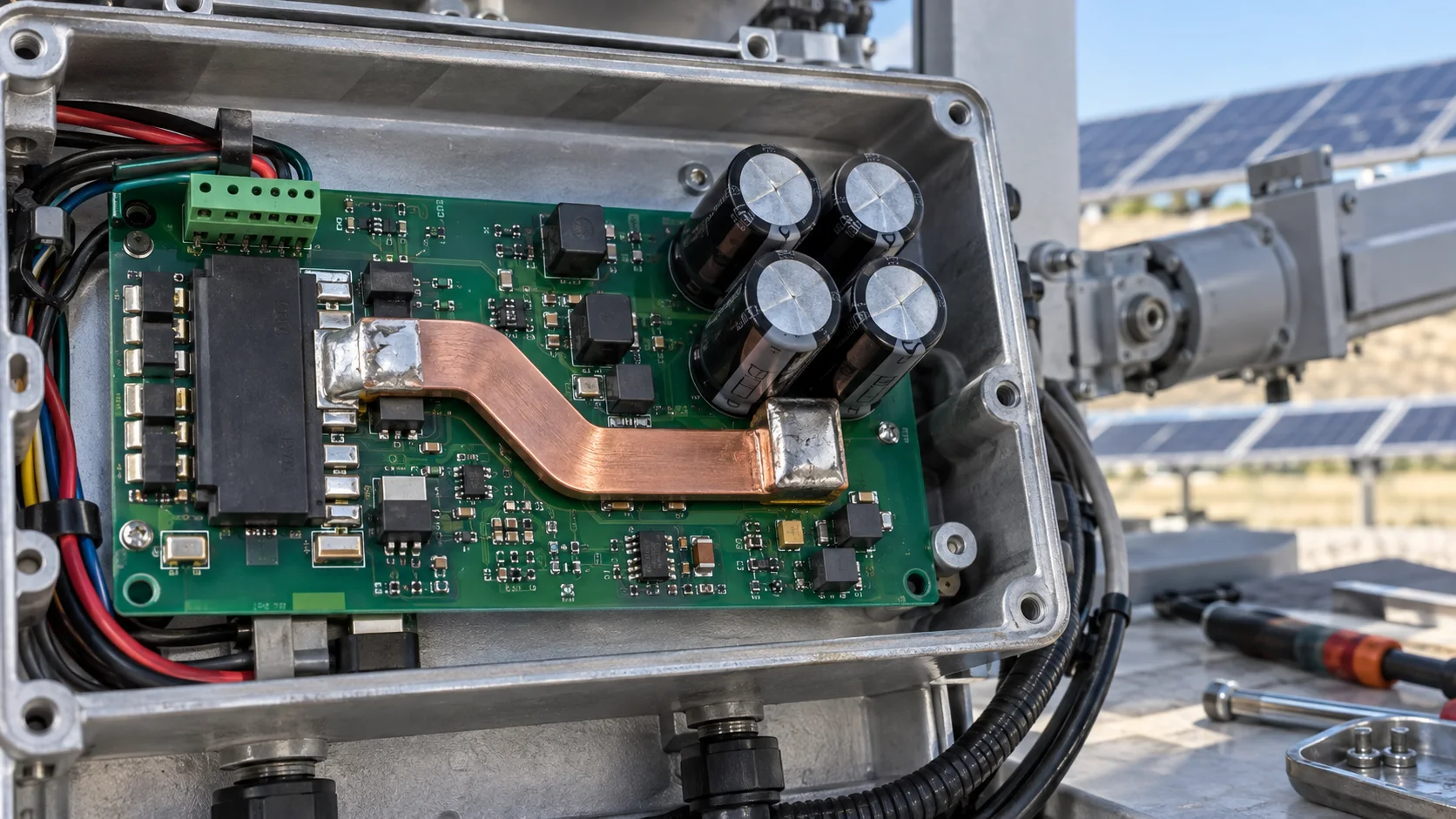
Quick answer: Select an SMD busbar for a PV tracker actuator controller by checking motor start and stall pulses, DC drop, pad-exit heating, outdoor heat, surge path, insulation spacing and condensation corrosion, not average motor current alone.
Questions answered on this page
- Why use SMD busbars in tracker controllers?
- How do motor start and stall currents affect the bar?
- How do heat, dust and condensation affect pads and insulation?
- How should surge path and busbar layout work together?
- What belongs in prototype and production checks?
Application context
PV tracker controllers drive motors and gear systems to adjust module angle. The power board connects a battery or DC bus, H-bridge, protection and actuator cables. An SMD busbar shortens the current path, while starts, stalls, reversals and long-cable drop create transient differences. Hongchuan supplies SMD busbars matched to voltage, waveform, pulse, copper, stack-up, pads, housing, environment and surge path.
Four outdoor boundaries
| Boundary | Review | Risk |
|---|---|---|
| Motor load | Start, stall, reverse and cable drop | Bar or pad hot spot |
| Environment | Heat, dust, moisture, condensation and salt | Corrosion or insulation loss |
| Transient | Protector, loop area and return | Overshoot or joint stress |
| Manufacturing | Stencil, placement, reflow and inspection | Void, offset or poor wetting |
Motor pulses and pad temperature
Measure bar, pad exit, vias, power-device end and cable connection during start, tracking, reverse, stall protection and low battery voltage. Record current and segmented drop together so cable drop is not mistaken for a busbar fault. If the exit is hotter than the bar, inspect copper neck-down, inner layers and vias. See pad-exit temperature troubleshooting.
Outdoor surge, condensation and reflow
The surge path includes protector, bar, pads, vias, ground return and housing. Keep it short and continuous without narrow copper or unnecessary layer changes. Check solder protrusion, burrs, housing tolerance and condensation paths. Thick copper changes reflow heat; inspect coverage, voids, offset and pad edges, using X-ray inspection when needed. Establish electrical and insulation baselines, run start, stall, high ambient, humidity and condensation exposure, then repeat resistance, temperature, insulation and appearance checks.
FAQ
Can average motor current size the bar?
No. Start, stall, reverse, cable drop and ambient temperature matter.
Does a wider bar always improve surge capability?
No. Protector location, return, pads and vias matter too.
How should samples be specified?
Provide waveform, pulse, cable, stack-up, copper, environment and surge path. Start with the SMD busbar product page.