
Do not obtain an SMT nut assembly load rating directly from an ordinary steel-nut proof-load table in ISO 898-2. Check material, thread size and geometry against the standard scope, then distinguish nut-body testing from the soldered PCB assembly. An axial proof load does not directly specify allowable installation torque.
Read the scope with the standard name
ISO 898-2 2022 covers specified non-alloy or alloy steel nuts, property classes and geometry. Its public scope gives coarse threads M5 to M39 and fine threads M8x1 to M39x3, with additional dimensional conditions and testing at 10 to 35 degrees Celsius.
A proposed M2, M3 or M4 coarse thread therefore cannot automatically use that coarse-thread table. Brass, other materials and special solderable bases need their own applicable basis. These sizes describe requirements, not confirmed Hongchuan SKUs.
| Information | Object assessed | Does not establish |
|---|---|---|
| Nut class and proof load | A nut within the applicable scope | PCB pad and assembly capacity |
| Load N and stress MPa | Force versus stress using a defined area | Interchangeable numerical values |
| Assembly pull record | Specified fixture and loading direction | All directions and service life |
| Torque N m | Actual mating and installation conditions | Torque calculated directly from axial load |
Separate loose-nut and installed-assembly evidence
Bossard identifies property class, proof stress and test load as distinct technical information. Establish nut style and size before using a table, and use the contractually adopted full method. A public scope is not the complete test procedure.
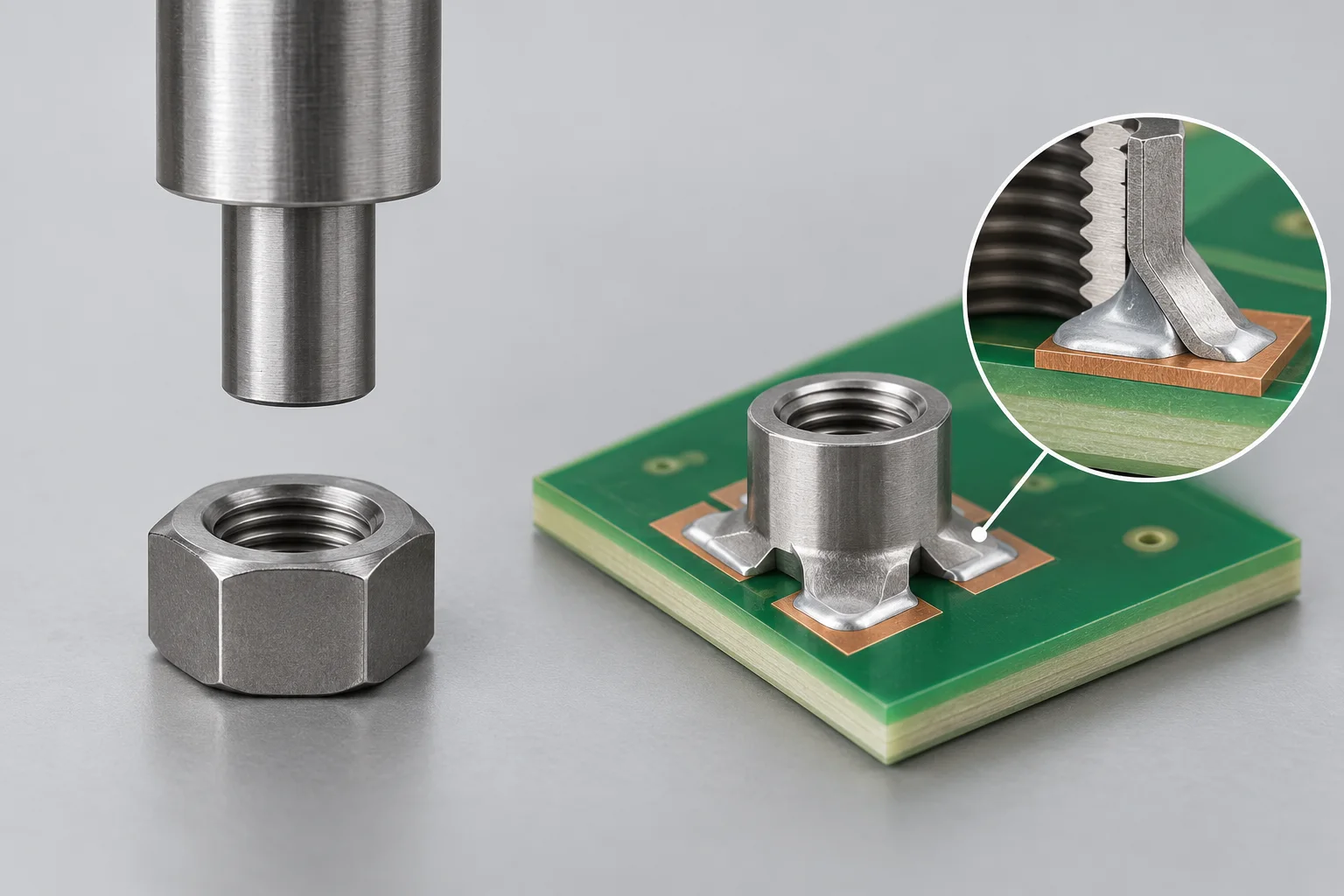
For SMT surface mount nuts, the installed load path includes the base, solder, copper pad and PCB. Nut-body evidence does not evaluate all of these. An assembly report should identify board thickness and support, direction, speed in mm/min, force in N, displacement in mm and failure location. These are reporting recommendations, not asserted mandatory test settings.
Do not convert proof load directly into torque
The ISO public scope excludes torque/clamp-force functional requirements. Multiplying an axial proof load by nominal thread diameter does not establish an allowable SMT assembly torque. Assess mating parts, friction and the actual installation load path using an applicable method.
For an RFQ, separate body material and inspection basis from the board, bracket, screw and installation conditions. Confirm available evidence with the supplier. See nut torque-out versus screw tightening torque for rotational-test distinctions.
Questions
Does a stronger screw increase assembly capacity? Review the nut and board load path rather than relying on screw markings.
Is a special nut outside the scope unusable? Assess an appropriate drawing, agreement and validation plan without claiming an inapplicable table class.
Sources
ISO 898-2 2022 public scope;Bossard nut property-class technical information
The cover is an AI loose-nut and assembly concept. The left objects do not form a standard proof-load fixture; the right section is not to scale. No Hongchuan grade, proof load or installation torque is assigned.