


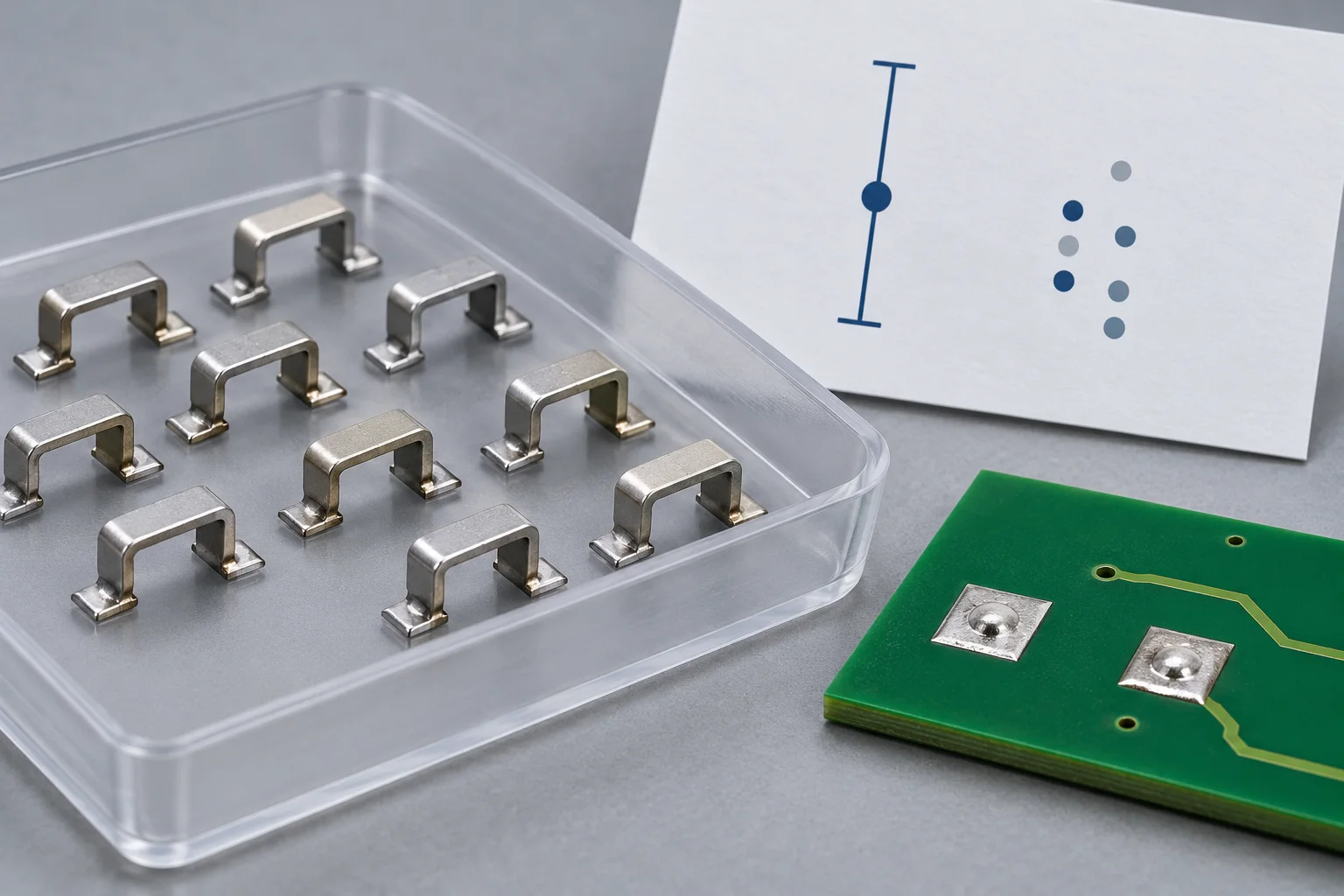
If 30 surface mount PCB jumper samples all pass, the observed sample pass rate is 100%; the population pass probability is not thereby proven to be 100%. Under independent, identically distributed binary trials, 30 passes give an exact one-sided 95% lower confidence bound of about 90.50%. The statement concerns the defined test, not a lifetime guarantee.
Define a pass before testing
A plan might define a pass as completing a specified procedure and meeting approved final resistance and visual criteria. The procedure, thresholds and sample-selection method must be established beforehand. This article specifies none of those product limits and does not report an actual Hongchuan 30-sample experiment.
NIST TN 2045 discusses binary trials and sample planning, while the NIST statistical handbook presents exact binomial interval methods. The calculation below derives a one-sided bound for zero failures. Do not confuse it with the endpoint of a two-sided 95% interval.
Derive the zero-failure bound
Let p be the population probability of passing the same defined test. The probability that n independent samples all pass is pn. With a fixed sample size and all samples passing, the exact lower bound at one-sided confidence 1−α is pL=α1/n. For α=0.05 and n=30, 0.051/30=0.904966, or about 90.50%.
| Independent samples n | Hypothetical observations | One-sided 95% lower bound |
|---|---|---|
| 30 | 30 passes, zero failures | About 90.50% |
| 100 | 100 passes, zero failures | About 97.05% |
| 300 | 300 passes, zero failures | About 99.01% |
These calculations are not recommended sampling plans. Frequentist confidence concerns the repeated-sampling coverage of the interval procedure; it does not assign a 95% probability to the fixed unknown p after observing the data. A zero sample variance in a simple normal approximation must not be interpreted as zero uncertainty.
Repeated cycles are not automatically independent samples
Thirty cycles on one jumper describe repeated exposure of one specimen, not automatically 30 independent trials. Multiple jumpers on the same PCB may share soldering, board-strain and environmental effects. The plan should define the independent sampling unit and justify the model rather than merely counting components.
For vibration or temperature cycling, retain the procedure, specimen origin, board identifiers and failure criteria. Final continuity does not establish an absence of intermittent opens during exposure; see the intermittent-continuity monitoring guide.
Report observations, assumptions and inference separately
For surface mount PCB jumpers, state the actual sample count, passes and failures, predefined conditions, selection method and whether inference is one-sided or two-sided. If failures occur, this zero-failure formula no longer applies. Repeatedly adding samples until a desired result appears requires a separately designed statistical rule.
The estimated quantity is pass probability under the specified conditions, not operating life in hours. AQL lot acceptance is a different decision and is not direct evidence of a population pass probability or long-term reliability.
Questions
May the sample pass rate be reported as 100%? Report “30 of 30 passed this test,” with conditions and scope, rather than “all products pass.”
Does the bound mean the true probability is exactly 90.50%? No. It is a lower bound under the stated method and assumptions, not that point estimate.
Sources
NIST TN 2045: binary response and performance-threshold planning; NIST handbook: exact binomial confidence intervals.
The AI cover illustrates sampling and statistical uncertainty, not a Hongchuan test or result. All sample counts and probabilities are hypothetical calculations, not pass-rate or lifetime commitments.