

If a stainless screw jams in an SMT nut, stop forcing the assembly and preserve the parts. Check material identity and thread compatibility first. Galling is one possible adhesive-wear mechanism, but mismatched threads, cross-threading, solder ingress and debris can also increase resistance. “It will not turn” is not a sufficient diagnosis or a reason to increase torque.
Identify both materials first
Bossard's public guidance relates stainless-fastener galling to friction and material adhesion, and discusses lubrication and surface treatments as possible controls. Its assembly note for an austenitic stainless product also warns of seizure. These are material-specific warnings, not evidence that every SMT nut is stainless steel.
Use documents tied to the actual nut and screw part numbers and batches to establish base material, finish and surface condition. Silver appearance does not establish material identity. Knowing the screw is stainless does not establish the nut material. No Hongchuan model is assigned a stainless grade by this article.
Record where resistance begins
| Observation | Evidence to retain | Questions to distinguish |
|---|---|---|
| High resistance at entry | Thread identification, entrance images and dimensions | Pitch, form and cross-threading |
| Jamming partway in | Position, speed, torque history and condition | Adhesive wear, debris or local damage |
| Resistance only after reflow | Matched before/after samples and bore images | Solder ingress, residue or another change |
| Abnormality after bracket seating | Contact condition, screw length and assembly drawing | Bottoming, interference and load |
These are investigation prompts, not automatic diagnoses. The responsible engineer should decide whether and how to disassemble a jammed pair. Forced removal can damage surfaces further. Record prior trial assembly, lubrication and rework so that modified evidence is not mistaken for the original condition.
Make comparisons reproducible
Establish metric or unified thread identity, size, pitch and applicable tolerance from controlled drawings. Inspect unassembled samples using the approved method and compare damaged regions with unaffected samples. Appropriate magnified examination or material analysis may be needed to identify adhesive transfer or base-metal damage; hand feel alone does not establish the mechanism.
Retain tool identity and mode, rotational speed in r/min, torque in N·m, insertion position or angle, fastener batch and PCB state. Note whether resistance arose before or after the bracket contacted its seating surface. This article specifies no universal installation speed or torque.
Treat lubrication as an engineering change
A lubricant or coating can change friction, requiring reassessment of the clamping condition associated with the previous torque setting. For SMT and SMD nuts, also review compatibility with the PCB, solder joints, nearby materials and cleanliness requirements. Approve the material and application area, then validate the assembly rather than transferring advice from another stainless joint.
If solder ingress is suspected, use the separate thread solder-contamination guide. Different causes need different evidence; higher torque can conceal the problem while increasing risk to the soldered attachment.
Questions
Will a different stainless screw eliminate galling? Not necessarily; assess the full pairing, surfaces and assembly conditions.
Does passing a thread GO gauge guarantee trouble-free installation? Gauging and dynamic assembly address different conditions. Check the mating part and process too.
Sources
Bossard: galling of stainless steel fasteners; Bossard: example austenitic stainless assembly warning.
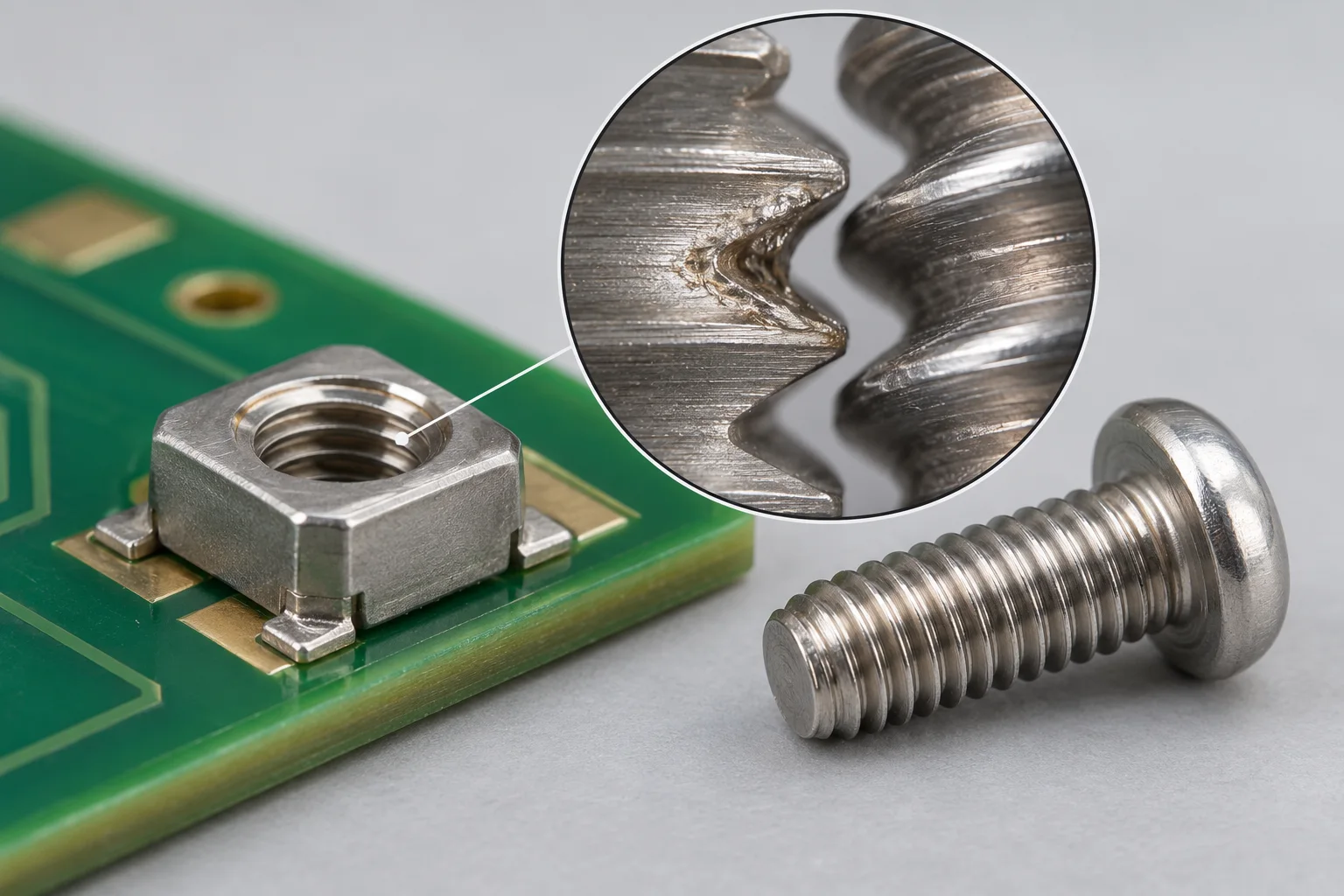
The AI cover illustrates adhesive thread wear; it is not a Hongchuan failure sample, material certificate or inspection image. No product-specific lubricant, speed or installation torque is prescribed.