When selecting a fastening or verification tool for SMT nuts, read an accuracy percentage with its reference basis. Full scale (FS) and indicated value (IV) can produce different absolute errors at low readings. Also check the specified range, direction and conditions. Display resolution is not accuracy.
Convert the percentage to N·m
Mountz distinguishes full-scale and indicated-value accuracy. The first uses the manufacturer's defined full-scale value; the second uses the relevant indicated or set value. Follow the actual model documentation. An unexplained “±5%” needs clarification.
Assume a 0 to 1.00 N·m tool, a 0.20 N·m check point, and both hypothetical specifications valid there. ±5% FS gives ±0.050 N·m, while ±5% IV gives ±0.010 N·m: a factor of five difference. The 0.20 N·m input is not an approved installation torque for any Hongchuan nut.
| Hypothetical statement | Calculation | Absolute error amount |
|---|---|---|
| ±5% FS | 5%×1.00 N·m | ±0.050 N·m |
| ±5% IV | 5%×0.20 N·m | ±0.010 N·m |
| 0.001 N·m resolution | Display increment | Does not establish ±0.001 N·m accuracy |
Check where the specification applies
Manufacturers may specify different accuracy over different portions of a range. A Mountz sensor guide also conditions system accuracy on compatible analyzers. Do not extend one interval's value across the entire display range or apply one sensor's data to arbitrary instrument combinations.
Record model, range, check point, direction, mode and associated equipment with raw readings. Specifications containing fixed or digit terms require the complete expression; this simple percentage example does not cover them.
Verify tools and assemblies separately
After establishing an approved process range for SMT nuts, assess the tool and verification method. Tool accuracy alone cannot demonstrate joint, bracket or thread suitability. Assembly geometry, friction and process repeatability require separate evidence.
Calibration or verification records must correspond to actual equipment and conditions. Error, expanded uncertainty and conformity decision rules are different quantities. Handle out-of-tolerance or damaged tools under the control procedure rather than increasing the setting to hide a problem.
Torque unit conversion addresses N·cm, N·m and other units. This page addresses percentage reference bases; both are needed for a meaningful comparison.
Questions
Is an IV tool always better? Compare complete values, intervals and application needs, not abbreviations alone.
Do more digits make a tool suitable for lower torque? Verify its valid range, error and verification capability. Resolution describes display increments.
References
Mountz full-scale and indicated-value accuracy; Mountz system range and compatibility example.
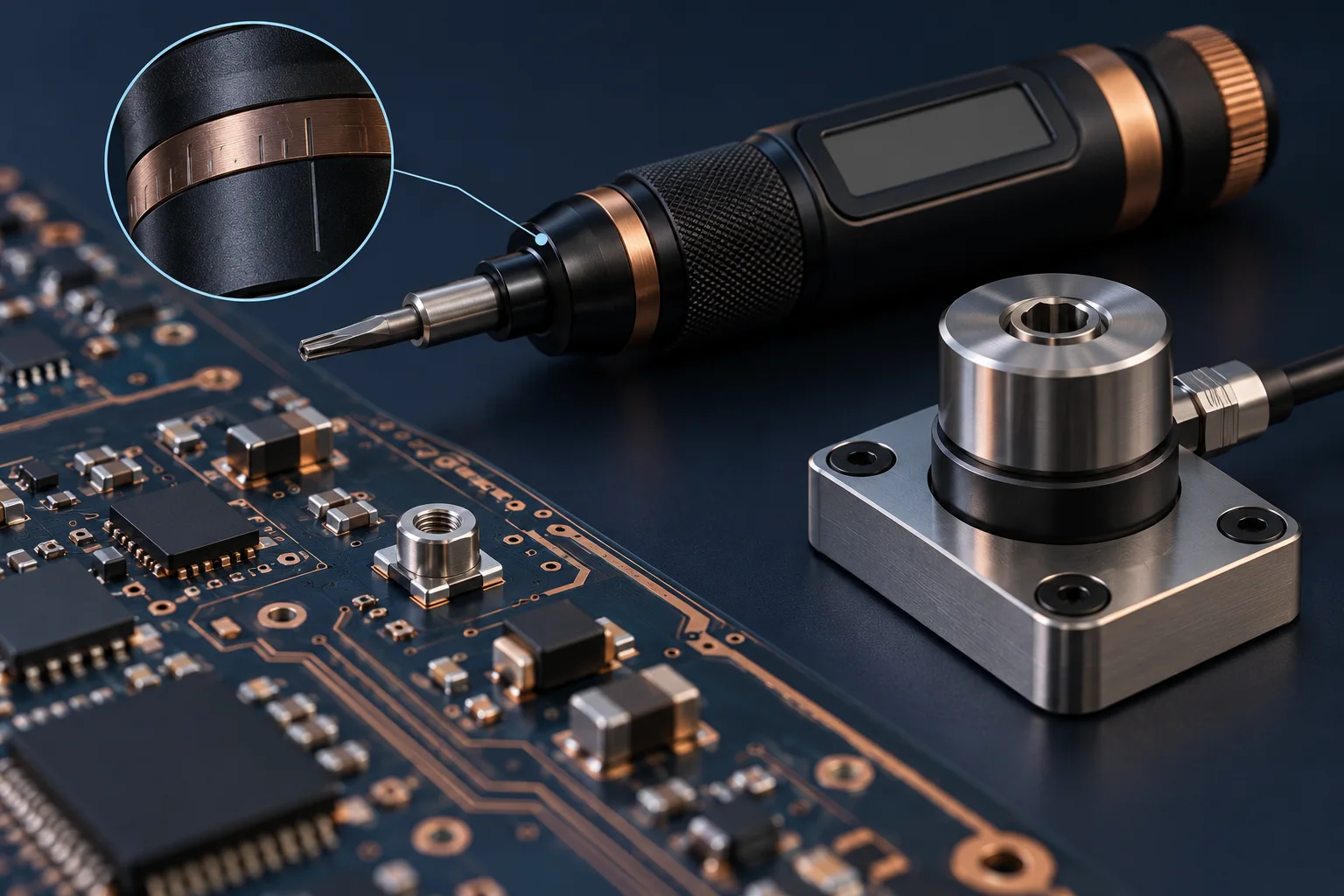
Cover is an AI-generated verification concept, not Hongchuan equipment or calibration evidence. Hypothetical values provide no nut torque limit or tool recommendation.