


For a constant-thickness rectangular copper bar with one circular through-hole, the transverse section through the hole center has remaining metal area Anet=(w−d)t. Here w is bar width, d is the removed width at that section and t is thickness. This geometric check does not justify scaling the original ampacity directly by the remaining-area ratio.
Limit the simplified geometry
The UL Solutions Panelboard Application Guide identifies thermal and mechanical concerns with drilling or enlarging busbar holes. Its equipment-specific certification context must not be presented as certification of a PCB busbar. For custom hardware, use it as a reason to review geometry changes rather than an automatic approval rule.
The formula here assumes one full through-hole normal to a flat, constant-thickness rectangular bar, with the examined plane perpendicular to its length. Countersinks, threaded holes, bends, staggered hole patterns and laminated joints need their own geometric treatment. For a slot, state its orientation and calculate the actual missing width in the section being examined.
Separate transverse metal area from plan-view hole area
For a hypothetical 20 mm wide, 2 mm thick bar with a 6 mm hole, Agross=20×2=40 mm² and Anet=(20−6)×2=28 mm². The remaining ratio is 70%. These are example dimensions, not an available Hongchuan part specification.
Do not subtract πd²/4 from the transverse bar section. That circle describes the hole in plan view, a different plane. At an assumed 100 A, I/A is 2.50 A/mm² for the gross section and approximately 3.57 A/mm² for the net section. Neither average gives the peak at the hole edge or establishes that 100 A is acceptable.
| Quantity | Use | Not established |
|---|---|---|
| Gross area wt | Describe the unperforated bar | Uniform flow around a hole |
| Net section | Screen remaining metal | A proportional ampacity reduction |
| I/Anet | Compare section averages | Peak local current density |
| Temperature rise | Verify thermal behavior under stated conditions | Short-circuit mechanical strength |
Review the actual electrical boundary
The busbar example in the COMSOL AC/DC Module introduction illustrates nonuniform current distribution caused by geometry. It is a tutorial with specific boundary conditions, not a source of a universal hole correction factor.
Current flowing past a mid-span hole differs from current entering through a lug near that hole. Show current entry and exit areas, edge ligaments, spacing between holes, corner geometry, contact area and coating condition. A bolt occupying the hole is not automatically equivalent to the removed copper: its material, interfaces and current path require separate consideration.
Record what changed before accepting a revised drawing
Keep old and new drawing revisions with tolerances. Screen the narrowest sections, then compare voltage drop and temperature rise using the actual current waveform, ambient conditions and cooling arrangement. Simulation records should include materials, electrical contacts, thermal boundaries and mesh convergence. Check the sensitivity of single-point peaks near sharp corners.
Review fault loads, fastening and supports independently. Field modification of certified equipment must follow the equipment manufacturer's instructions and applicable requirements; the area equation cannot authorize drilling. Isolate equipment safely for machining and inspection and remove burrs and metal debris before approved reassembly.
Related products and questions
When discussing a custom PCB copper busbar, provide hole purpose, location, current entry and exit areas and an assembly drawing. For a separate PCB-side transition, see pad exits and copper neckdowns.
Does 70% remaining area mean 70% of the original rated current? No. Current distribution, cooling, contacts and temperature limits may change.
Can equal hole diameters share one validation? Compare location, edge spacing, thickness, material, joint geometry and conditions as well.
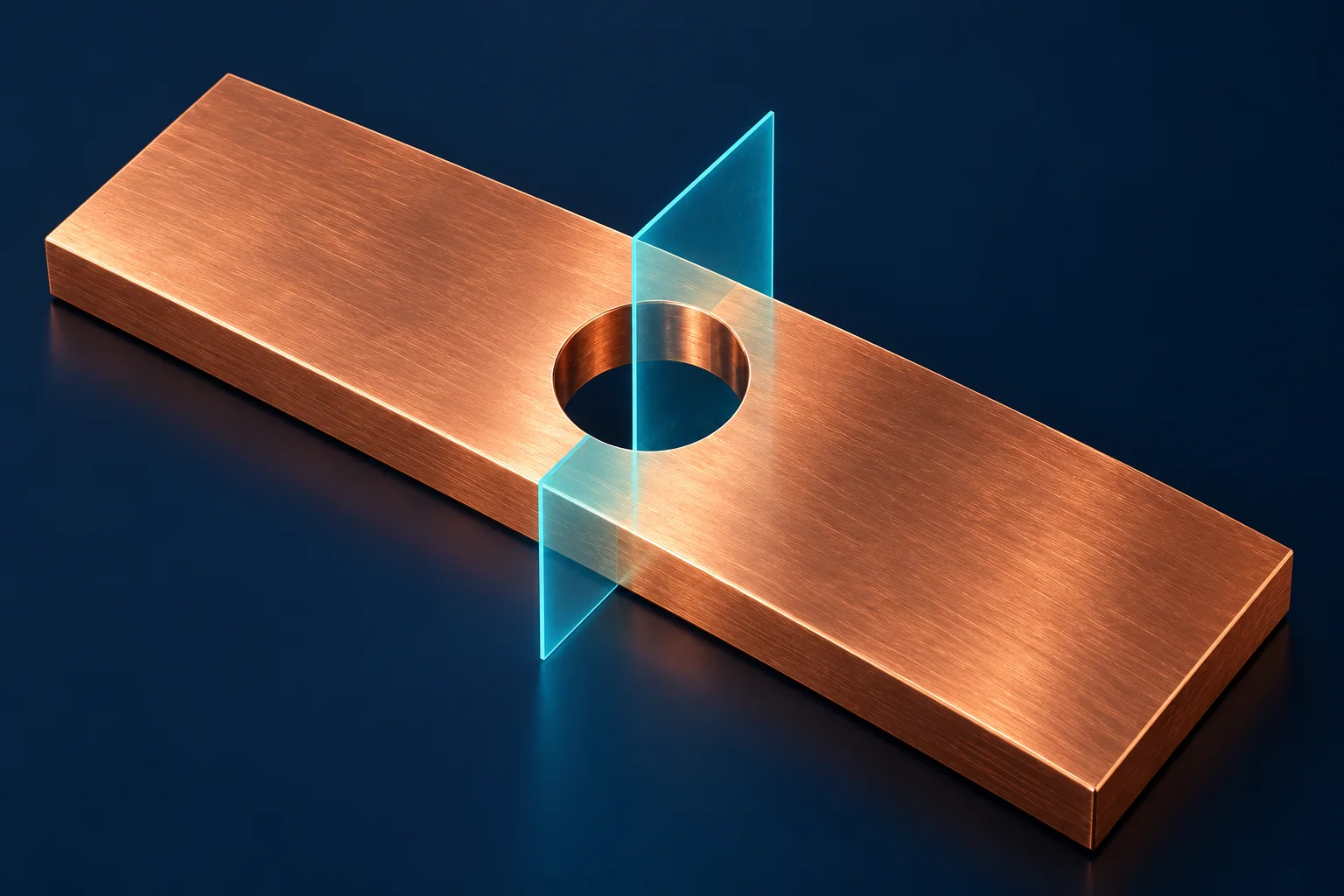
The AI-generated cover is a geometric concept, not a measured current map or thermal simulation. Example values are not Hongchuan ampacity ratings.