


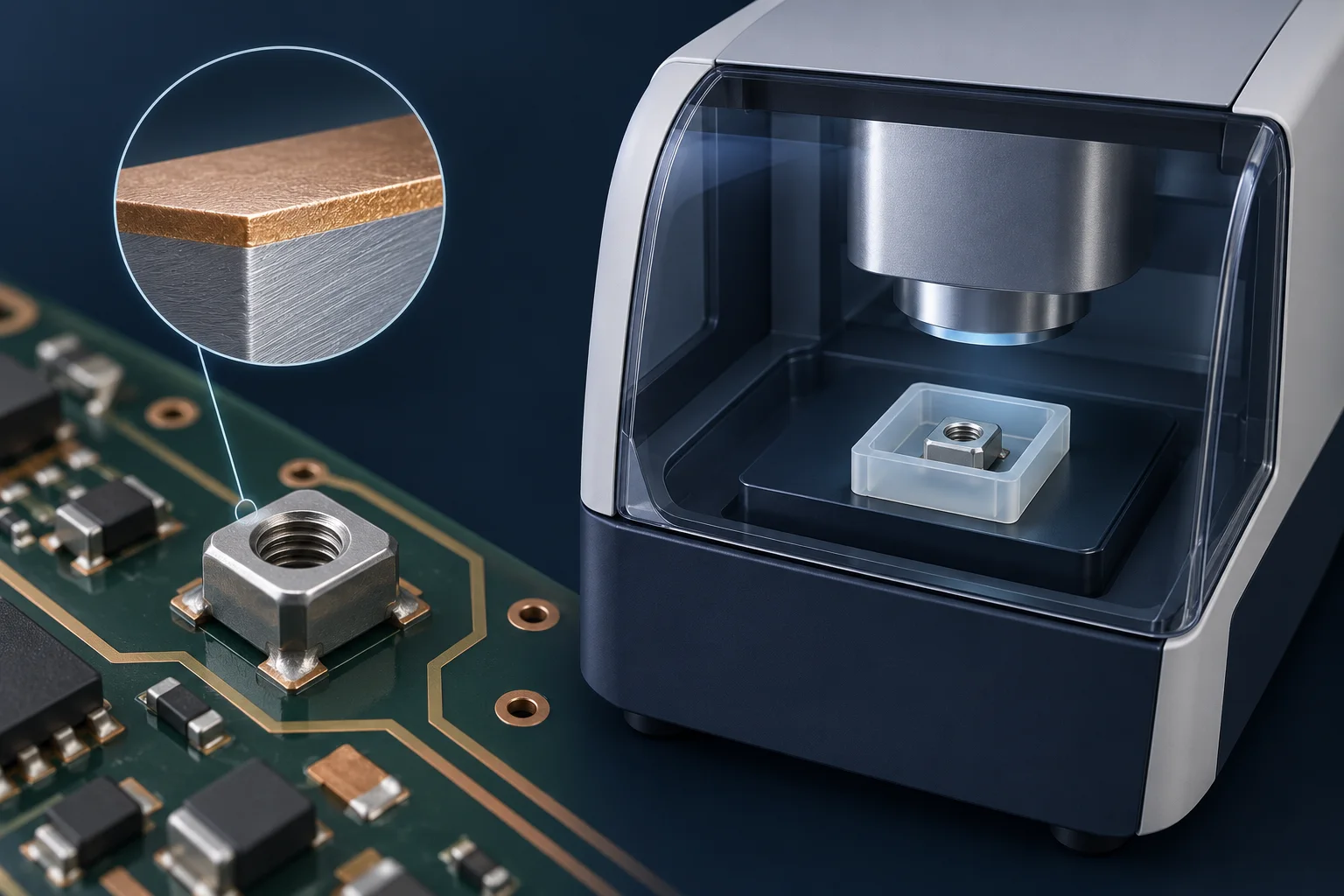
An XRF alloy match can support elemental screening of an SMT nut, but acceptance also requires the correct analysis mode, base-metal/coating distinction, measurement geometry and coverage of critical elements. A grade name on screen does not verify temper, thread performance or post-soldering torque resistance.
Identify what the measurement includes
Evident's XRF PMI guidance explains surface and geometry effects. This 2016 discussion concerns conventional handheld alloy XRF; its instrument specifications should not be generalized to every newer system. For a small nut, the laboratory must establish whether the measurement region includes the intended metal rather than a bore, fixture or adjacent part.
Record nickel or tin plating separately from the substrate grade. Detecting Ni or Sn alone does not identify the base as a nickel or tin alloy. If substrate identification is required, have the laboratory assess coating influence and method suitability, preserving original-condition and preparation records. Removing a functional coating must not silently be described as non-destructive finished-part inspection.
| Check | Request | Confusion avoided |
|---|---|---|
| Analysis task | Alloy identification, quantitative chemistry or coating thickness | Substituting modes |
| Location and geometry | Photo, spot size, fixture | Bores and neighboring material entering the region |
| Element coverage | Measured elements, detection capability, units | Replacing blank/not-detected entries with zero |
| Traceability | Part batch, stock certificate, method record | One specimen representing an entire delivery |
Unmeasured elements leave an identification gap
Evident's handheld PMI application guidance also discusses near-surface measurement and limitations for elements such as carbon. If candidate grades differ by an unmeasured critical element, obtain a suitable method that covers it. Separate actual measurements, inferred matches and uncovered requirements.
“Not detected” is conditional on method capability, not proof of absolute absence. An incoming composition limit requires detection and quantification capability adequate for that decision; extra display digits do not establish suitability.
Chemistry does not complete component qualification
SMT and SMD nuts still need evidence for hardness, dimensions, threads and assembly behavior. Similar elemental composition can accompany different processing states. Alloy XRF itself does not measure hardness or clamp performance. XRF coating-layer and location checks concern a separate task.
Common questions
Can a tiny nut be held by hand at the analyzer window? Trained personnel must use appropriate radiation protection and small-part fixtures. A hand is not a sample support.
Does one matching specimen eliminate batch records? No. Retain the sampling plan, material documents and batch linkage required by purchasing and inspection.
Cover is an AI analysis illustration, not Hongchuan XRF equipment, certification or material evidence. No radiation-equipment procedure or product composition/performance commitment is provided.