


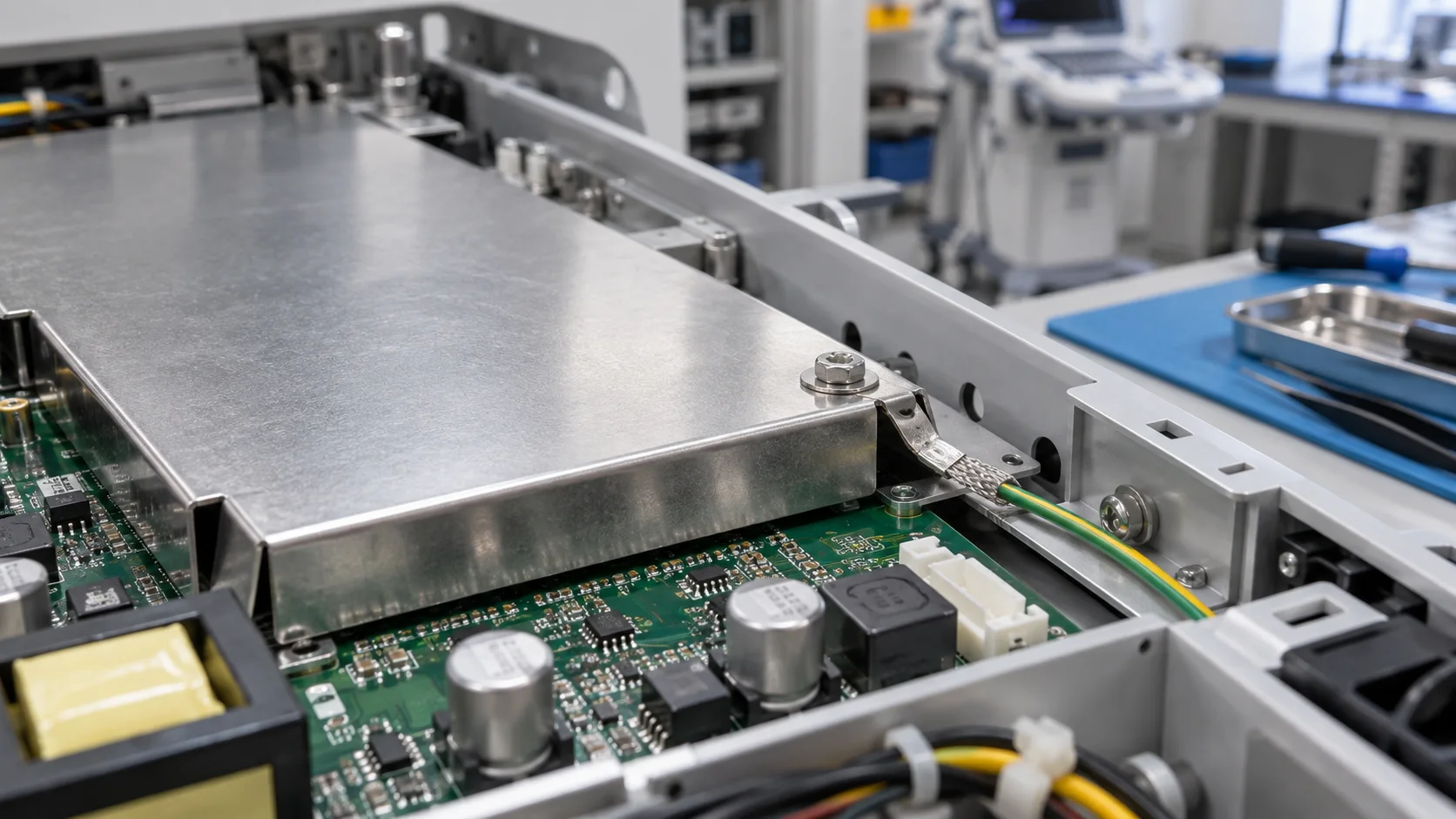
Quick answer: Select SMT nuts for a medical-ultrasound power board by validating shield fastening and EMI ground continuity separately. Low height must still provide screw engagement, board support, shield clearance, spring pressure and service-tool access.
Questions answered on this page
- Why use SMT nuts to fasten shields on ultrasound boards?
- How are fastening and grounding paths different?
- How can torque and board bending be controlled on thin PCBs?
- How can thread contamination and nut offset be prevented after reflow?
- How should repeated service be validated?
Application context
Ultrasound power, clock and signal boards may use shields around DC/DC, clock, amplifier and high-speed acquisition circuits. An SMT nut can be placed through SMT and reflow, then a screw attaches the shield during assembly or service. Hongchuan supplies SMT nuts matched to board thickness, screw, shield, pad, height, torque, spring and reflow.
Separate fastening from grounding
| Function | Path | Validation |
|---|---|---|
| Fastening | Screw, nut, pad and shield | Torque, pull, shear and bend |
| Grounding | Shield edge, spring, ground copper and chassis | Low resistance and continuity |
| Manufacturing | Stencil, paste, placement and reflow | Offset, coverage, thread gauge |
| Service life | Tool, engagement and repeated fastening | Post-cycle torque and resistance |
Low height and thin-board load
A low nut is sensitive to screw length, shield flange, connector and device tolerances. A small pad concentrates load; an oversized pad can consume high-speed routing or insulation. Confirm engagement, base-to-pad overlap, tool access and board bend with the final board and shield. Lock screw head, length and target torque first, then verify pull, shear, torque, ring crack and spring contact. See SMT nut pad and torque troubleshooting.
Reflow and EMI grounding
Metal mass changes local heating and wetting. After reflow inspect base coverage, offset, pad edge, thread cleanliness and board underside. Use cross-section, pull, thread gauge and low-resistance sampling for critical joints. Measure between the nut, near and far shield edges, spring, PCB ground and chassis before fastening, after fastening, after thermal cycling and after service cycles. If noise appears only at the far edge, inspect gaps, cable entry and high-frequency return instead of changing the nut alone.
FAQ
Does strong soldering guarantee EMI performance?
No. Fastening strength and ground continuity are independent metrics.
Should the lowest nut always be selected?
No. Check engagement, board load, shield clearance, tool access and spring pressure.
How should samples be specified?
Provide board, screw, shield, pad, torque, spring and reflow details. Start with the SMT nut product page.