


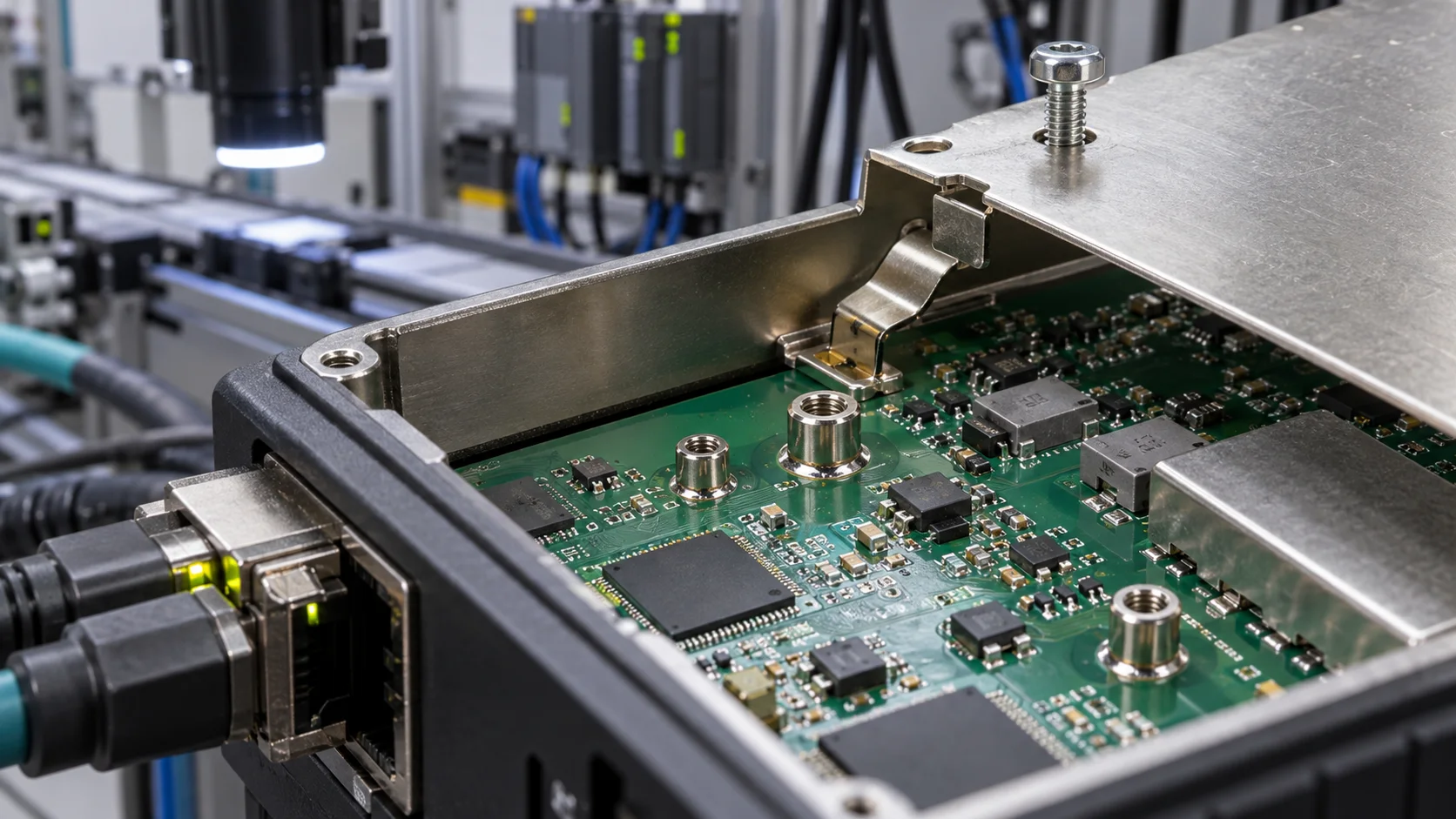
Quick answer: Select an SMT nut for an industrial-camera PoE controller by separating low-height fastening, shield grounding and service torque. The pad carries fastening load; the shield edge, spring or ground copper creates the EMI return path. One pull test or initial resistance reading cannot replace both validations.
Questions answered on this page
- Why use SMT nuts on an industrial-camera PoE board?
- How can a low shield meet fastening and grounding needs?
- How can thread contamination, offset and pad lift be prevented?
- How should torque match a thin PCB?
- How should far-edge ground continuity be verified?
Application context
Industrial cameras, PoE vision controllers and remote-I/O modules use shields around high-speed image, Ethernet, clock, DC-DC and sensor circuits. An SMT nut can be placed through SMT and reflow, then a screw attaches the shield or bracket for compact serviceable hardware. Hongchuan supplies SMT nuts matched to board, screw, shield, height, pad, spring, torque and reflow.
Function split
| Function | Parts | Validation |
|---|---|---|
| Fastening | Nut base, pad, screw and shield | Torque, pull, shear and bend |
| Grounding | Shield edge, spring, ground copper and chassis | Low resistance and continuity |
| Manufacturing | Stencil, paste, placement and reflow | Offset, coverage, thread gauge |
| Service | Tool access and repeated fastening | Cycles and drift |
Low height and thin-board control
Match nut height to shield flange, screw engagement, connectors and device clearance. Thin boards are more sensitive to pad-edge stress and bending. Confirm base-to-pad overlap and tolerances, set pull, shear, ring-crack and bend tests for target torque, avoid paste in the thread and check shield, nut and spring alignment. See SMT nut pad and torque troubleshooting.
PoE shield grounding and production
After assembly, measure low resistance between nut, near and far shield edges, springs, PCB ground and chassis. Record before fastening, after fastening, after thermal cycling and after service cycles. If Ethernet immunity is unstable, inspect shield gaps, RJ45 area, cable entry and high-frequency return. Large metal nuts change local reflow heating, so inspect base coverage, offset, thread cleanliness and pad edge; sample thread gauge, pull, torque and ground continuity.
FAQ
Does a strong solder joint prove shield grounding?
No. Fastening strength and ground continuity are separate measurements.
Is the lowest nut always best?
No. Check screw engagement, pad load, shield clearance, tool access and spring pressure.
How should samples be specified?
Provide board, screw, shield, pad, torque, spring and reflow. Start with the SMT nut product page.