

A magnet test alone cannot determine an SMT nut's grade or authenticity. Cold working can change the magnetic response of some austenitic stainless steels. Establish the specified base material, finish and supplied condition first. If low permeability is a functional requirement, agree a measurement method and limits rather than using a hand magnet as quantitative acceptance.
Magnetic response depends on condition
Carpenter discusses magnetic behaviour across stainless structures and the influence of cold work on some austenitic steels. BSSA also explains how deformation-related structural changes can produce magnetic attraction. These support checking material and processing state together, not declaring attracted material to be counterfeit stainless.
Neither source identifies any Hongchuan SMT nut as stainless steel. For actual incoming parts, use documents tied to the part number and batch. Silver appearance, an informal material name or an untraceable certificate image is insufficient. Copper, brass and steel grades must remain separately identified.
| Task | Evidence to retain | Not proven by attraction alone |
|---|---|---|
| Material identity | Part, batch and applicable composition evidence | Complete grade and supplied state |
| Low-magnetic function | Parameter, method, locations and limit | Quantitative permeability conformance |
| Surface finish | Base metal and coating records | Layer identity and thickness |
| Assembly performance | Thread, soldering and relevant mechanical evidence | Fastening or soldered reliability |
Specify the quantity and measurement conditions
Relative permeability μr is dimensionless, not a force, mass or torque. A report also needs the method, magnetic-field conditions and measurement locations; magnetizing field H may be expressed in A/m. Hand-magnet attraction depends on the magnet, separation and part geometry and does not directly provide a permeability value.
Where a nearby magnetic sensor makes the property important, design and test owners should agree the controlled parameter, limits and a method suitable for small finished parts. Raw bar-stock values do not automatically guarantee every machined or formed nut. Preserve differing batch samples in their original state before investigation.
Investigate a changed response
Identify and segregate suspect samples, then check batch, material, finish and processing records. A fixed screening setup with a known magnet and separation can support comparisons, but appropriate material or magnetic testing is still needed to explain them.
For SMT and SMD nuts, keep material identity, magnetic function and soldering performance separate. The XRF base-material and coating limitations guide addresses composition evidence; elemental analysis alone does not prove every mechanical or magnetic property.
Questions
Does no obvious attraction confirm a stainless grade? No. It is not complete composition or condition evidence.
Should a soldered nut simply be annealed? Do not try heat treatment on the assembly as an informal fix. Establish the cause and review effects on finish, solder joints and PCB with the responsible specialists.
Sources
Carpenter stainless magnetic-property guidance; BSSA guidance on cold work and permeability.
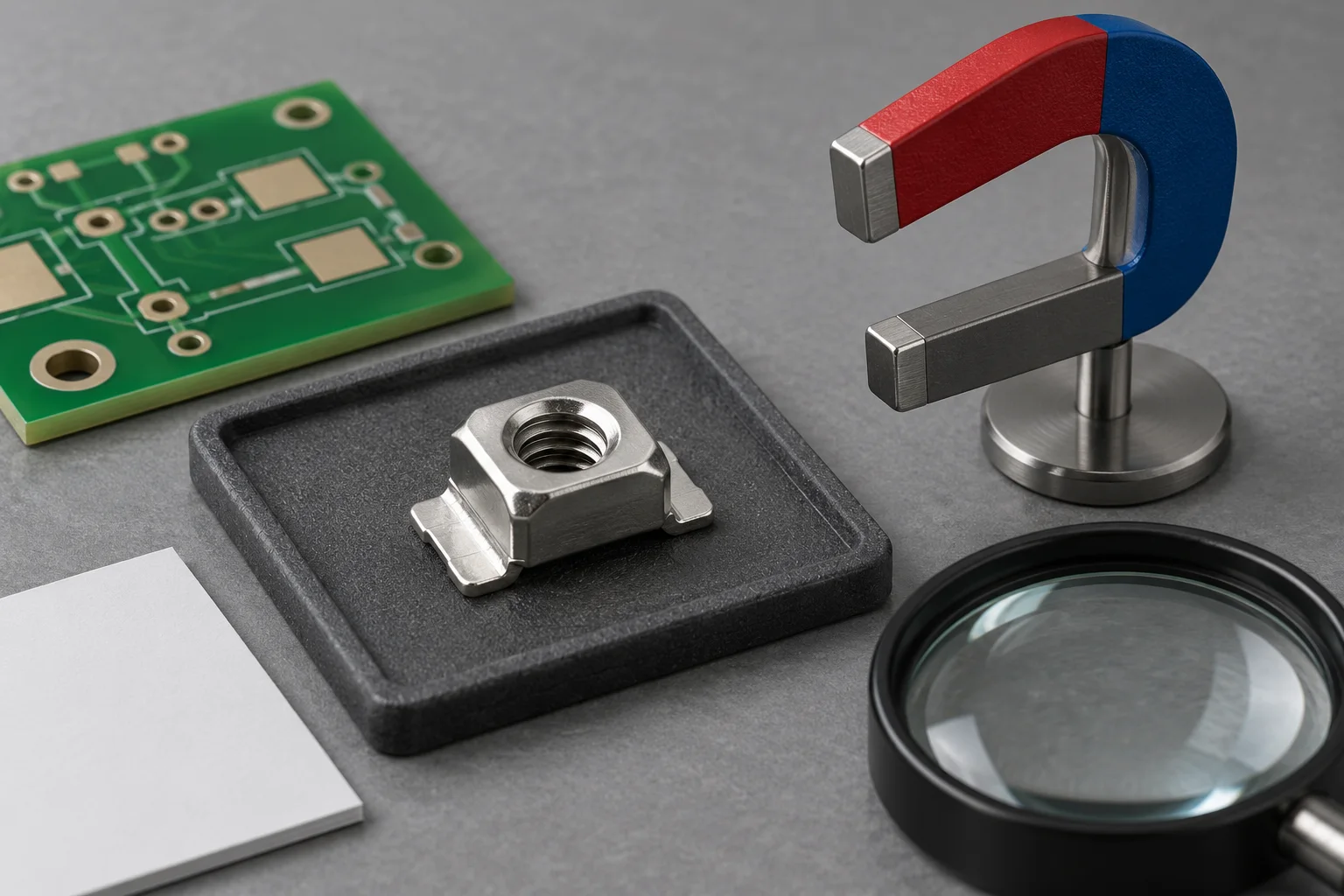
The AI cover illustrates screening, not actual nut material, attraction force or a Hongchuan inspection. No model-specific permeability is claimed.