

After changing conveyor speed for surface mount PCB jumper reflow, t=L/v gives transit time through a fixed oven section, not automatically solder-joint time above liquidus (TAL). Determine TAL from the actual joint temperature trace and the alloy's liquidus temperature. Review peak, heating behaviour and TAL at the relevant locations under the change procedure.
Speed sets time through a physical distance
KIC's profiling guidance treats oven temperature distribution, PCB thermal response and conveyor speed separately. Slower movement increases exposure to the corresponding oven environment, while board temperature still depends on its thermal response. This article uses that relationship, not the early tin-lead temperature targets in the document.
Define the physical distance L and the actual constant speed v. Total oven length, heated length and a selected hot-zone distance are different quantities. Reconcile m/min, cm/min and mm/s; a machine speed-setting label is not a unit.
A 25% speed increase does not mean 25% less time
Assume L=2.00 m, constant motion, an original speed of 0.80 m/min and a new speed of 1.00 m/min. Original transit is 2/0.8=2.5 min=150 s. New transit is 2/1=2 min=120 s. Speed increases 25%, but section transit decreases 30 s, or 20%.
| Item | Example result | Not established |
|---|---|---|
| Fixed-section transit | 150 s becomes 120 s | The same ratio for joint TAL |
| Speed change | 25% increase | 25% reduction of every thermal parameter |
| Unchanged zone settings | Setpoints remain unchanged | Identical board peak or joint profile |
| Recipe revision | Retain old and new conditions | Automatic transfer of validation |
This is kinematics, not a recommended oven length or Hongchuan jumper conveyor speed. Acceleration, stops or transport faults require actual running records instead of an assumed constant speed.
Read TAL from the joint trace
Indium defines TAL using the time that solder temperature exceeds liquidus. Identify the actual alloy and its applicable liquidus temperature, then calculate the threshold-crossing duration from the measured trace using the approved method.
A zone set above liquidus does not show that each joint has reached that temperature. Board and jumper thermal response, atmosphere, loading and copper distribution belong in the process record. Speed changes can alter the curve's shape; multiplying an old TAL by a speed ratio does not produce a new measured result.
Record a change before releasing it
For surface mount PCB jumpers, retain oven identity, zone settings, actual speed, board and component revisions, paste, loading and thermocouple arrangement. Measure the changed profile on a representative PCB, review controlled parameters against approved material and component requirements, and complete the relevant post-solder checks.
Thermocouple locations should represent the controlled joint regions. The two-ended jumper temperature-recording guide discusses measurement locations; rework-tool settings there are not reflow-oven recipes. Define production monitoring separately from change validation.
Questions
Can the previous peak result be retained? Retain it as evidence for its original conditions; review the changed process separately.
Does a good-looking joint replace the profile? Visual inspection and thermal-process evidence have different roles.
Sources
KIC conveyor-oven profiling guidance; Indium explanation of time above liquidus.
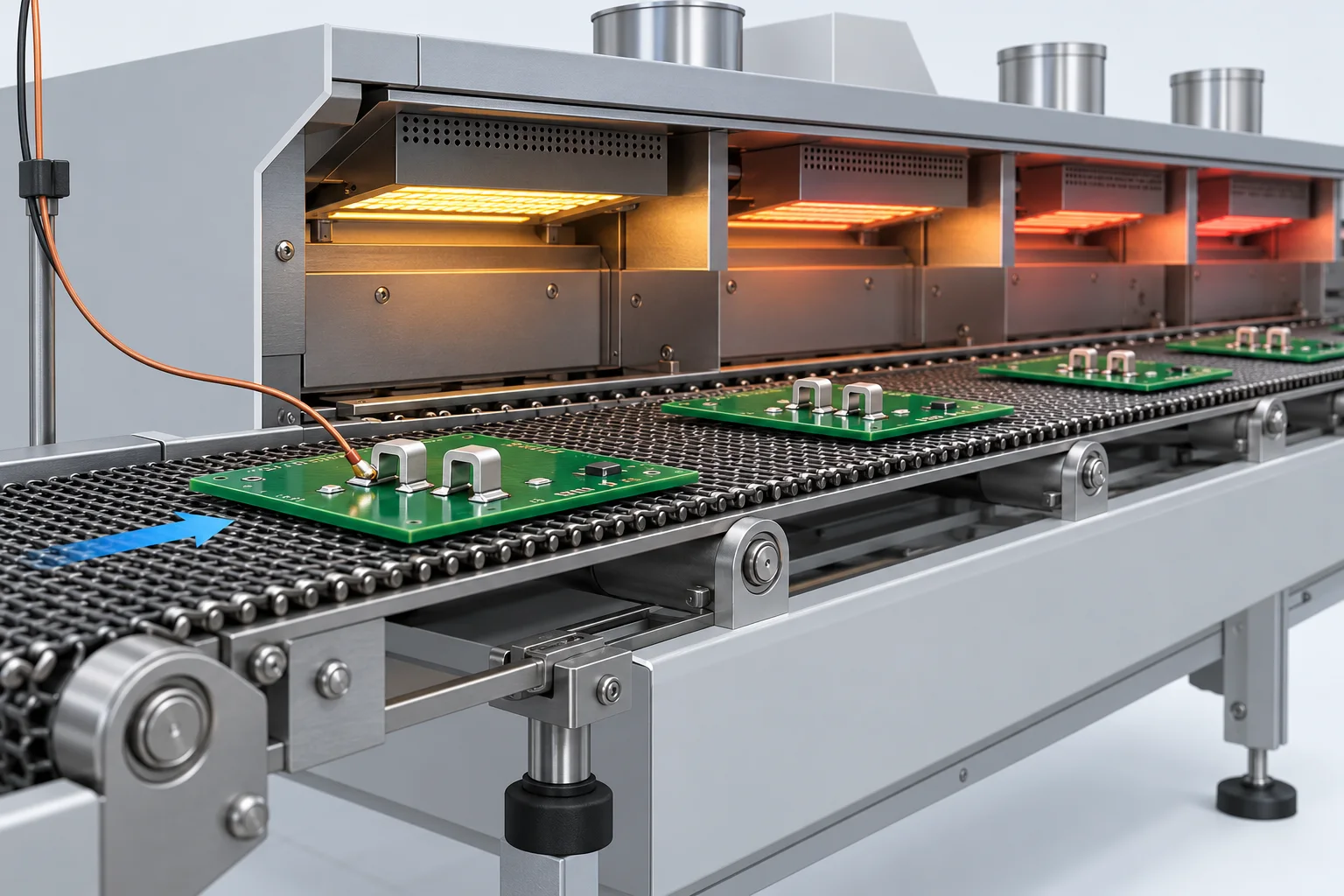
The AI cover is an oven-conveyor illustration, not a Hongchuan factory or production record. Example values do not specify conveyor speed, TAL, peak or production capacity.