


Read thermal diffusivity a and thermal conductivity λ as different PCB busbar properties. Diffusivity is commonly reported in mm²/s and concerns transient heat conduction; conductivity uses W/(m·K). Their relationship is λ=aρcp, with consistent units and temperature. A value in mm²/s cannot simply be relabelled as conductivity.
Check dimensions before comparing numbers
NETZSCH's thermal-property guidance distinguishes diffusivity, conductivity, specific heat and density. A higher diffusivity describes a faster material temperature response under the relevant conditions. It does not specify a busbar's highest operating temperature or its contact resistance to a heatsink.
| Property | Units used here | Check |
|---|---|---|
| Diffusivity a | m²/s or mm²/s | Material, direction, temperature and method |
| Conductivity λ | W/(m·K) | Measured or calculated result |
| Density ρ | kg/m³ | Units and specimen state |
| Specific heat cp | J/(kg·K) | Temperature and mass basis |
A worked unit conversion
For illustration only, assume a uniform material has a=100 mm²/s, ρ=8000 kg/m³ and cp=400 J/(kg·K), all at the same temperature and direction. Since 1 mm²=10−6 m², a=1×10⁻⁴ m²/s. Thus λ=1×10−4×8000×400=320 W/(m·K).
These are not properties assigned to a Hongchuan copper grade. Using 100 directly with the stated SI density and specific-heat units introduces a factor of 106. Other combinations, including g/cm³ and J/(g·K), also require a complete unit check rather than changing the final label.
Audit the calculation inputs
If a report measures a, for example by a flash method, and calculates λ from density and specific heat, identify the source of each input. Do not combine temperatures, directions or material states without assessing compatibility. Input uncertainties also affect the calculated result.
For procurement, request the property name, units, temperature, method, specimen identity and data status. Distinguish typical reference values from batch inspection results. A general material table is not a measured certificate for the delivered finished components. Changes to brass, copper-aluminium construction or material condition require review.
Use properties within the assembly model
For SMD and SMT PCB busbars, geometry, heat generation, soldered and contact paths, airflow and cooling boundaries are additional inputs. Appropriate modelling and actual tests are still needed to validate the assembled temperature distribution.
The thermal time-constant guide addresses assembly response. Diffusivity has units of area per time, while a time constant is measured in seconds. They are not interchangeable, and diffusivity alone cannot set a test stabilization time without geometry and boundaries.
Questions
Does greater diffusivity mean a higher current rating? Not by itself. Electrical resistance, geometry, connections and cooling remain relevant.
Does equal conductivity guarantee equal warm-up? Density, heat capacity, geometry and boundary conditions may differ.
Sources
NETZSCH definition of thermal diffusivity; NETZSCH conductivity and related properties.
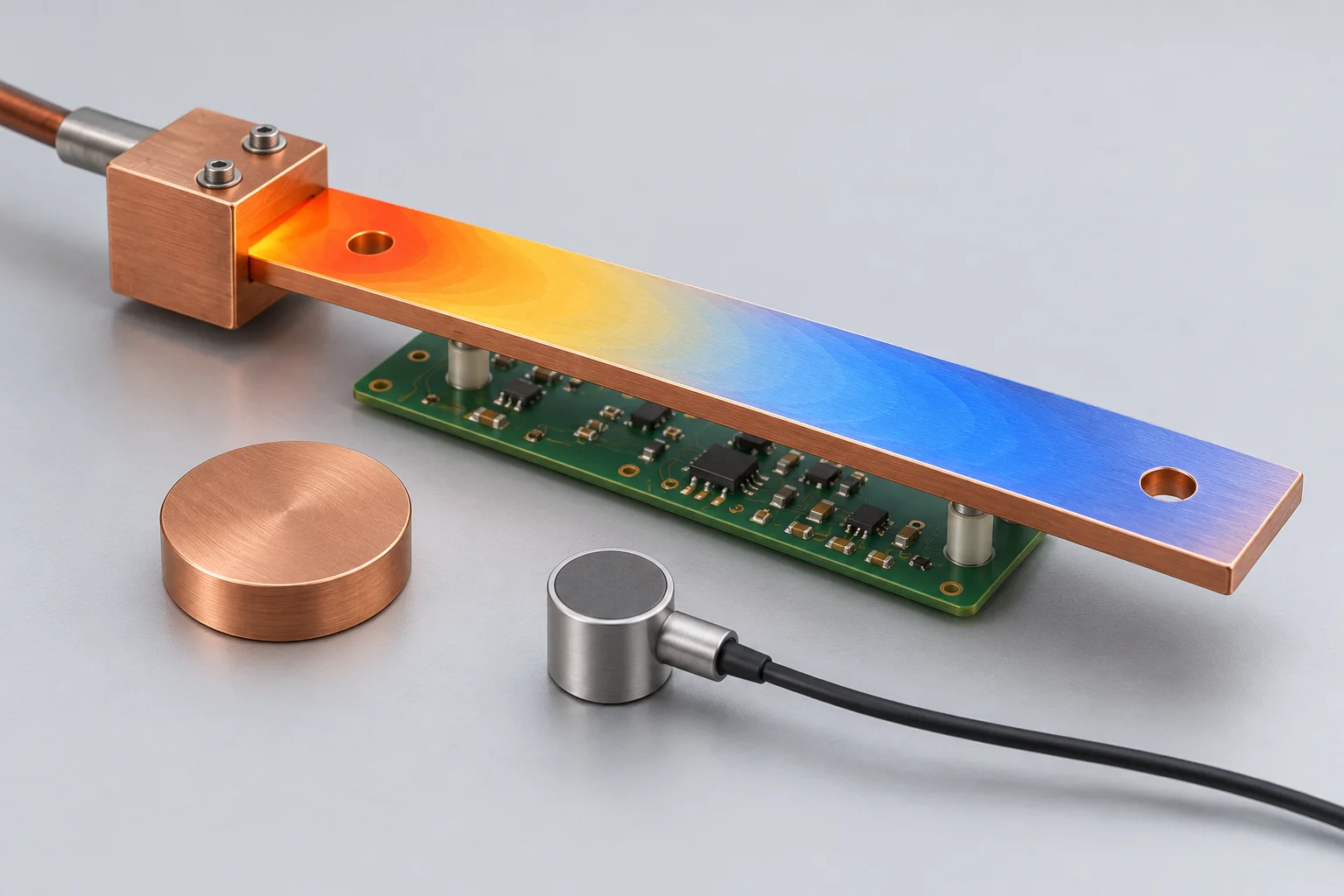
The AI cover is a heat-transfer illustration, not a temperature measurement. Example inputs are not Hongchuan material data, test results or current-rating commitments.