

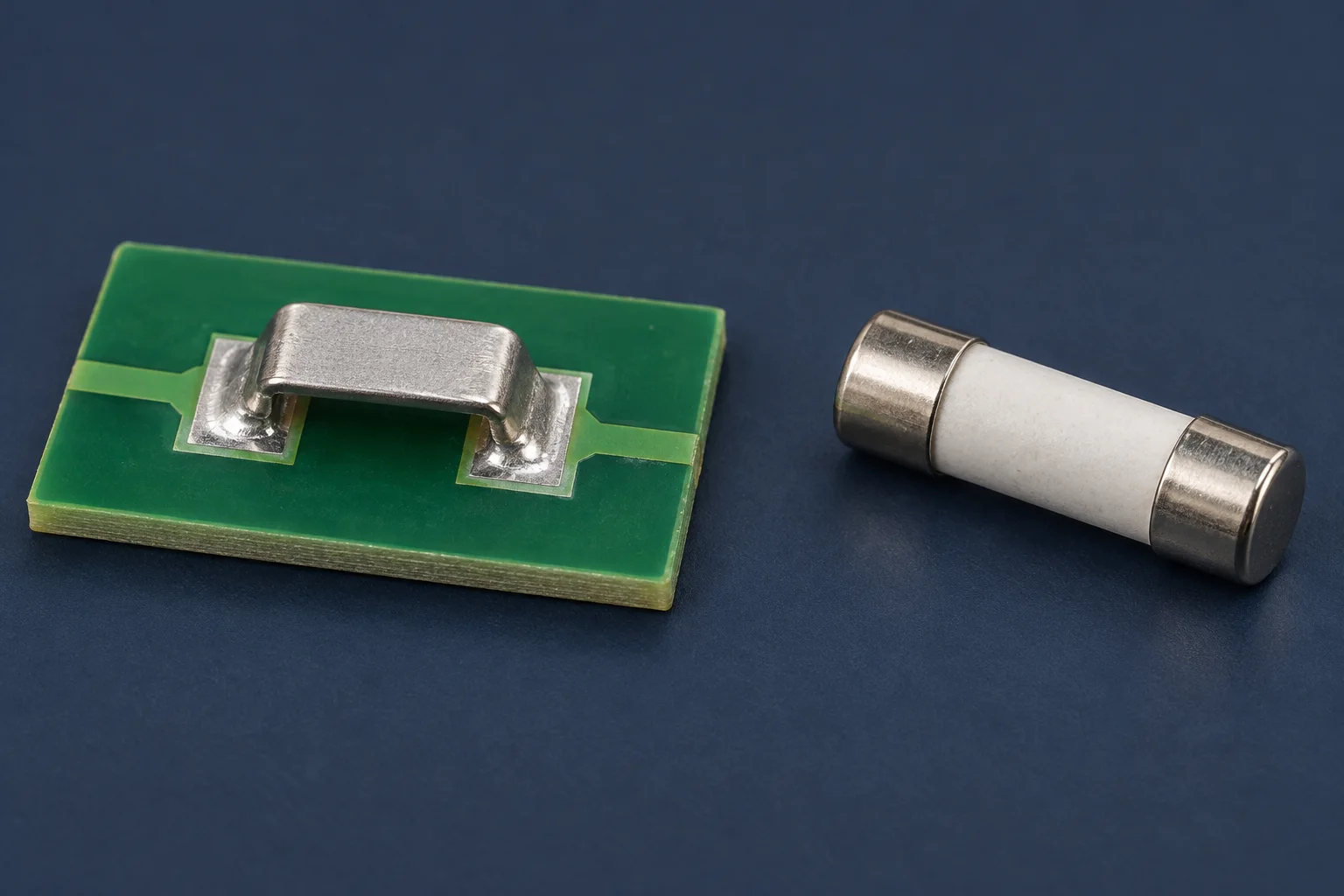
An ordinary surface mount PCB jumper connects a conductive path. A small cross-section or an observed burned-open specimen does not make it a qualified fuse. A protection role needs safe interruption evidence at specified voltage and fault current, plus time-current behaviour. Without these ratings and evidence, assign interruption to an appropriately qualified protection device.
Conduction and interruption are different functions
Littelfuse's fuse selection guide addresses operating current, voltage, prospective fault current and interrupting capability. Normal voltage drop and temperature rise do not establish safe fault interruption. A break in one specimen is not rated-condition interruption evidence.
| Evidence | Purpose | Does not replace |
|---|---|---|
| Resistance and temperature rise | Normal connection losses | Safe interruption |
| Time-current characteristic | Operation over a specified range | Voltage and interrupting ratings |
| Interrupting rating | Fault current interrupted under stated conditions | Every source and installation condition |
| Total-clearing I²t | Integral until complete current interruption | A melting-only value |
Melting is not the end of the event
Littelfuse's Fuseology document distinguishes melting, arcing and total-clearing I²t. Total-clearing I²t is the sum of melting and arcing contributions, in A²·s. A downstream withstand assessment must not treat the melting phase as the whole interruption process.
In a hypothetical specified test, melting I²t = 100 A²·s and arcing I²t = 40 A²·s would give 140 A²·s total. These are not jumper or fuse data. I²t is not itself energy in joules; resistance and its time variation are needed for a heating-energy calculation.
Document separate jumper and protection roles
For surface mount PCB jumpers, request normal connection verification separately from withstand evidence during system protection operation. Protection documents must match AC or DC type, voltage, prospective fault current and mounting. Do not transfer an AC interrupting rating to DC without applicable evidence.
A proposed schematic review checks that protection lies in the intended current path. Copper or harness bypasses need topology review; the presence of a fuse in a bill of materials alone is insufficient. Include board, joints, external conductors and insulation in the assessment boundary.
Use controlled qualification equipment
Fault and interruption tests require competent personnel and controlled conditions. This article gives no procedure for shorting a bare board or making a jumper burn open. Preserve source conditions, current/voltage waveforms, operation time, specimen revision and post-test conductor, solder and insulation evidence.
See RMS and I²t calculations for normal pulse integrals. An integral alone does not establish system safety.
Frequently asked questions
Can a thinner jumper set a stable fuse rating?Geometry alone cannot establish it. Material, manufacturing, environment, operation and interruption need full qualification.
Does surviving one fault prove protection acceptance?Withstand and interruption are separate functions; verify each under applicable conditions.
The cover is an AI illustration of separate component roles, not a recommendation, fault test or HC fuse claim. No universal opening current is provided.