

Specify AWG, conductor area and overall cable diameter separately when requesting PCB solder terminals. AWG is a gauge, mm² is area and insulated diameter is in mm. Similar geometric area does not automatically make wires or lugs interchangeable; conductor construction, termination range and assembly conditions also matter.
Read the correct column in a conversion table
LAPP's T16 technical table separates geometrical conversion from metric nominal sizes and warns against treating the systems as direct equivalents. The following values are geometric area references only, not ampacities or HC terminal wire ranges.
| AWG | Approximate geometric area, mm² |
|---|---|
| 18 | 0.82 |
| 14 | 2.08 |
| 12 | 3.31 |
| 10 | 5.26 |
| 8 | 8.37 |
For example, 10 AWG corresponds to approximately 5.26 mm², about 0.74 mm² different from 6 mm². A neighbouring metric-size column does not make those areas equal. Review applicable wire and termination requirements rather than substituting by rounding alone.
Equivalent solid diameter is not cable diameter
For S = 5.26 mm², the equivalent circular solid-conductor diameter d = √(4S/π) is approximately 2.59 mm. Stranded construction includes spaces between individual wires, and insulation adds diameter. Measuring the outside of an insulated cable cannot directly give copper area through the circular-area formula.
The NBS/NIST copper wire handbook treats total strand area and circumscribed diameter separately. This historical source supports geometry, not current cable certification. Obtain current construction, conductor-resistance and termination data for the product.
A strand-count calculation
For a purely hypothetical geometry of 19 circular copper strands, each 0.30 mm in diameter, the sum of areas normal to each strand is S = 19 × π × 0.30² / 4, approximately 1.34 mm². It excludes voids and insulation and does not qualify a cable as a 1.5 mm² nominal product. Actual inspection must use the applicable standard and product definition.
Include termination details in the RFQ
For PCB solder terminals, provide cable part number, conductor material, solid/stranded construction, AWG or nominal area, insulated diameter and lug drawing. Copper and aluminum require their own connection review; equal area is insufficient.
Check bolt hole, lug palm width/thickness, crimp range, sleeve and tool space. M3/M4/M6 may be drawing requirements but are not unverified HC terminal SKUs. See crimp height and pull-force inspection for process evidence.
After mechanical matching, verify voltage drop and temperature rise at the actual current, ambient, PCB and cooling boundaries. Area conversion supplies no universal current limit.
Frequently asked questions
Does a larger AWG number mean a larger conductor?Within the conventional range above, increasing the number corresponds to smaller geometric area.
Does a different diameter on two 10 AWG cables prove different copper area?No. Insulation and strand construction affect diameter; review the product data.
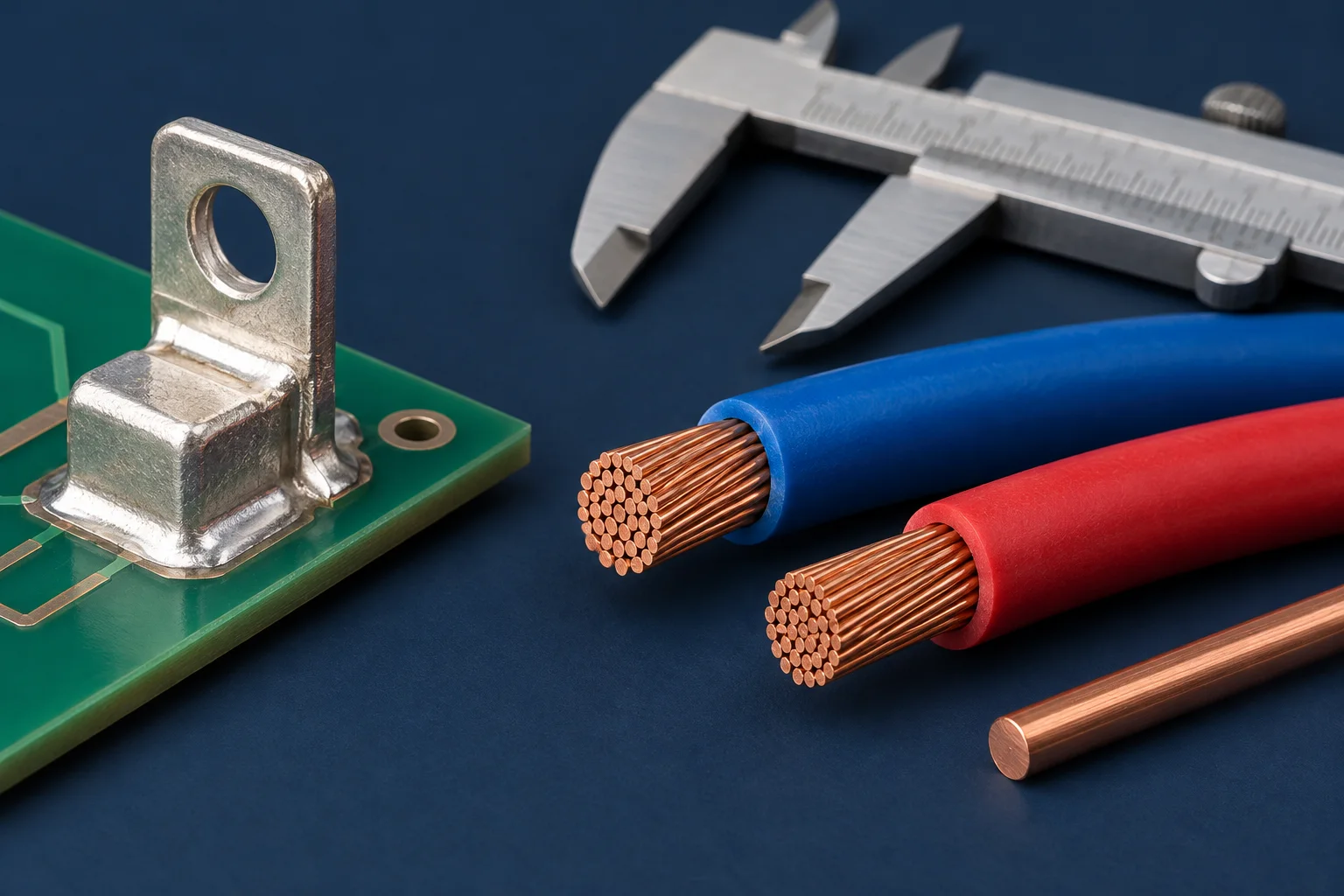
The cover is an AI conductor-geometry illustration, not an HC terminal specification, cable photograph or crimp test. Table values and examples are not terminal current commitments.