


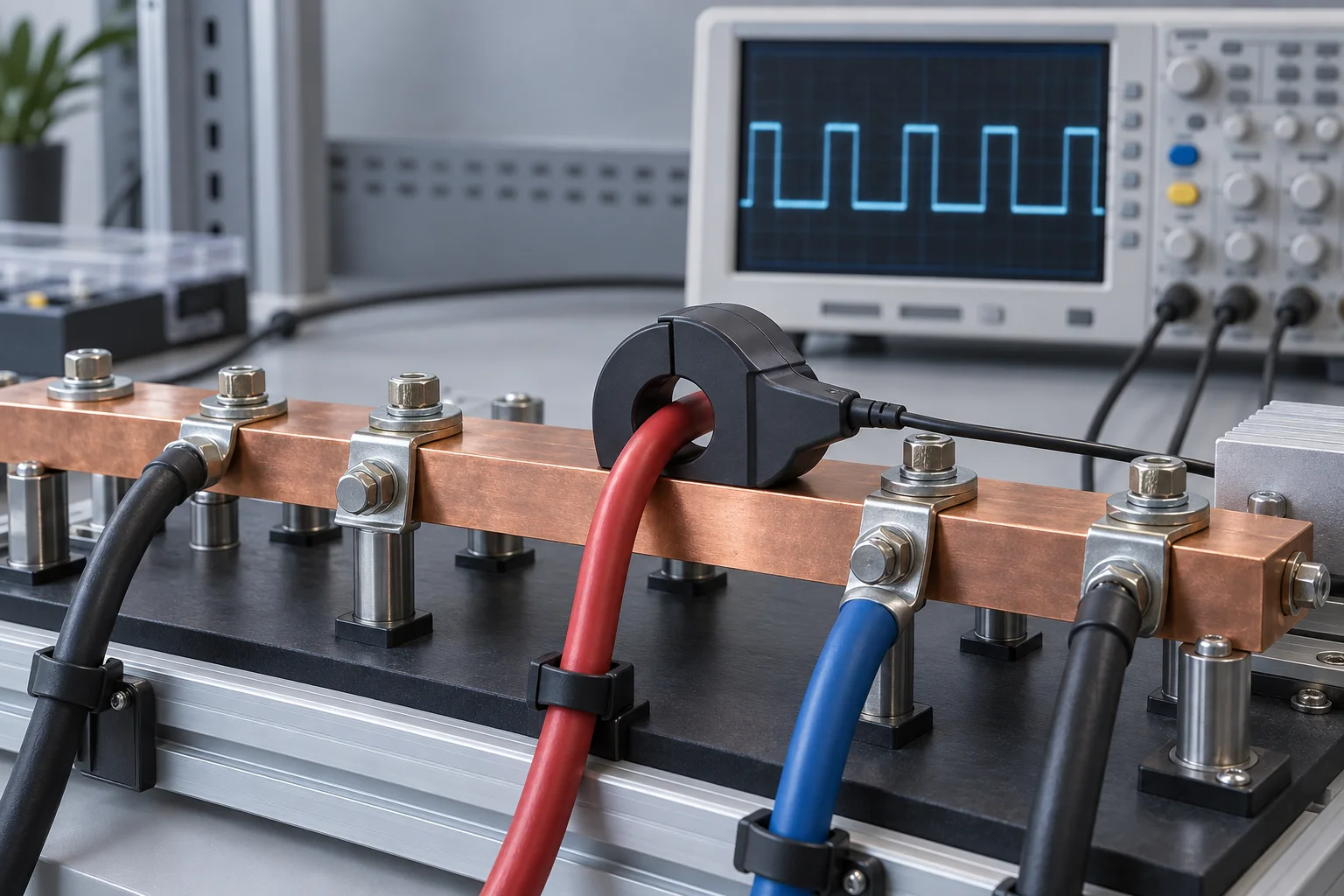
Direct answer With approximately constant resistance, RMS current estimates average resistive loss. Peak current informs instantaneous drop and loading. I²t integrates squared current over a specified interval. Keep waveform and timing because these quantities serve different purposes.
Analog Devices explains RMS as a heating-equivalent quantity and discusses the measurement challenges of low-duty pulses. The following is an illustrative SMD busbar calculation.
A 200 A pulse example
Assume rectangular current alternating between 200 A and zero at 25% duty, ignoring edge and AC resistance effects. Average current is 50 A; RMS current is 200 × √0.25 = 100 A. At a fixed 0.2 mΩ, average loss is 2 W. Substituting average current would give 0.5 W. These are calculated examples, not Hongchuan ratings.
| Quantity | Use | Limit |
|---|---|---|
| Average | Net charge per period | Not sufficient for pulse heating |
| RMS | Average loss with constant resistance | Does not give peak temperature |
| Peak | Instantaneous drop and loading | Needs pulse width and period |
| I²t | Squared-current integral | Does not independently prove fault withstand |
Timing still matters
A 1 ms on / 3 ms off waveform and a 1 s on / 3 s off waveform have the same duty. Their temperature excursions depend on thermal mass and cooling. At higher frequencies, assess skin and proximity effects. Capture full cycles and confirm whether the instrument reports total RMS or AC-only RMS. Reversing current can yield nearly zero average while still causing heat.
Keep waveform files, timing, ambient and hot-spot locations. Pair calculations with actual assembly tests and the pad-exit inspection guide.
Common questions
Does 100 A RMS justify a catalog 100 A part?
Only after matching rating conditions and validating peaks, PCB transitions and temperature excursions.
Does equal I²t guarantee equal safety?
No. Temperature-dependent resistance, cooling and failure mechanisms also matter.
Sources
The cover is an AI-generated concept; its waveform is not measured data.