


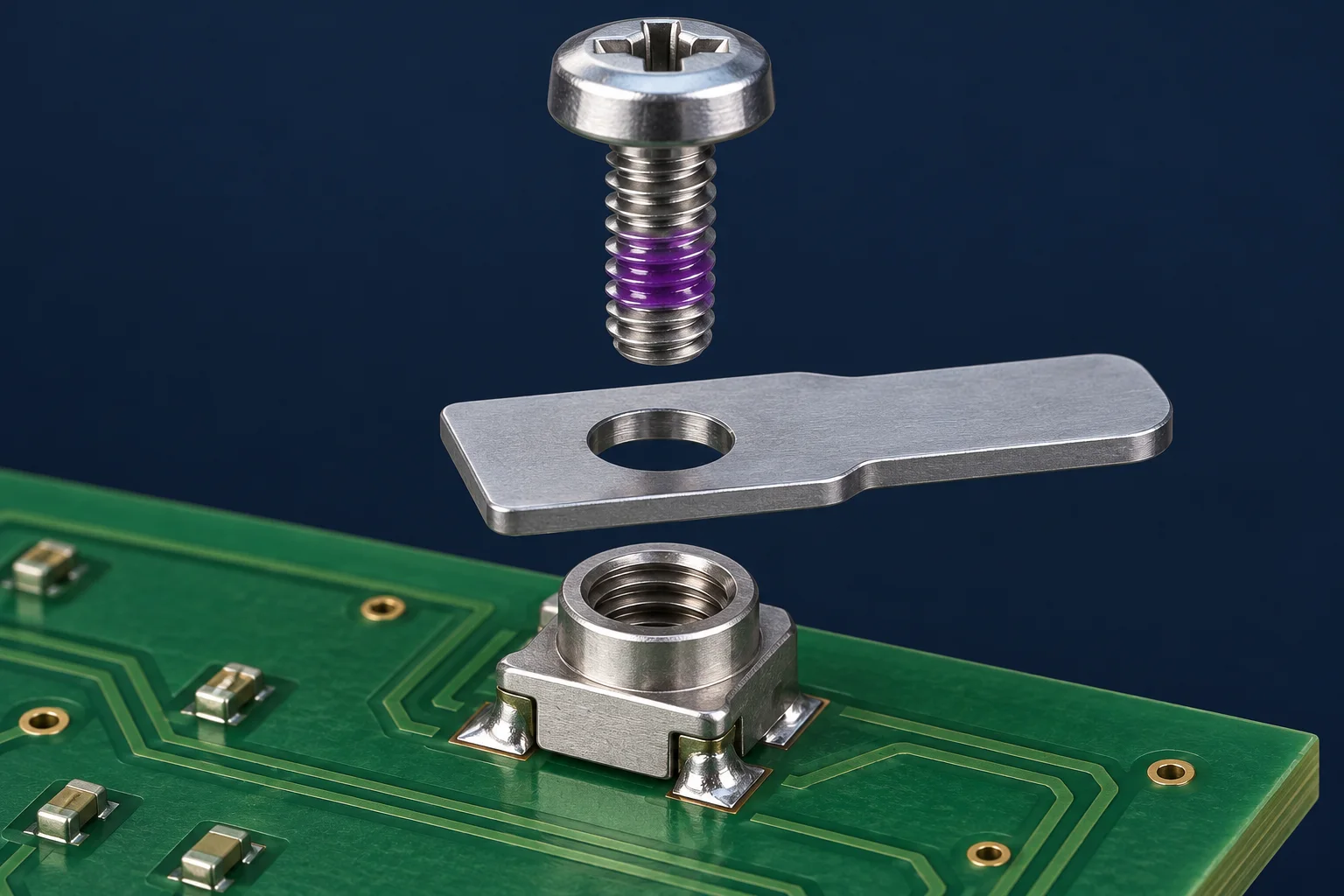
Threadlocker use on an SMT nut must be qualified for the actual assembly. Select against maintenance needs, then verify cure, adjacent-material compatibility and removal loads on solder joints and pads. Adhesive cannot repair a cracked soldered connection, and ordinary metal-fastener test data are not PCB limits.
Identify the supplier's test assembly
Henkel's low-strength threadlocking product overview and the LOCTITE 222 technical sheet describe anaerobic cure and include curves based on M10 steel nuts and bolts. Cure varies with substrate, gap and temperature. These documents illustrate review conditions; they are not evidence that this adhesive is approved for HC nuts.
| Item | Review | Do not infer |
|---|---|---|
| Fixture time | Adhesive, material, temperature and criterion | Final cured performance |
| Breakaway torque | Thread, amount, cure and specimen | Permissible PCB load |
| Temperature range | Specified operating conditions | Reflow-process approval |
| Adjacent materials | Plastics, coatings, cleaners and insulation | Compatibility from metal threads alone |
Control the application boundary
The technical sheet requires compatibility review for preparation materials and warns of potential stress cracking in some plastics. As a PCB qualification proposal, verify amount, placement and cured spill extent on specimens. Keep adhesive out of intended electrical contact regions, solder pads and neighbouring connectors. Review any added activator or cleaner separately and follow its safety documentation.
Do not make unqualified adhesive dispensing a standard pre-reflow step. Operating-temperature and cure statements do not automatically cover soldering exposure, flux and subsequent cleaning.
Removal loads reach the PCB
For SMT nuts, removal reaction passes through the nut, solder and pad to the board. Verify cured removal torque with the actual screw and clamped part; inspect rotation, cracks and pad lift. A low-strength description does not replace this assembly test.
Do not transfer a metal-fastener local-heating removal procedure directly to a populated PCB. If heat, solvents or mechanical cleaning are required, confirm a board-level repair procedure and material safety before proceeding.
Keep a control and a maintenance history
A suggested comparison uses no-adhesive and candidate-adhesive specimens of one assembly revision, with fixed screws, finish, amount, cure temperature and wait time. Apply the project's environmental requirements and record remating count, cleaning or reapplication and failure location. For grounding nuts, also check the actual electrical interface.
Use pad-lift and annular-crack inspection alongside this plan. Threadlocking and solder-joint integrity need separate evidence.
Frequently asked questions
Does hand-tool removal guarantee PCB safety?No. Check actual removal torque and board load transfer.
Does a non-flowing adhesive mean final acceptance?No. Use the specified cure conditions and performance criterion, not appearance alone.
The cover is an AI assembly illustration. Purple only indicates adhesive location, not HC use or approval of a particular product. No universal amount, cure time or removal torque is provided.