


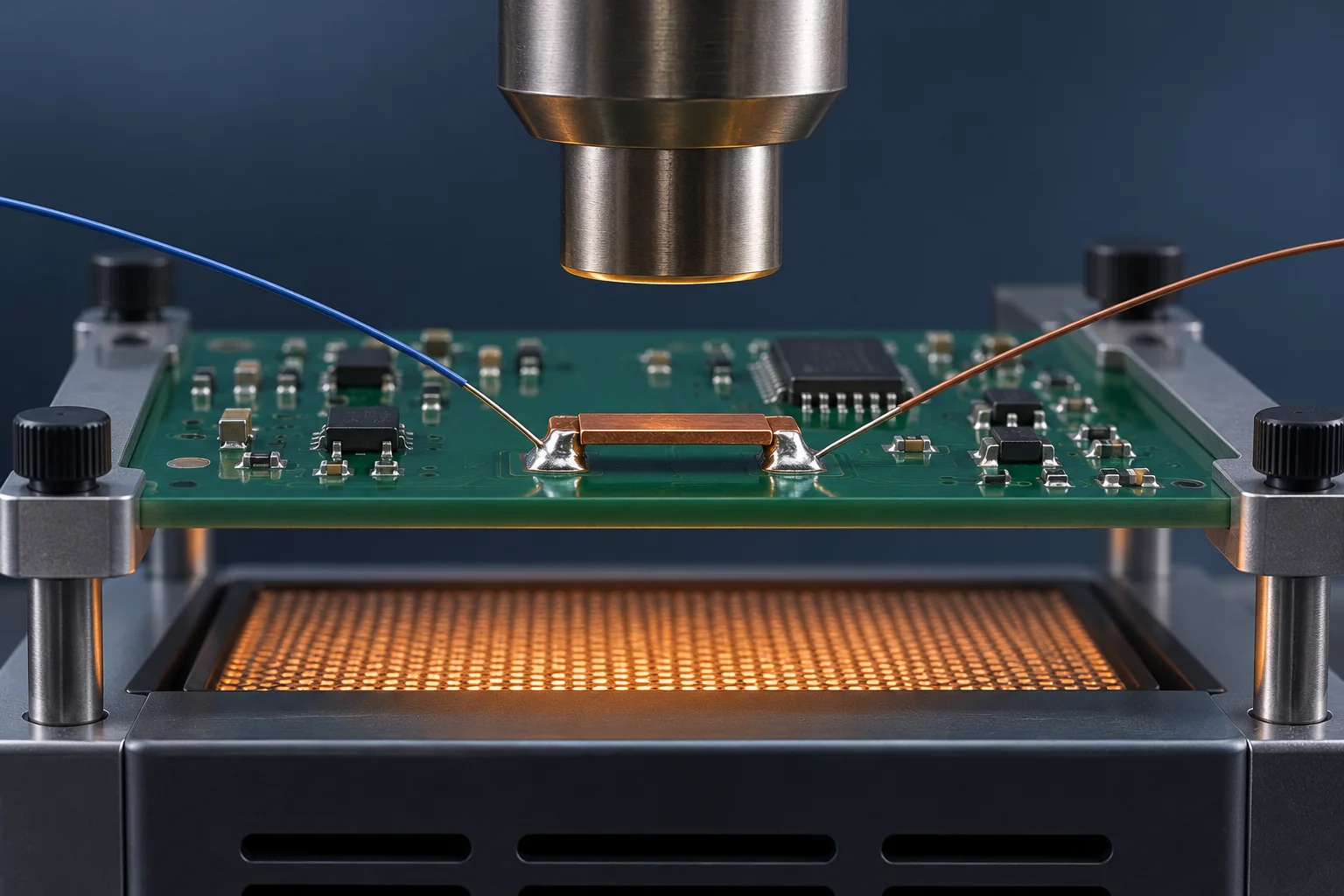
Develop a surface mount PCB jumper rework profile for the actual board, copper layout and solder. The hot-air display is not the joint temperature. For a two-ended copper bridge, instrument both joints on a process-validation board and check sensitive neighboring parts. Remove it only under an approved process after the relevant connections have released; do not pry against unmelted solder.
Measure the assembly response
Nozzle distance, airflow and board heat paths affect joint heating. Ends connected to different copper areas can heat differently. JBC's rework process explanation describes external thermocouples for component/PCB control and protection. Its preheating guidance calls for application-specific controlled profiles. Neither supplies a fixed Hongchuan jumper rework temperature.
Keep enough information to repeat the process
Experienced personnel should plan measurements on representative validation boards. Attach junctions to reflect the intended location rather than suspended hot air, document attachment and assess measurement-induced thermal disturbance. Isolate power and manage stored energy according to equipment instructions. Follow ESD and hot-tool safety procedures.
| Record | Units or context | Define |
|---|---|---|
| Both joint profiles | Temperature °C and time s | Location and attachment |
| Thermal behavior | Ramp °C/s, peak and dwell | Applicable solder/component limits |
| Equipment settings | Nozzle, distance mm, airflow setting and preheat | Settings with equipment model |
| Neighbor protection | Location, temperature and shielding | Shielding changes heating conditions |
| History | Original assembly and previous rework | Retain cumulative thermal history |
Mark heating, intended removal and heating-stop events. Average ramp rate is the temperature change divided by elapsed time over a stated interval; it does not establish the fastest local ramp. Obtain peak and time-above-liquidus requirements from the actual solder and component information. No universal temperature or duration is prescribed here.
One released end is insufficient
HAKKO's SMD rework station explanation identifies pad-peeling risk when lifting before solder has melted sufficiently. One movable jumper end does not prove the other has released. Stop forced removal and reassess heating and measurement if the validated procedure cannot be followed.
Assembly-reflow capability is not permission for unlimited rework. Agree allowable actions using supplier information, customer requirements and thermal history. The official IPC-7711/7721 program overview covers removal, land preparation and installation for experienced personnel. This article asserts no Hongchuan process certification.
Agree post-rework checks before starting
Define reusable-land criteria, stop conditions and visual, resistance and functional checks. Compare bridge span, overall length, solder transitions and post-reflow gap with the drawing. Continuity alone does not prove intact lands. Route peeling, cracking or abnormal resistance through an agreed disposition process.
Supply board construction, solder, dimensions and thermal history when discussing surface mount PCB jumpers. See post-reflow gap measurement. Do not turn a hot-air setpoint into a production recipe without assembly validation.
FAQ
Does preheating remove the need for joint measurements? Validate actual locations when establishing or changing a process; define routine monitoring separately.
Must both profiles be identical? No. Each connection and nearby component must meet its applicable conditions and allow safe removal under the procedure.
AI-generated rework measurement concept, not a Hongchuan operation record or wiring instruction. No universal rework temperature, duration or cycle allowance is specified.