


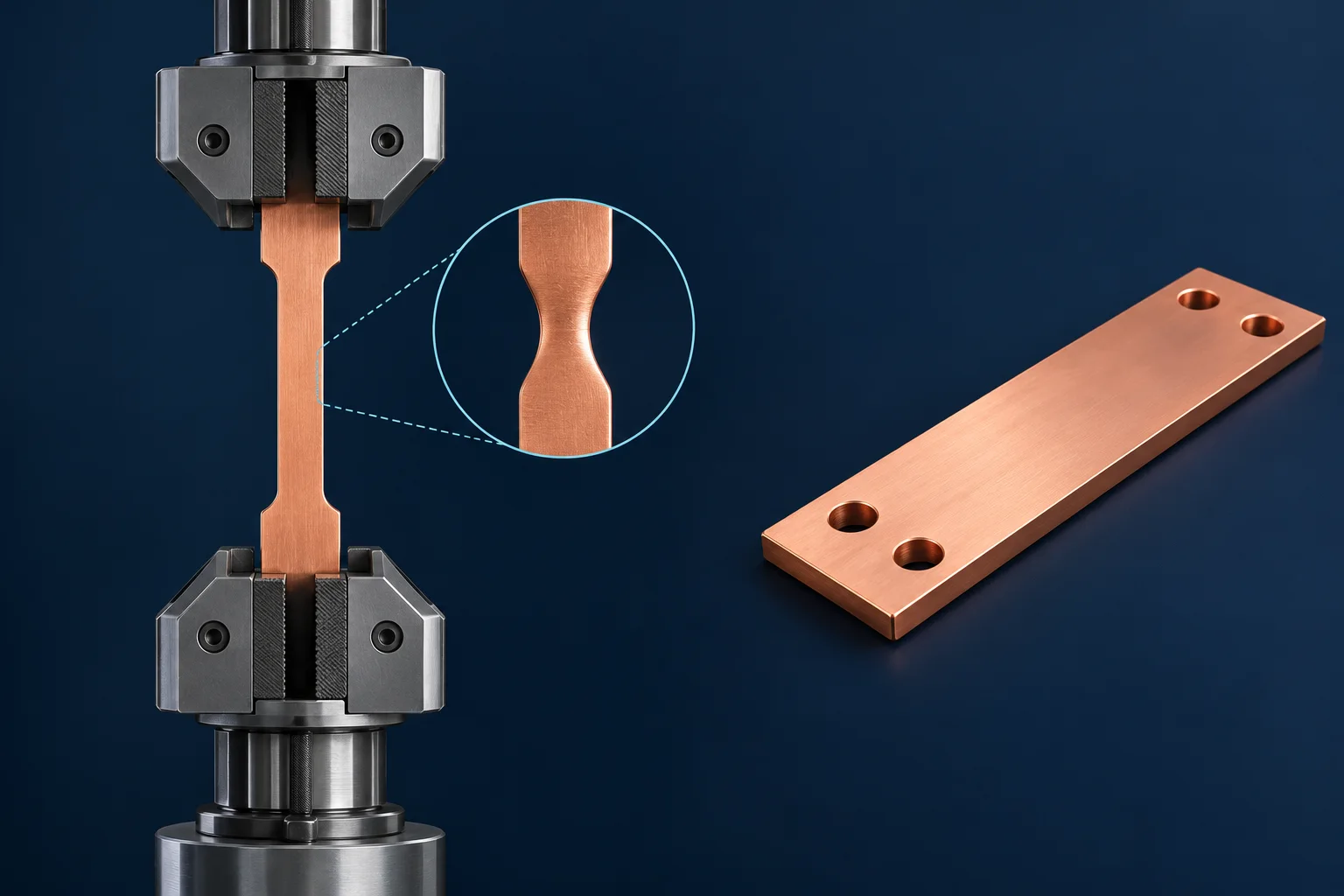
Rp0.2, Rm and elongation describe different tensile properties of PCB copper busbar material. Rp0.2 is proof strength at a specified plastic extension; Rm is ultimate tensile strength; elongation after fracture refers to a specified gauge length. Compare reports only after matching material state, orientation, section, gauge length and method.
The 0.2 denotes plastic extension
ZwickRoell's proof-strength explanation describes the 0.2% offset convention for materials without a pronounced yield point. It is not a universal permitted extension or finished-part load limit.
For a hypothetical extensometer gauge length of 50 mm, 0.2% corresponds to 0.10 mm of plastic extension. Total extension under load also includes an elastic component. Determining Rp0.2 requires a stress-strain curve and suitable extension measurement; 0.10 mm of crosshead travel does not identify it.
| Property | Typical unit | Retain in the report |
|---|---|---|
| Rp0.2 | MPa or N/mm² | Offset definition, extensometer gauge, curve |
| Rm | MPa or N/mm² | Maximum force, initial section |
| Elongation after fracture A | % | Initial/final gauge lengths, specimen form |
Maximum force is not necessarily fracture
Instron's tensile-testing guide separates maximum stress, yield, extension and fracture. In a necking specimen, maximum force can occur before fracture. Rm uses maximum force and the original cross-section; substituting the necked final section changes the quantity.
In a hypothetical unit example, initial width is 5.0 mm and thickness is 0.20 mm, giving 1.0 mm². Maximum force of 250 N gives Rm = 250 N/mm² = 250 MPa. In a separate elongation example, initial gauge length of 50 mm and final length of 60 mm give A = (60 − 50)/50 × 100% = 20%. None of these values are Hongchuan material data.
Connect the specimen to the purchased part
For PCB copper busbars, identify batch, temper, thickness and sampling direction. State whether the coupon represents incoming stock, heat-treated material or a formed region. Use suitable specimen preparation rather than labeling the breaking force of a perforated finished part as standard material Rm.
Temper can change forming and load behavior within one alloy designation. See copper-strip temper and bend direction. A material tensile pass does not qualify the solder joint, bolted connection or PCB support; verify the actual assembly separately.
Common questions
Are two 20% elongation values interchangeable? Check gauge length, specimen shape and method first.
Can hardness fill a missing Rm result? Only a validated relationship for the particular material and state supports conversion. Steel conversion tables cannot substitute for copper testing.
Cover is an AI material-test illustration, not Hongchuan equipment or measured results. Hypothetical values are not material specifications, assembly load limits or acceptance commitments.