


A residual-torque audit on an assembled SMT nut joint does not directly reconstruct the original powered-tool tightening torque. Define direction, waiting time, speed and whether the result is a breakaway peak or a value identified by a torque-angle method. Auditing can change the joint; repeated checks are not independent observations.
Different readings can describe different events
Atlas Copco's quality-assurance Q&A describes applying torque to an already tightened joint and observing renewed movement, while distinguishing dynamic tightening and static-friction breakaway. This explains measurement terminology, not Hongchuan torque limits.
A starting peak and a reading during continued movement represent different conditions. The STRwrench peak-strategy documentation states that this strategy does not automatically detect the breakaway point. A peak-only result therefore should not be treated as interchangeable with a method that identifies that point.
| Record | Stage | Does not replace |
|---|---|---|
| Dynamic tightening torque | Original assembly | Joint condition after waiting |
| Breakaway peak | Near renewed movement | Original dynamic trace |
| Method-defined residual value | Specified algorithm or angle rule | Direct clamp-force measurement |
| Loosening value | Reverse-direction release | Same-direction retightening result |
Validate correlation before setting an audit window
Use the actual PCB, solder process, screw, washer and clamped component. Preserve original tightening traces, then audit after a defined delay using a consistent method. Record torque and angle while checking nut rotation, solder joints, pads and board bending. Use separate specimens where clamp-condition or destructive investigation is needed.
Suppose one record shows 0.30 N·m at the end of dynamic tightening and another shows a 0.36 N·m static starting peak after waiting. Their 20% difference alone does not prove tool overshoot, nor should the values simply be forced to match. These hypothetical numbers are not recommended settings or permitted deviations.
The audit also loads the PCB
An SMT or SMD nut transfers load through its base, solder and PCB. Control added rotation, tool alignment and support. State whether audited specimens remain usable and which abnormalities require isolation; checking is not automatically non-destructive.
With threadlocker, also fix adhesive, quantity, cure state and waiting time. See threadlocker cure and removal validation. Results before and after curing cannot be made comparable by an arbitrary percentage.
Common questions
Can the audit limit always be 80% of tightening torque? No universal ratio applies to all SMT nut assemblies. Validate the joint and audit method.
Should three checks on the same joint be averaged? Earlier checks may have rotated it. Preserve sequence and use an approved sampling method instead of assuming independence.
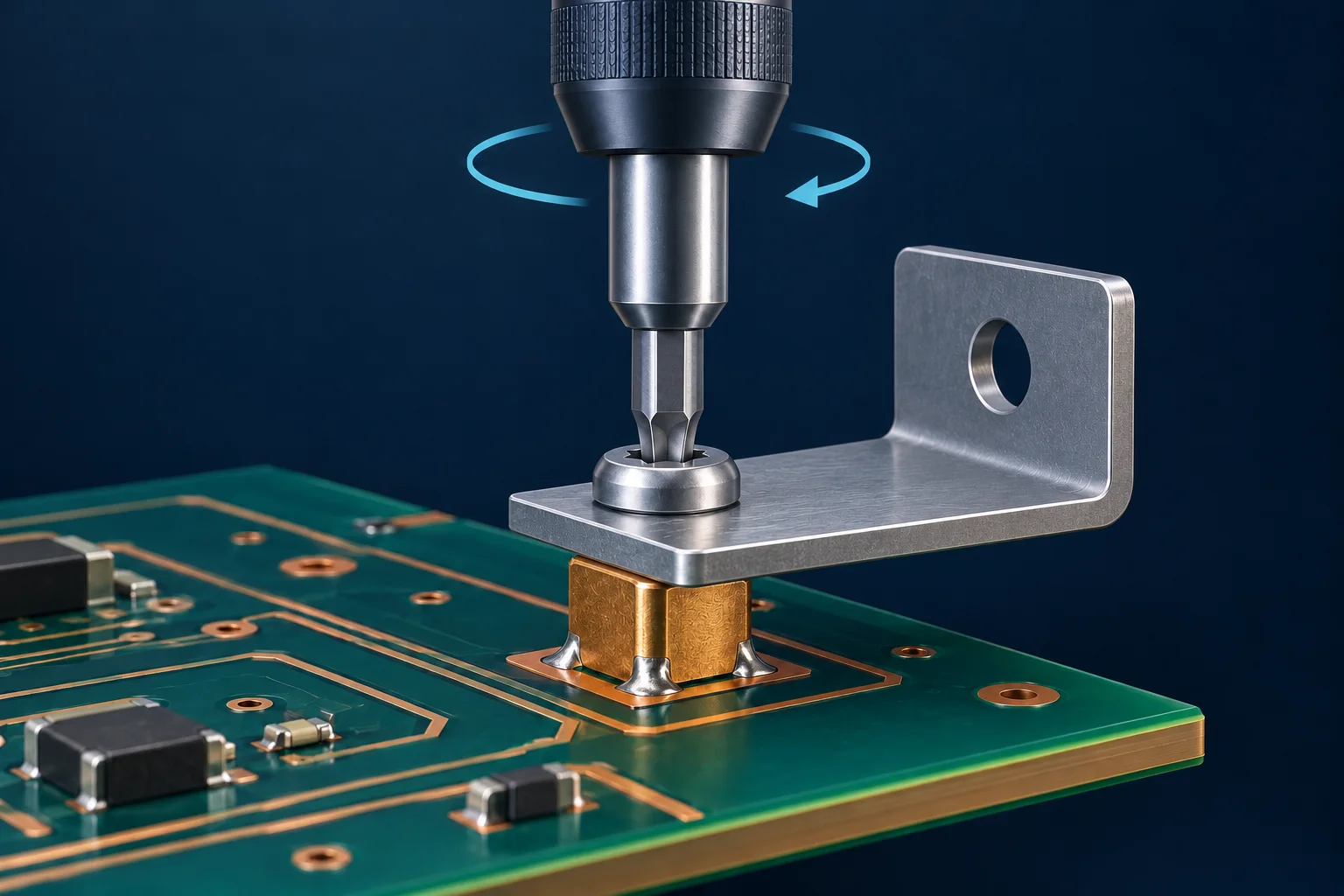
Cover is an AI inspection illustration, not Hongchuan equipment or test evidence. Example torques are not specifications, process settings or acceptance commitments.