


Direct answer There is no universal acceptable crimp height for every terminal and wire. Use the application specification for the exact terminal, conductor and tooling, then check conductor position, crimp shape and pull-test results. TE's published crimp specification ties dimensional criteria to specific contacts and tooling conditions.
This guide applies to wire connections with a crimp barrel. If a PCB terminal uses a screw clamp or solder joint, set acceptance criteria for that connection method instead of reusing crimp values.
Three checks answer different questions
| Check | What it can reveal | What it cannot prove alone |
|---|---|---|
| Visual inspection | Missing or skewed crimp, loose strands, visible cracks or insulation damage | Internal conductor compression |
| Crimp height and width | Whether formed dimensions meet the part-specific specification | Pull strength or cross-section condition |
| Pull test | Mechanical retention of the wire in the terminal | Electrical resistance or long-term stability |
| Microsection | Conductor compaction, voids and barrel shape | Routine dimensional records for every part |
Match the crimp height to the right combination
A change in wire size, strand count, terminal number or die may make the previous setting unsuitable. A quick caliper reading may also differ from the measurement location specified by the application document. Follow its gauge, location, sample size and production check frequency. Record the tool and terminal revisions.
TE guidance calls for the conductor to remain within the wire barrel and for crimp placement and dimensions to follow the applicable drawing. Its crimp-height article also treats height as a part-specific quality measure, not a universal tolerance.
Record where a pull test fails
If a result is low, note whether the wire slipped, strands broke or the terminal deformed. Failure location changes the investigation. The work instruction should also identify pull speed, grip method and wire size. Acceptance limits come from the terminal specification, product requirement or customer agreement.
Common questions
Can visual inspection replace pull testing?
The control plan and terminal specification determine the sampling method. Visual inspection alone does not establish mechanical retention.
Can I copy the crimp height from a similar terminal?
No. Barrel shape, stock thickness, wire size and tooling can differ. Check the document for the exact part number.
Sources
- TE Connectivity crimp-terminal application specification example
- TE Connectivity guidance on crimp height
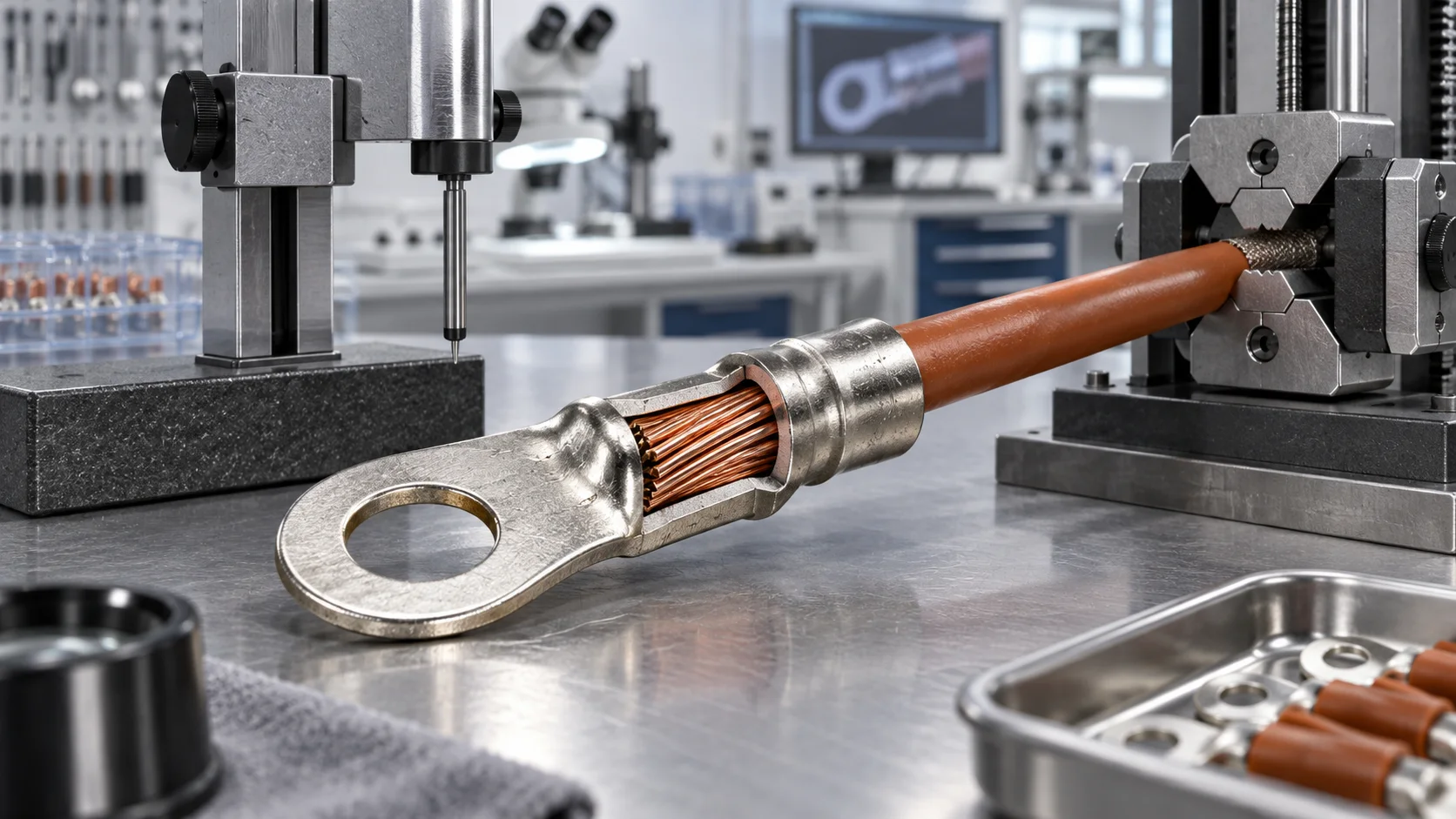
The cover is an AI-generated crimp cross-section concept, not a Hongchuan terminal or inspection result.