


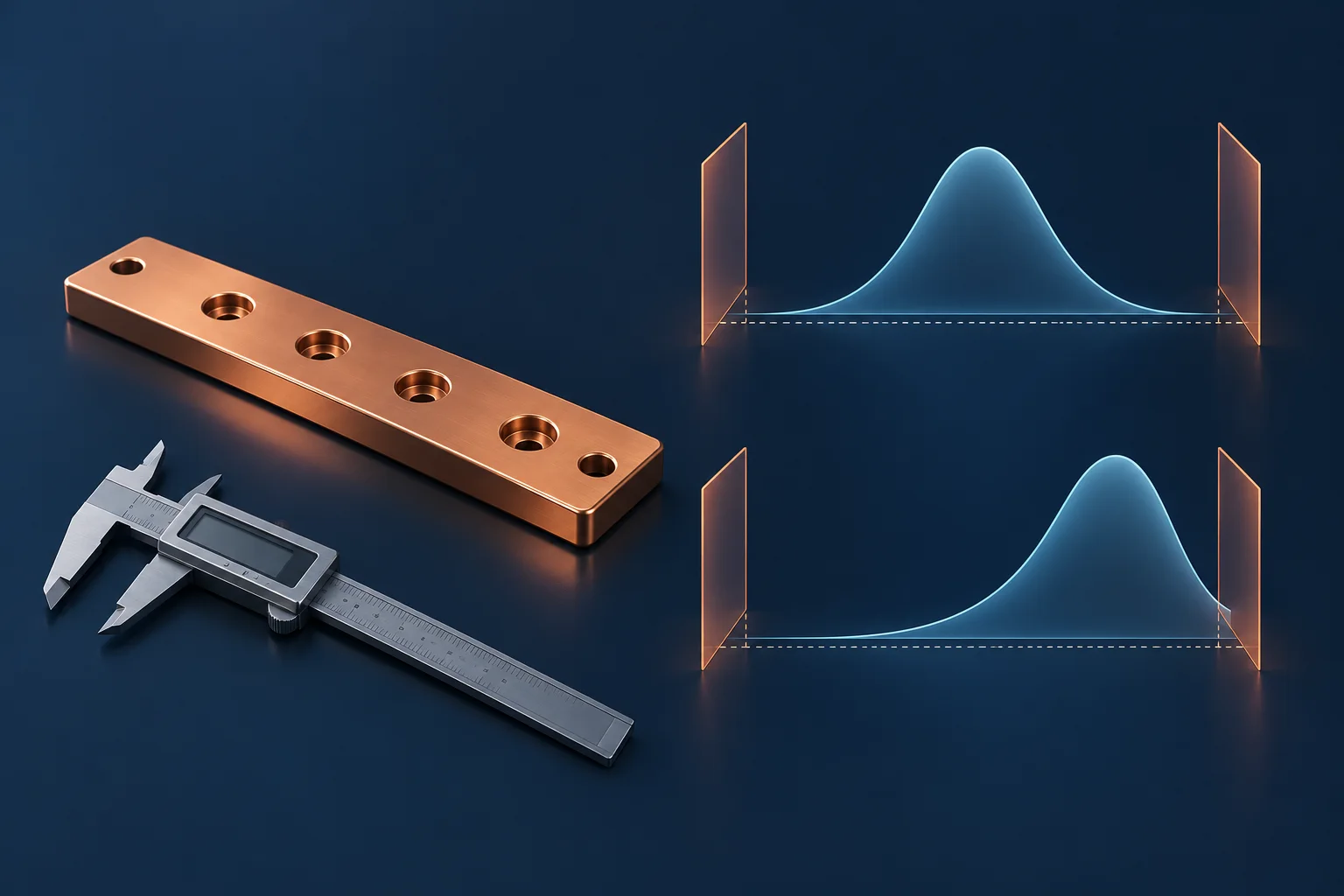
For PCB copper busbar dimensions, Cp compares specification width with process spread; Cpk also accounts for an off-center mean. Interpret either only when process stability, distribution assumptions and the standard-deviation estimate are suitable. A conforming first article does not establish production capability.
Ask how the sample was collected
The NIST capability guide starts from a stable process. For PCB and SMD busbars, connect a width study to the drawing revision, measured feature, material and process state, sample count and chronological sampling plan. Identify any pooling across machines, cavities or adjustments.
Keep measurement direction, locations and coating inclusion consistent. Repeatedly measuring one piece is not equivalent to sampling many manufactured parts. Calculating only from preselected acceptable pieces changes the population represented.
Same spread, different centering
This is an illustrative calculation, not Hongchuan production data. Assume a width specification of 10.00 ± 0.10 mm, with USL = 10.10 mm, LSL = 9.90 mm and a suitable standard-deviation estimate s = 0.020 mm. Estimated Cp = (USL − LSL)/(6s) = 1.67.
| Assumed mean | Cp | Cpk | Observation |
|---|---|---|---|
| 10.000 mm | 1.67 | 1.67 | Centered |
| 10.060 mm | 1.67 | 0.67 | Less margin toward USL |
Cpk is the smaller of (USL − mean)/(3s) and (mean − LSL)/(3s). In the second row the upper distance is 0.040 mm; dividing by 0.060 mm gives approximately 0.67. These numbers illustrate centering, not an acceptance rule or a measured defect rate.
What a single index leaves out
Review time-ordered data and an appropriate control chart first. NIST's out-of-control guidance calls for investigating assignable causes. A shift following a tool or material change should be explained before combining observations into one normal distribution.
Request the method used to estimate s, independence and distribution checks, and any confidence interval. An index without its calculation basis may not be comparable with another report. Do not invent a second specification limit for a genuinely one-sided characteristic.
Capability evaluates a process; lot release follows the agreed inspection requirements. For a borderline individual measurement, consult dimensional uncertainty and guard bands as a separate question.
Questions from purchasing
Does Cpk of 1.33 automatically release a lot? No. The project defines targets, study methods and release rules; the index does not replace material, appearance or functional checks.
Can all sampled pieces pass while capability remains uncertain? Yes. A finite conforming sample does not establish stable future behavior.
Cover is an AI engineering illustration, not Hongchuan photography, equipment or a capability report. Hypothetical calculations are not specifications or performance commitments.