


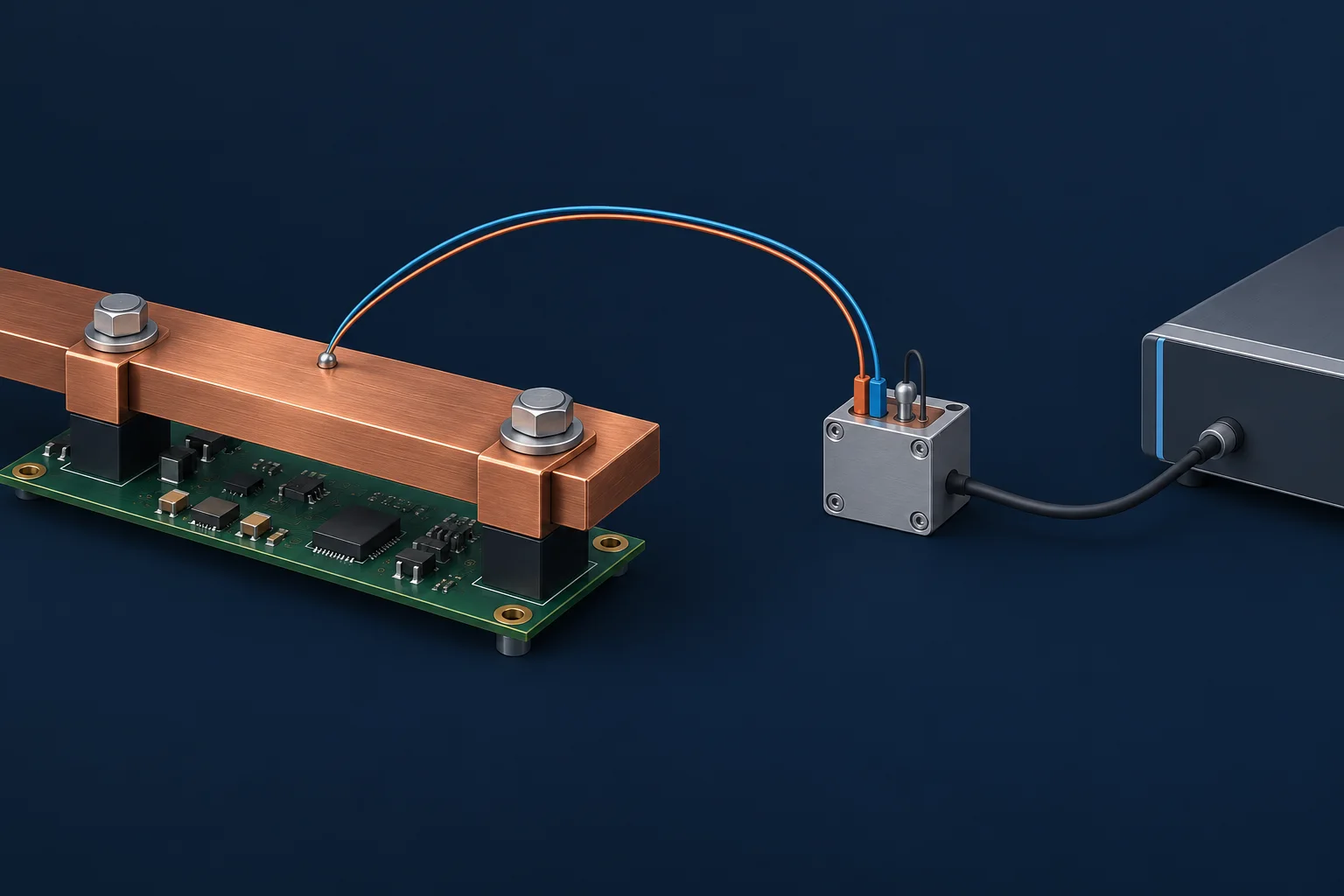
If an SMD busbar thermocouple reading changes with the terminal-box temperature, check thermocouple type, polarity, extension wiring and cold-junction compensation first. CJC accounts for the reference junction. Temperature rise still requires a separately defined ambient reference; an unverified room-temperature value cannot serve both purposes.
Locate the actual reference junction
NI's temperature-measurement guide identifies CJC and suitable signal conditioning as thermocouple requirements. The reference junction is not necessarily at room-air temperature or beside the busbar. A power supply, enclosure or air duct can heat the connection area; confirm that the compensation sensor represents the actual junctions.
A cold junction need not stay cold. Record the instrument, terminal module and channel setup, including whether CJC uses an internal sensor, external measurement or constant. A constant requires a genuinely controlled reference matching that value; changing it to cancel drift is not a valid correction.
Where copper wire begins matters
The OMEGA-CJ manual makes a useful distinction: thermocouple extension wire connects a remote probe to that compensator, while copper wire connects its output to the readout. This is device-specific wiring guidance. It demonstrates why a wiring decision must include the compensation location rather than a universal rule to use one cable everywhere.
| Location | Record | Misinterpretation to avoid |
|---|---|---|
| Probe and channel | Type, polarity, input configuration | Assuming automatic recognition |
| Probe to reference | Extension cable, connectors, transitions | Arbitrary copper substitution |
| Reference junction | CJC source, local temperature, gradients | Equating nearby air with terminal temperature |
| Ambient reference | Location, synchronized time, airflow | Using CJC temperature as board ambient |
Calculate rise separately
In a hypothetical example, busbar temperature is 75.0 °C and the specified ambient reference is 30.0 °C, giving a rise of 45.0 K. A separate terminal-box CJC sensor reading of 35.0 °C does not change that rise to 40.0 K. It serves the measurement reference, not automatically the specimen's ambient reference. This example defines quantities; it does not predict a fixed error for a particular wiring fault.
For SMD busbar comparisons, check channel agreement under safe, unpowered, thermally uniform conditions before arranging loaded measurements under an approved plan. Sensor insulation, attachment, channel isolation and common-mode limits must suit the circuit. Never attach an exposed grounded junction to an unknown live potential.
Common questions
Does a lower reading after rewiring prove better cooling? Hold load and mounting constant and verify the measurement chain first.
Does correct CJC validate a brief test? Attachment and sensor response still matter. Record the full curve as discussed in transient rise and thermal time constants.
Cover is an AI wiring illustration, not Hongchuan photography, equipment or test evidence. Example temperatures are not product ratings; instrument safety instructions remain applicable.