


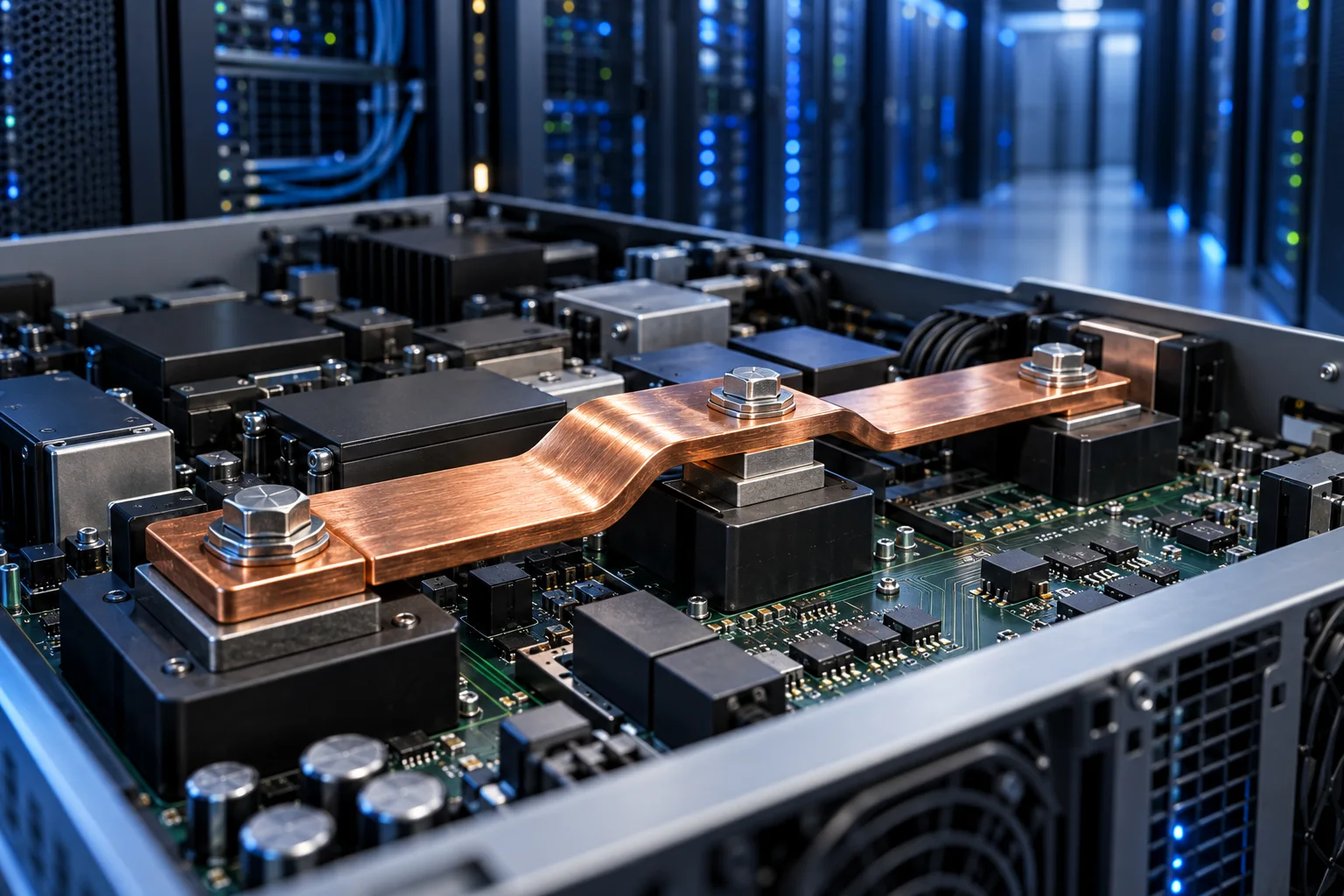
Quick answer: Select an SMD busbar for a 48V data-center power shelf by validating the complete path from parallel rectifier branches through the bus entry, pad exits, via arrays and airflow. Total cross-section alone does not prove equal branch current or stable long-run temperature.
Questions answered on this page
- Why use an SMD busbar in a 48V power shelf?
- How can parallel modules avoid uneven current?
- How do pad exits and vias control local heating?
- Which cases matter with restricted airflow?
- What should production inspection include?
Application context
Data-center shelves connect several rectifier modules to a low-voltage DC bus, batteries, backup units and server loads. An SMD busbar shortens high-current PCB paths and supports repeatable automated assembly. Hongchuan supplies SMD busbars matched to continuous current, branch current, module count, load steps, board stack-up, pads, airflow and temperature limits.
Four current-sharing checks
| Location | Review | Risk |
|---|---|---|
| Module output | Branch length, section and contact resistance | Uneven static sharing |
| Bus entry | Geometry, bends and hole positions | Different path impedance |
| Pad exit | Copper neck-down, inner layers and vias | Local hot spot |
| Cooling | Air volume, obstructions and nearby heat | Heat accumulation |
Load-step and temperature testing
Cover cold start, light and rated load, module addition or removal, load steps, backup transfer and maximum inlet temperature. Record each branch current, four-wire busbar drop, solder-leg temperature, pad exit, via field and connector temperature. If the pad exit is hotter than the bar, inspect copper neck-down and via arrays using this pad-exit troubleshooting guide.
Reflow and production validation
Thick copper changes local heat capacity and can cause unequal wetting, voids or lift. Validate stencil aperture, paste volume, coplanarity, board support and profile on the real assembly. Inspect coverage, offset, voids and pad damage, using X-ray inspection where needed. Establish branch drop, temperature and sharing baselines, repeat them after load switching and thermal cycling, and retain the same measurement points for production sampling.
FAQ
Does sufficient total cross-section guarantee sharing?
No. Branch length, joints and pad exits can concentrate current.
Does adequate fan volume prevent every hot spot?
No. Cables, heat sinks and modules alter the local flow.
What belongs in an RFQ?
Provide voltage, current, branch count, load steps, stack-up, pads, airflow and packaging. Start with the SMD busbar page.