


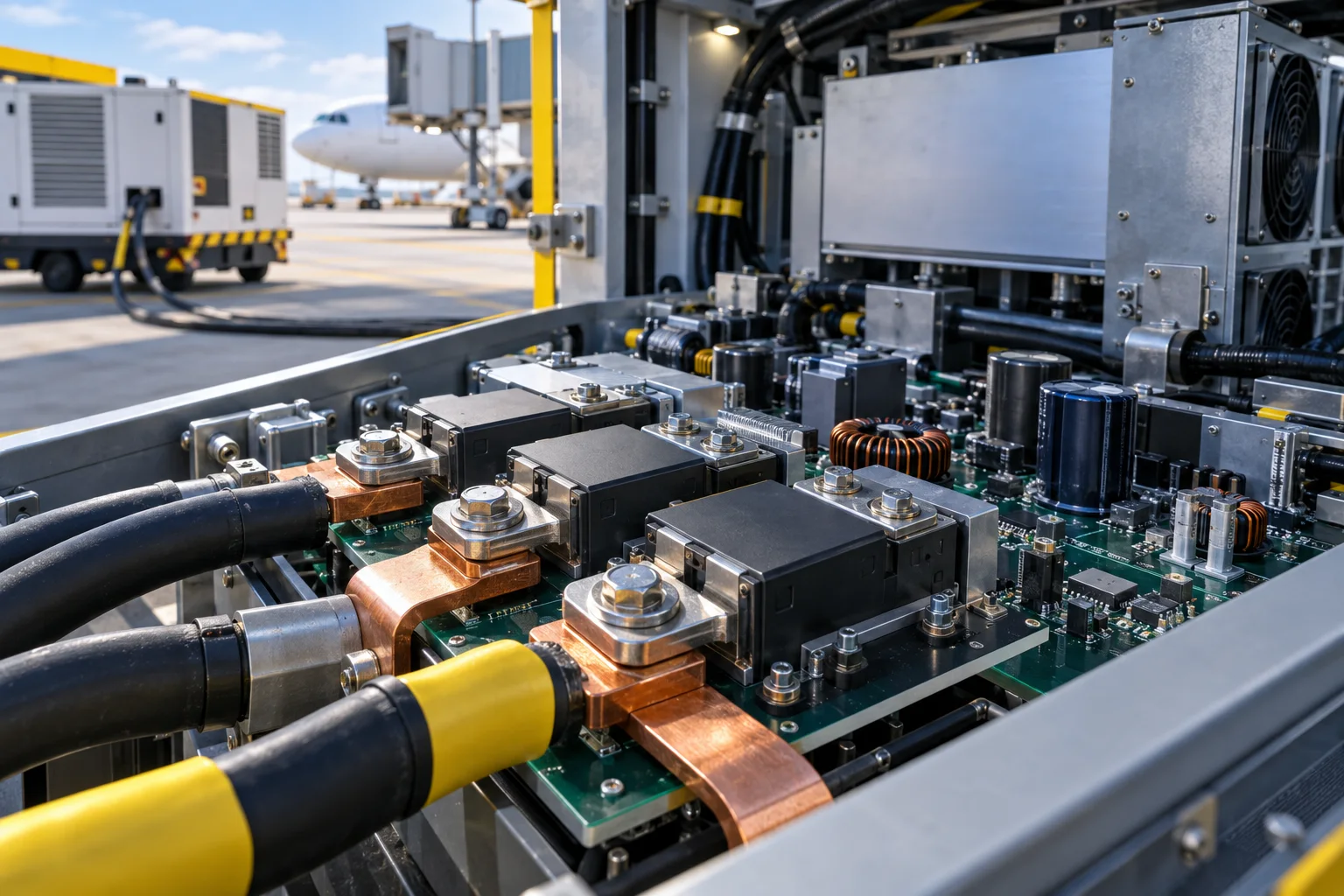
Quick answer: Select a PCB welding terminal for a 400Hz airport ground power unit by validating converter inrush, load changes, cable mass, vehicle vibration, outdoor temperature and service connection. Current rating is only the starting point; pad exits and cable support often become the first thermal or fatigue limits.
Questions answered on this page
- Why use high-current PCB terminals in a GPU?
- How do inrush and 400Hz load changes affect heating?
- How should heavy cables be supported under vibration?
- Which insulation boundaries matter with condensation?
- What should be rechecked after soldering and service?
Application context
Mobile and fixed ground power units connect input rectification, a DC link, inverter modules, filters and aircraft cables. A PCB terminal forms a compact interface to a bar or heavy cable but should not carry all cable pull and connector handling loads. Hongchuan supplies PCB welding terminals matched to voltage, continuous and peak current, start time, cable, board copper, vibration, airflow and enclosure conditions.
Four boundaries
| Boundary | Review | Risk |
|---|---|---|
| Electrical | Continuous, inrush, frequency and allowed drop | Terminal or pad heating |
| Mechanical | Cable clamp, vehicle vibration and service pull | Solder fatigue |
| Environment | Temperature, moisture, dust and condensation | Corrosion or insulation loss |
| Manufacturing | Pad, solder volume, verticality and inspection | Poor joints or offset |
Operating tests and measurement points
Cover cold start, no load, rated aircraft load, load steps, long supply time and maximum ambient temperature. Measure the terminal body, solder leg, pad exit, via field, bar joint and cable crimp, and record segmented four-wire drop. If the pad exit is hot, use this terminal overheating guide to separate terminal and PCB causes.
Vibration, condensation and service
Clamp heavy cables close to the terminal so bend radius and routing do not twist the solder joint. For outdoor equipment inspect condensation paths, drainage, contamination and spacing to the metal housing. After soldering inspect wetting, coverage, verticality and board support. Repeat low-resistance and powered temperature checks after vibration, thermal cycling and service removal.
FAQ
Is aircraft-side rated current enough for sizing?
No. Include converter start, load steps, cable support and maximum ambient temperature.
Can the terminal support the cable?
It should not be the main cable support; use an independent clamp.
What belongs in an RFQ?
Provide waveform, duration, cable, board copper, vibration, airflow and environment. Start with the welding terminal page.