


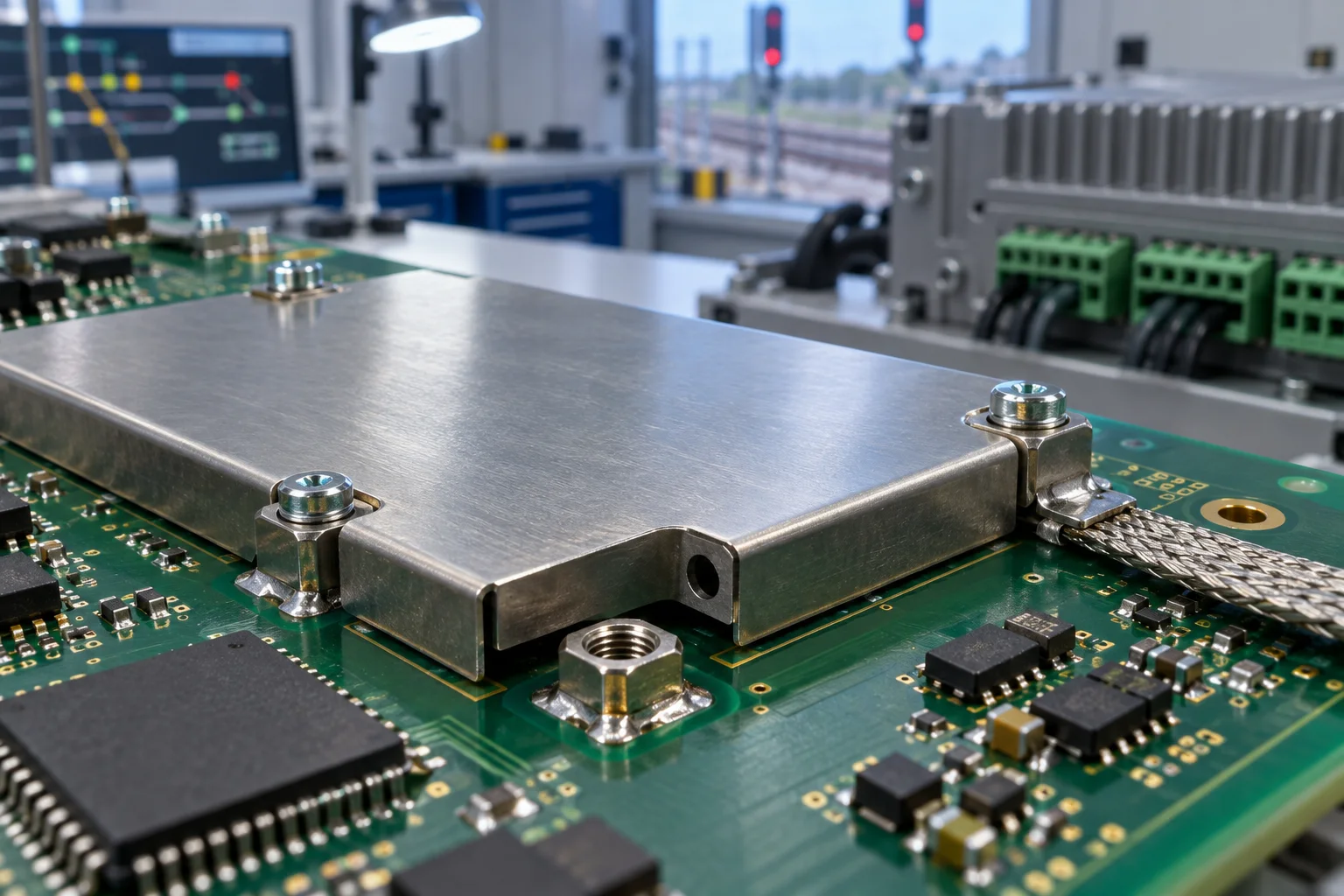
Quick answer: Do not select an SMT nut for a railway signal controller by M2 or M3 thread alone. Confirm the complete shield-screw-nut-pad-ground-plane path together with stencil, reflow, structural support, vibration spectrum, torque window and expected service cycles.
Questions answered
- How can an SMT nut support fastening and EMI grounding?
- How do pad and stencil prevent lift and solder wicking?
- How is reliability checked after vibration?
- What risks come from repeated service?
- Which production data should be retained?
Application context
Railway signal electronics may operate for long periods in vehicle or trackside vibration. An SMT nut provides an automated thread point, but the solder joint should not absorb enclosure mismatch. If it participates in EMI grounding, the finish and contact boundaries must be defined.
Four boundaries
| Boundary | Review | Risk |
|---|---|---|
| Reflow | Pad, mask, stencil, paste and profile | Lift, offset or solder in thread |
| Mechanical | Screw length, torque, backing support and vibration | Pad lift or thread damage |
| Grounding | Finish, pressure, plane and shield path | Impedance drift |
| Service | Tool, cycle count and sequence | Over-torque or contamination |
Validation
After reflow inspect coplanarity, coverage, offset, thread cleanliness and board distortion. Torque and pull tests should use production screws, washers, shields and board support. After vibration, thermal cycling and damp heat, repeat continuity, low resistance, torque capacity and crack inspection. Use this pad-lift guide for abnormal joints.
FAQ
Can an SMT nut automatically serve as protective earth?
No assumption is safe; validate the full conductive path, fault current and applicable safety requirements.
Does more torque improve vibration resistance?
No. Excess torque can damage the thread, joint or PCB.
What belongs in an RFQ?
Provide thread, board, pad, stencil, screw, torque, shield, vibration and environment. Start with the SMT nut page.