


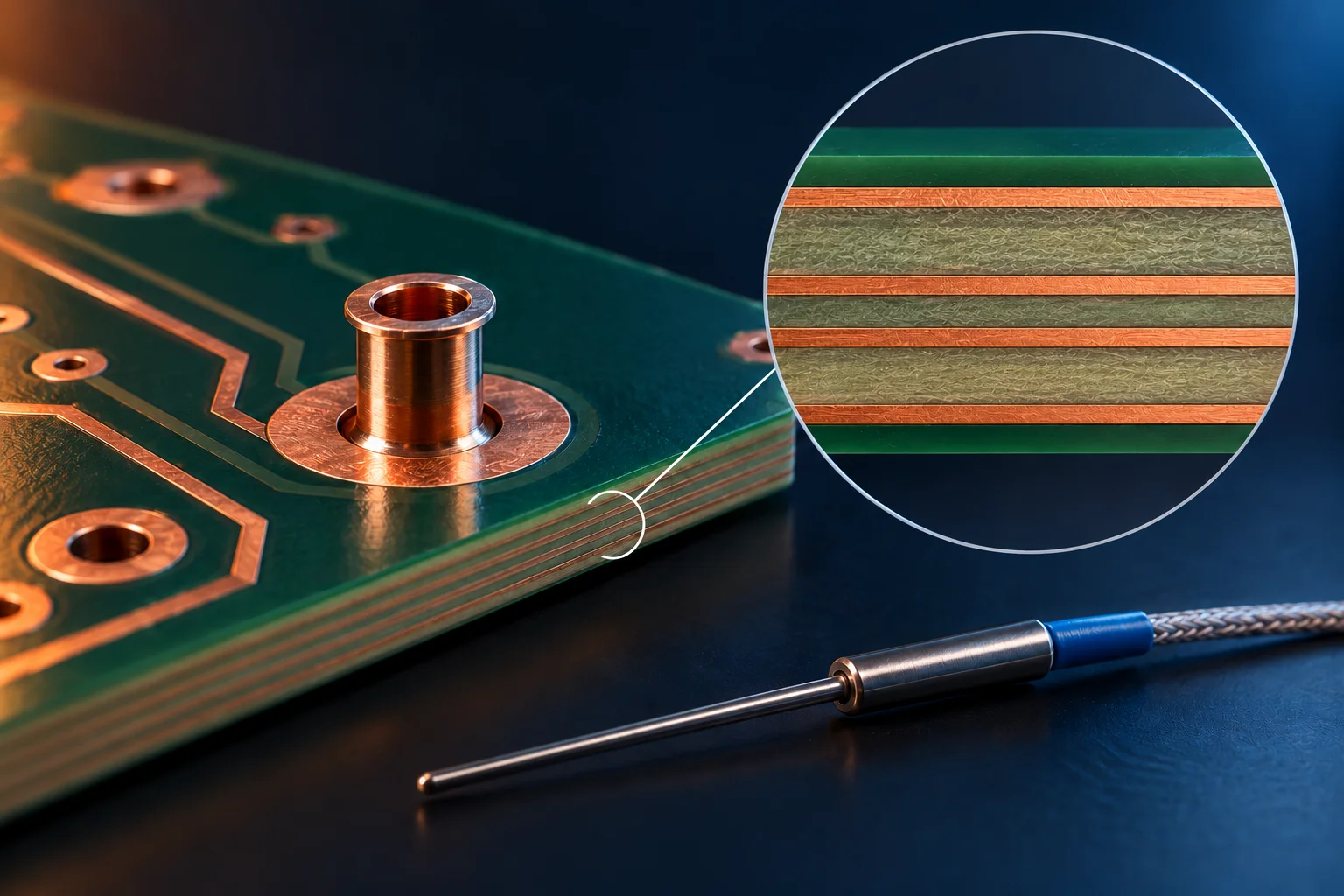
Review Tg, Td and T260/T288 separately when planning a PCB solder terminal thermal process. Tg and Td are normally reported in °C; T260/T288 report time to delamination at specified temperatures, commonly in minutes. These material tests do not independently define a soldering peak, rework count or allowed assembly exposure.
Read the units and methods
Isola's terminology guide and IS400 data use different methods for glass transition, decomposition and delamination time. Tg concerns a change in resin mechanical behaviour; Td uses mass-change information; T260 and T288 assess time at their respective temperatures. Ventec also lists the properties separately.
| Property | Meaning | Check |
|---|---|---|
| Tg | Glass-transition temperature | °C and DSC, TMA, DMA or stated method |
| Td | Defined decomposition indicator | °C, thermogravimetric method, mass criterion |
| T260 | Time to delamination at 260°C | Minutes, specimen and conditioning |
| T288 | Time to delamination at 288°C | Minutes, specimen and conditioning |
Match the measurement basis
The public IS400 table specifies DSC for Tg, TGA with a 5% mass-loss basis for Td, and TMA with copper removed for delamination time. These qualifications belong to that data. Do not assume every Td statement uses the same mass criterion or compare values while ignoring specimen preparation.
The VT-441C sheet separates specification and typical-value columns. Confirm material identity, document revision and whether a value is a typical reference or an agreed acceptance requirement. These examples explain data fields; no Hongchuan use of either laminate is claimed.
Do not turn delamination time into a soldering timer
T260/T288 concern specimens under defined methods. Actual PCB stack-up, holes, copper distribution, moisture and previous thermal history also matter, as does local terminal heating. A T260 value cannot simply be divided into a cumulative minute allowance for repeated soldering or rework.
Tg is not a stand-alone reflow peak limit. Exceeding Tg does not by itself establish failure; remaining below Td does not establish a safe process. The board fabricator, material supplier and assembly owner must approve relevant materials, thermal conditions and validation.
Connect material data to the assembly
For PCB solder terminals, retain laminate identity, stack-up, thickness, terminal/hole/land drawings, soldering method and actual temperature records. Match measurement locations to the question being evaluated. Keep machine settings separate from measured part profiles and inspect under the approved plan.
UL 94 and CTI records address different properties. Thermal-process data cannot replace electrical/material requirements or demonstrate long-term assembly life.
Questions
Can laminates with the same Tg use the same process automatically? Compare full material and construction conditions and follow controlled change validation.
Does a larger T288 permit more rework cycles? Approve actual thermal history separately; one material test cannot supply that conversion.
References
Isola terminology and test meanings; IS400 methods and specimen example; Ventec VT-441C sheet.
Cover is an AI-generated laminate concept, not a Hongchuan section or test result. No soldering temperature, rework count or service-life guarantee is provided.