


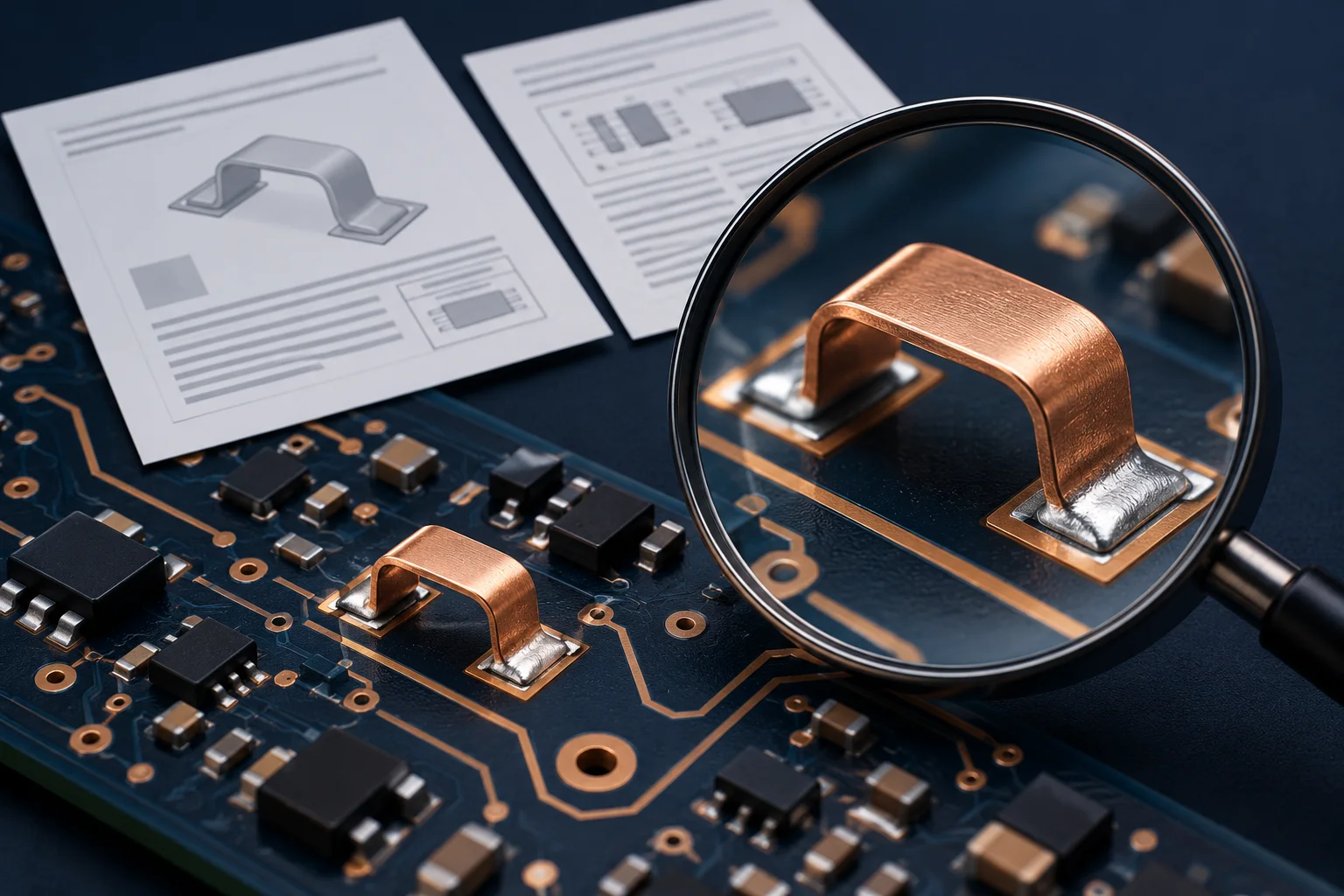
Referencing IPC-A-610 alone does not define every component and assembly acceptance requirement for a surface mount PCB jumper. Identify the part drawing, soldering process documents and assembly acceptance basis separately, including revision, class and inspection object. A standard name is not certification evidence for a jumper model.
Identify what the document evaluates
IPC's J-revision announcement distinguishes J-STD-001 soldering processes and materials from IPC-A-610 post-assembly acceptance. The public IPC-A-610J scope describes visual assembly acceptability and explicitly excludes cross-section evaluation and X-ray inspection criteria.
Ask whether a supplier's inspection statement concerns loose components, a qualification board or delivered assemblies. Additional microsection, void or mechanical requirements need their own methods, regions and limits. Do not infer them from a generic standard reference.
| Document layer | Define | Evidence |
|---|---|---|
| Incoming component | Part, drawing revision, material, dimensions | Batch-related inspection or declaration |
| Soldering process | Approved process, materials, documents | Process revision and required parameters |
| Assembly acceptance | Standard revision, class, inspection object | Results and defect disposition |
| Additional validation | Functional, mechanical or other method | Conditions, samples and actual results |
Use the class with the complete document
If a purchase order states Class 3, identify the document, revision and deliverable to which it applies. A material declaration, personnel training certificate and assembly acceptance record concern different subjects. They are not interchangeable evidence.
This page uses public descriptions and scope information, not unavailable detailed criteria. It provides no solder-coverage percentage or universal mechanical limit. The parties must use complete documents to confirm class-specific requirements, special-design applicability and document precedence.
Connect component identity to assembly records
For surface mount PCB jumpers, distinguish overall length, functional span and clearance using drawing-defined dimensions in mm. Record material, finish and supply condition separately. Link PCB revision, component lot, soldering process and inspection results rather than retaining an untraceable joint photograph alone.
If a microsection is required, define the target joint and observation plane first. Jumper microsection sampling addresses this planning. One local section does not automatically satisfy separate electrical or mechanical requirements.
Questions
Does a supplier's training certificate prove delivered-board conformity? Confirm certificate scope and actual delivery inspection separately. Personnel credentials do not establish an assembly result.
Can a referenced revision be changed unilaterally? Use the agreed change process and retain revision approvals.
References
IPC J-revision process and acceptance announcement; Public IPC-A-610J contents and scope.
Cover is an AI-generated document/inspection concept, not Hongchuan certification or acceptance evidence. No product IPC-class certification is claimed.