

Estimating PCB copper busbar radiation requires surface temperature, radiative surroundings, exposed area and applicable emissivity. For a uniform diffuse gray surface approximated as a small object inside a large isothermal enclosure, outward net power is P=εσA(Ts4−Tsur4). Use kelvin and m². Radiation is one part of the assembly heat balance.
Identify the surfaces exchanging radiation
COMSOL's surface-to-ambient boundary documentation and FLIR's thermography theory explain emission and incoming radiation from the surroundings. A hotter busbar can lose heat this way; hotter nearby surfaces can supply heat to it. Enclosure air temperature does not necessarily describe every radiating surface seen by the bar.
The expression above assumes opaque diffuse-gray behavior and a suitable large-enclosure approximation. Here ε is the applicable total hemispherical emissivity and σ is approximately 5.6704×10⁻⁸ W/(m²·K⁴). Obstructions, multiple nearby temperatures and reflections may require a surface-to-surface model. Do not assign every face an unobstructed view of room-temperature surroundings.
A hypothetical 10 cm² calculation
Assume A=10 cm²=0.001 m², surface temperature 80 °C, large isothermal surroundings at 25 °C, and ε=0.20. Converting to 353.15 K and 298.15 K gives approximately 0.087 W outward net radiation. The emissivity is an assumed input, not a measured value for any Hongchuan model.
| Input | Example | Required evidence |
|---|---|---|
| Temperatures | 353.15 K and 298.15 K | Surface and radiative surroundings separately |
| Area | 0.001 m² | Surfaces actually exchanging radiation |
| Emissivity | Assumed dimensionless 0.20 | Applicable finish, temperature and data basis |
| Result | About 0.087 W | Net radiation under these assumptions only |
Keeping the other assumptions but raising the surroundings to 100 °C gives about −0.043 W. The negative sign means net radiation enters the bar. Take each absolute temperature to the fourth power separately; do not substitute the fourth power of a Celsius temperature difference.
Use surface area rather than electrical cross-section
Electrical cross-section informs resistance and current density. Radiation uses external area. Soldered interfaces, PCB-facing surfaces and obstructed faces need their actual exchange conditions. Multiplying length, width and thickness gives volume, not radiating area.
Finish and surface condition can affect emissivity. A camera's spectral-band emissivity setting is not automatically a total hemispherical value. Do not alter solderable or electrical contact surfaces merely to improve a model's radiation term.
Keep the installation assumptions with the result
For SMD/SMT PCB busbars, retain enclosure and PCB revisions, area assignments, finish and temperature evidence. Include solder, PCB, air and cooling paths. Opening a cover changes the surroundings seen by the part, so validate the installed condition.
Busbar thermal property units address conduction inside materials. Radiation boundaries provide another input to the complete thermal assessment.
Common questions
Does high copper conductivity remove the need to specify surroundings? No. Conduction and radiation describe different processes.
Does 0.087 W justify a higher current rating? It does not establish a rating. Use a complete heat balance and appropriate assembly validation.
References
COMSOL surface-to-ambient radiation; FLIR thermography reference, section 7.3.
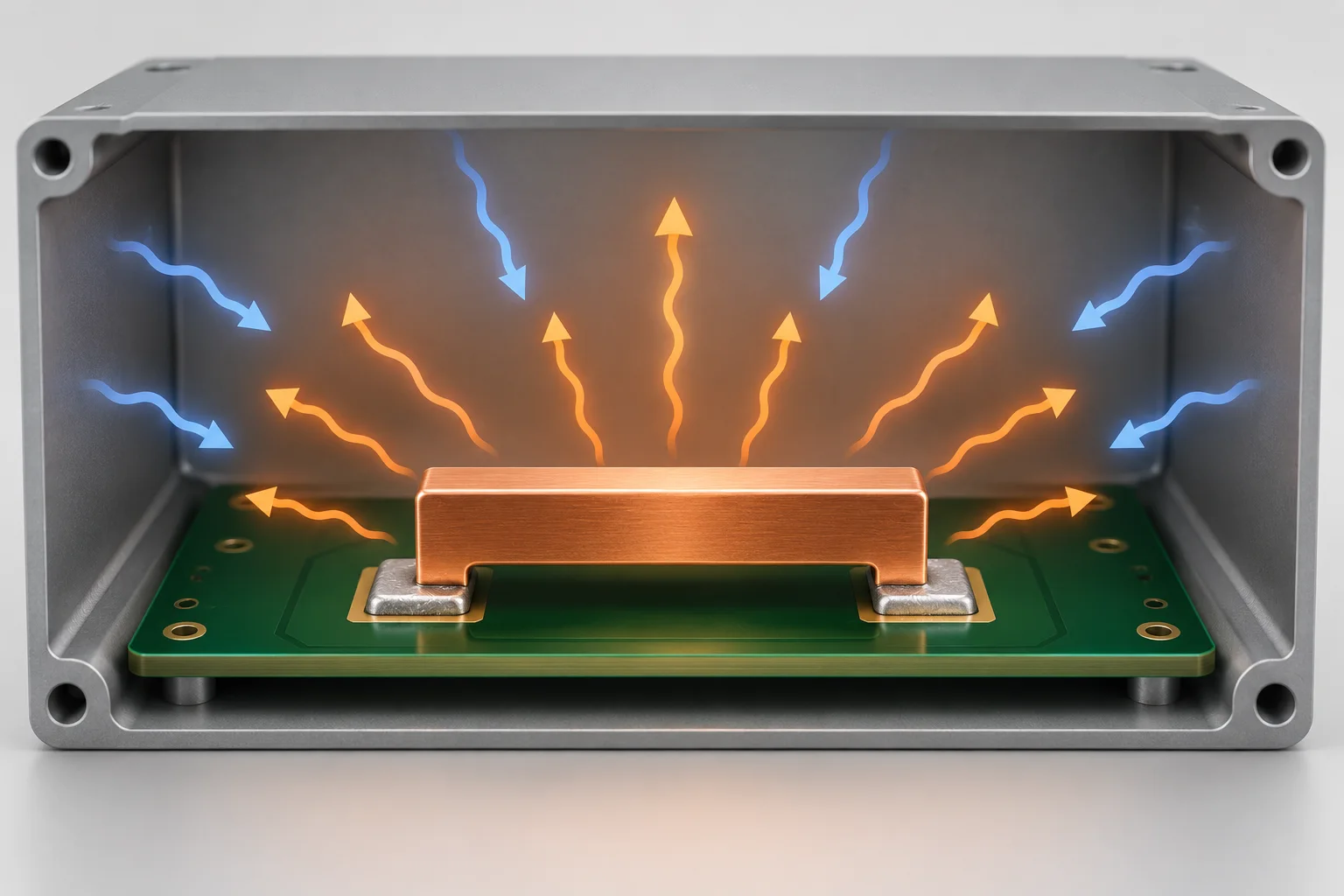
The cover is an AI concept illustration. Arrows are not measured heat flux or a Hongchuan test. All calculation inputs are hypothetical and imply no product rating.