


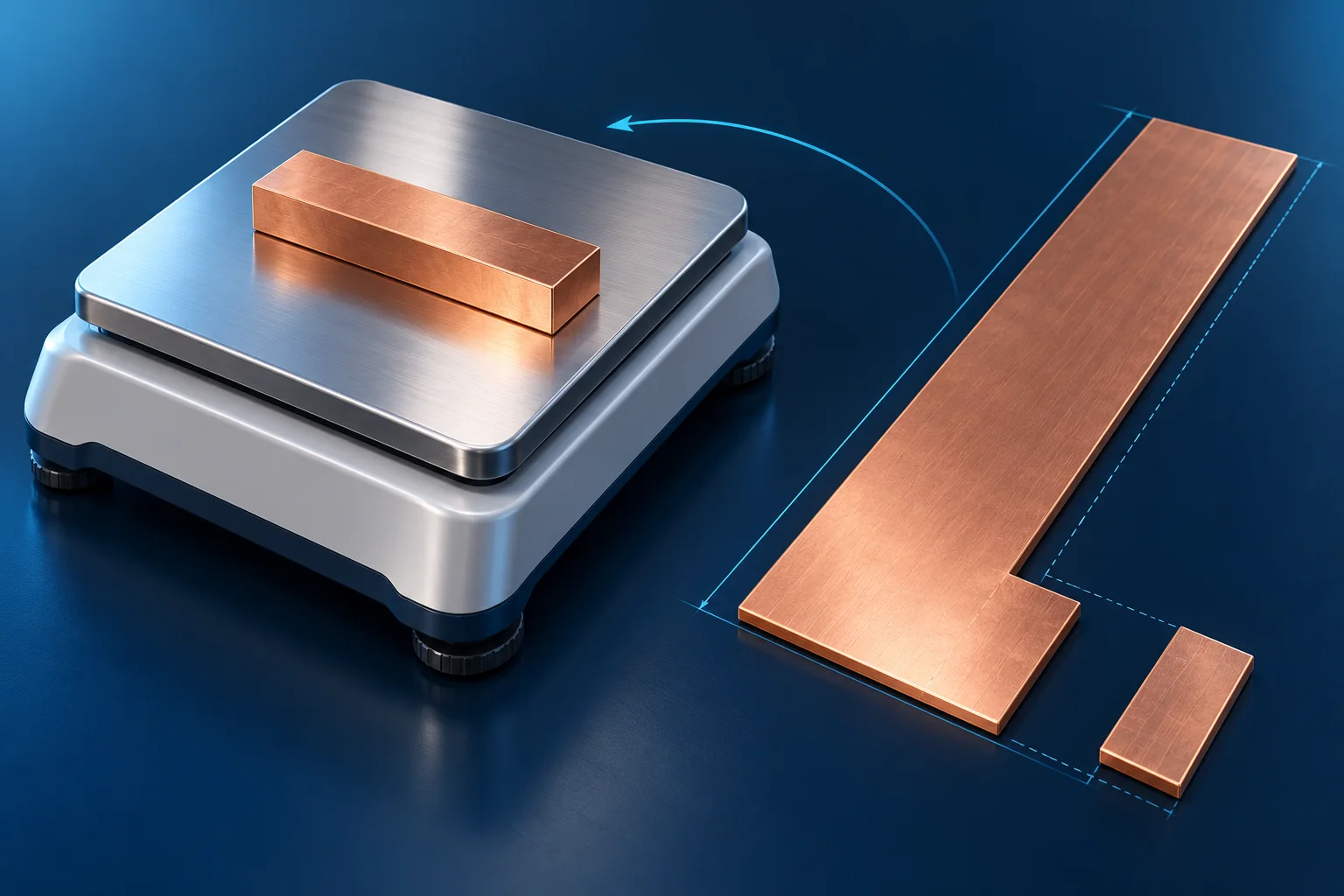
Theoretical PCB copper busbar net mass can be estimated with m=ρV. Quoted material consumption additionally depends on nesting, process losses and the agreed commercial scope. State finished-part net mass, raw input and packed gross mass separately. Multiplying finished grams by a copper price does not establish a complete manufactured-part quotation.
Match density to a material reference
The Aurubis Cu-ETP material sheet lists density as 8.9 g/cm³. That is a reference for the identified material, not proof of a Hongchuan lot's composition. Copper, brass and copper-aluminum parts must not share one assumed density indiscriminately.
A hypothetical unplated rectangular strip, without holes or chamfers, measuring 50×10×2 mm has volume 1000 mm³=1 cm³. With that reference density, theoretical mass is 8.9 g. These are calculation dimensions, not an available model. Specify g or kg explicitly when purchasing documents use the everyday word “weight.”
Keep quotation quantities separate
| Quantity | Suggested unit | Scope |
|---|---|---|
| Theoretical net mass | g/part | Specified model and density |
| Measured finished net mass | g/part | Defined coating and accessory condition |
| Allocated input material | g/part or kg/batch | Agreed manufacturing boundaries |
| Shipping gross mass | kg/carton | Parts, tape, reels and packaging |
Define yield before calculating consumption
If mass yield is defined as η=accepted bare-part mass/allocated raw input mass, average input per part is min=mnet/η. With hypothetical net mass 8.9 g and η=80%, input is 11.125 g, approximately 11.13 g per part. The yield is an assumed input, not a Hongchuan capability or industry default.
Nesting-area utilization is not necessarily this mass yield. Agree whether strip edges, webs, setup material and rejected parts are included, and how recovered scrap is credited. The equation excludes forming, plating, inspection, tooling and packaging charges and does not determine scrap ownership.
Check CAD mass rather than copying it blindly
Autodesk's body-properties documentation identifies density, mass and volume separately and notes calculation-accuracy settings. Check physical material, units, revision and selected bodies. Copper-colored appearance alone is not evidence that copper density was assigned.
Holes, chamfers, additional bodies and unmodeled coatings affect scope. For a weighing comparison, document balance resolution, calibration, tare, sample count and part condition. Similar mass does not establish correct dimensions, alloy or electrical performance.
Make RFQs comparable
For custom PCB copper busbars, provide finished drawings, material condition, model revision, pre- or post-plating dimensions, quantity and packaging. Request an explicit pricing scope. See the custom stamping RFQ checklist.
Questions
Does lower mass prove missing material? Check alloy, actual dimensions, removed features and weighing condition before assigning a cause.
Can theoretical net mass be used as shipping gross mass? No. Use the applicable packed and measured basis for shipping documents.
The AI-generated cover is a mass-and-consumption concept, not a Hongchuan weighing record or quotation. Examples are not mass, yield or price commitments.