


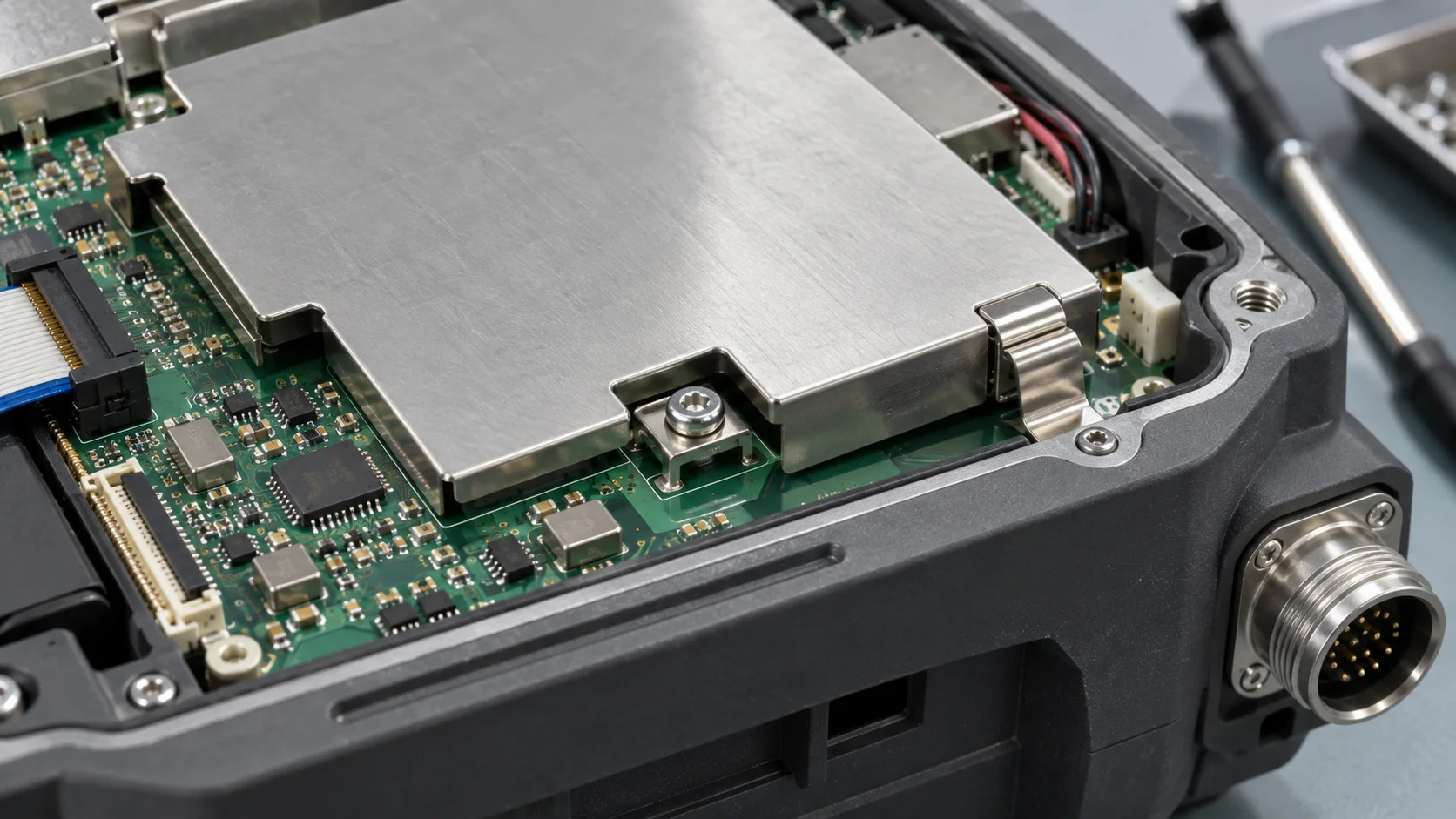
Quick answer: Select SMT nuts for a LiDAR surveying controller by validating shield fastening, ground return, optical and connector clearance, and service reliability after outdoor vibration. Low height must still provide engagement, pad load, spring pressure and board-tolerance margin.
Questions answered on this page
- Why use SMT nuts in LiDAR controllers?
- How should shield fastening and EMI grounding be separated?
- How can a low nut clear connectors and optics?
- How can thread fill, offset and pad lift be prevented?
- How should outdoor vibration and service be repeated?
Application context
LiDAR surveying controllers include high-speed interfaces, clocks, laser drivers, receiver chains and power conversion. A metal shield controls coupling, while an SMT nut provides a removable fastening point for scanner, cable or board service. Coordinate the nut with optics, connectors, seals and tools. Hongchuan supplies SMT nuts matched to board, screw, shield, pad, height, spring, torque, vibration and environment.
Four functional paths
| Function | Parts | Validation |
|---|---|---|
| Fastening | Screw, nut, pad and shield | Torque, pull, shear and bend |
| Grounding | Shield, spring, ground copper and housing | Low resistance and far-edge continuity |
| Clearance | Nut, connectors, optics and seals | Height, tolerance and assembly |
| Service | Tools, cables and cycles | Post-cycle movement and resistance |
Low height, pad load and enclosure
Lower is not always better. Check engagement, screw-head space, shield flange, connector mating, optical clearance and seal compression. A small pad concentrates torque; an oversized pad can consume high-speed routing or insulation. With the final board and enclosure, test pull, shear, torque, ring crack and bend. See SMT nut pad and torque troubleshooting.
Grounding, reflow and vibration service
After assembly measure low resistance from nut, near and far shield edges, spring, PCB ground and housing. After reflow inspect base coverage, offset, thread cleanliness, pad edge and board underside. After outdoor vibration, thermal cycling, cable replacement and repeated service, repeat ground resistance, shield movement, torque retention and connector clearance. Noise cannot be solved by changing the nut alone; inspect shield gaps and high-frequency return as well.
FAQ
Does strong soldering guarantee shielding?
No. Fastening and ground continuity are separate checks.
How can a low nut avoid optical interference?
Review nut, screw head, shield, connector and optical structure in one tolerance chain.
How should samples be specified?
Provide board, screw, shield, pad, torque, spring, vibration and sealing details. Start with the SMT nut product page.