


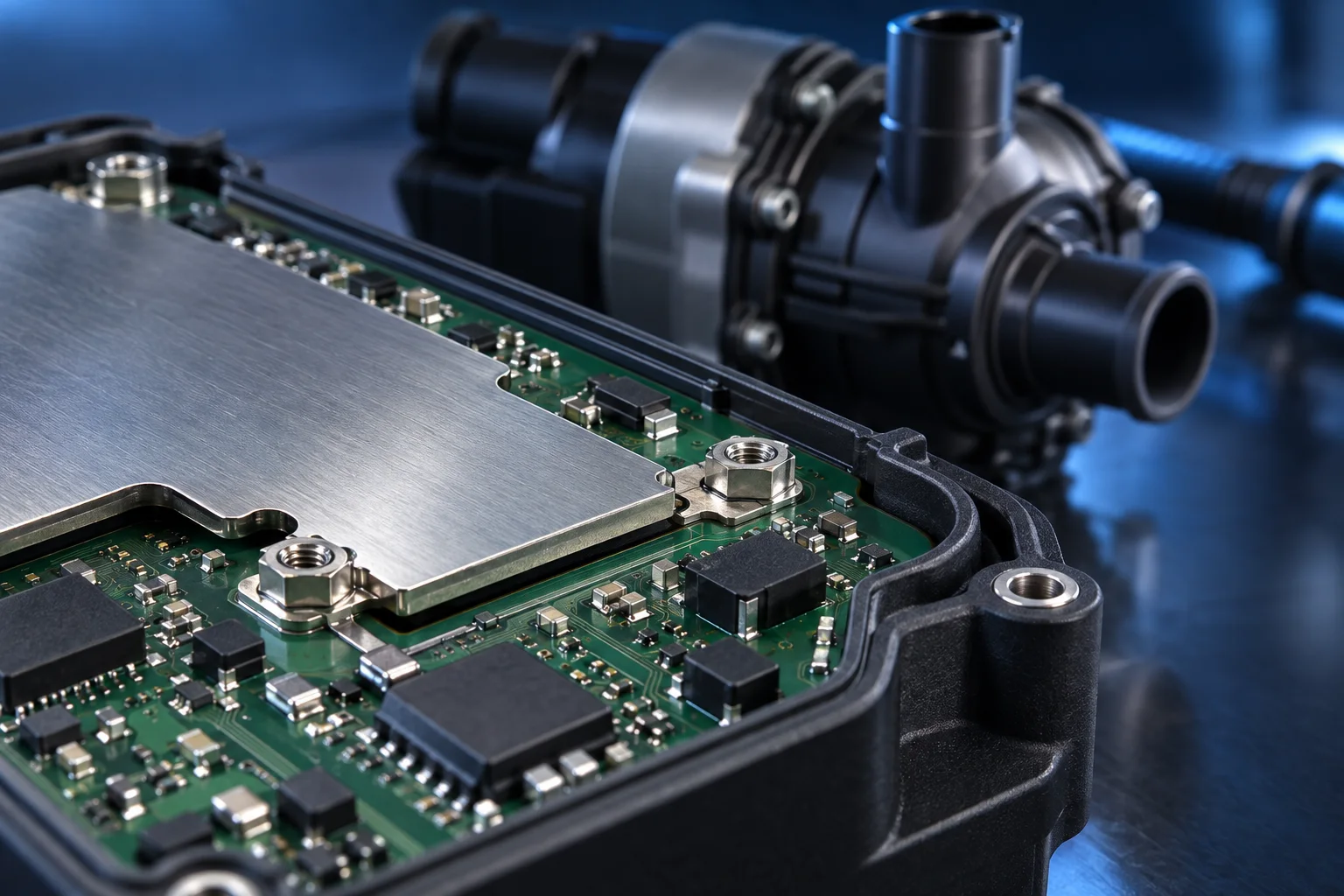
Quick answer: Select an SMT nut for an EV coolant-pump controller by checking the full shield-to-ground path, PCB thickness, pad and stencil, reflow balance, screw torque, pump vibration and expected service removals. Thread size alone is not enough.
Questions answered on this page
- Why use SMT nuts in a coolant-pump controller?
- Can one nut support fastening and shield grounding?
- How do pad and stencil reduce lift, offset and wicking?
- How should torque be validated after vibration and cycling?
- How is grounding continuity checked after service?
Application context
An electric coolant-pump controller integrates motor drive, sensing, communication and protection near the motor and coolant circuit. An SMT nut provides an automated threaded point for a shield, heat spreader or bracket, but the solder joint should not carry housing distortion or harness pull. Hongchuan supplies SMT nuts matched to thread, board, pad, stencil, screw, torque, shielding, vibration and temperature.
Four design boundaries
| Boundary | Review | Risk |
|---|---|---|
| Soldering | Pad, mask, stencil and profile | Lift, offset or poor joint |
| Mechanical | Torque, screw length, support and vibration | Pad lift or thread damage |
| Grounding | Finish, contact surface and shield path | Unstable impedance |
| Service | Removal count, tool and sequence | Over-torque or contamination |
Pad, reflow and torque window
The pad needs enough area for wetting and visible inspection without excessive paste entering the thread or lifting the part. After reflow inspect coplanarity, coverage, offset, thread cleanliness and board distortion. Torque testing must use the production screw, washer and support, not only a nut on a bare board. Use this pad-lift troubleshooting guide for crack analysis.
Shield grounding and durability
If the nut participates in shielding, define the complete path through nut, solder, pad, ground plane and housing, then measure continuity or low-frequency resistance after assembly. Cover pump start-stop, speed change, vehicle vibration, thermal cycling and humidity. After service removal repeat torque, thread, solder-joint and grounding checks.
FAQ
Can an SMT nut act as a grounding post?
It can participate only after the finish, pad, plane and housing contact path is validated.
Does more torque improve reliability?
No. Excess torque can damage the thread, solder joint or PCB pad.
What belongs in an RFQ?
Provide thread, board, pad, stencil, screw, torque, shield structure and environment. Start with the SMT nut page.