
Direct answer High-conductivity copper is often evaluated when conductor loss is a priority. A stamped contact that also needs complex forming or spring behavior requires strength and formability checks as well. Copper.org lists C11000 at 101% IACS and C26000 at 28% IACS at 68°F. These are published material values, not measurements for a Hongchuan part.
For an SMD busbar or PCB terminal, alloy designation alone does not predict assembly temperature rise. Section geometry, joints, solder connections and cooling also matter.
| Published material data | C11000 | C26000 |
|---|---|---|
| Common name | ETP copper | Cartridge brass |
| Conductivity at 68°F | 101% IACS | 28% IACS |
| Thermal conductivity at 68°F | 226 Btu·ft/(h·ft²·°F) | 70 Btu·ft/(h·ft²·°F) |
The values come from Copper.org alloy records. Verify product form, temper and lot against the material certificate and purchasing specification. IACS is a reference scale for electrical conductivity.
Consider the forming operation
C26000 is a copper-zinc brass that Copper.org lists for connector applications and describes as capable of cold work. C11000 has higher published conductivity and is also used in cold-worked products. The right material depends on whether the part is stamped, bent, expected to retain spring force or carries fastening load. Temper affects finished strength and forming behavior.
For a bent strip, also review bend radius and material condition. The alloy code does not replace drawing requirements for thickness, temper and forming.
Put material requirements in the drawing
- State the material standard and grade rather than “high-conductivity copper” alone.
- Specify thickness, temper and any permitted substitution.
- Identify whether a material certificate, conductivity or hardness record is required.
- Review plating, contact areas and joining process as separate requirements.
Common questions
Does 101% IACS mean a finished busbar has a fixed current rating?
No. Conductivity does not include part dimensions, joint resistance, ambient temperature or allowable temperature rise.
Can C11000 and Chinese T2 be treated as identical?
Do not substitute grades by name alone. Confirm the applicable standards, composition and temper, then state acceptable equivalents in the purchasing document.
Sources
- Copper.org C11000 alloy data
- Copper.org C26000 alloy data
- Copper Development Association conductivity guide
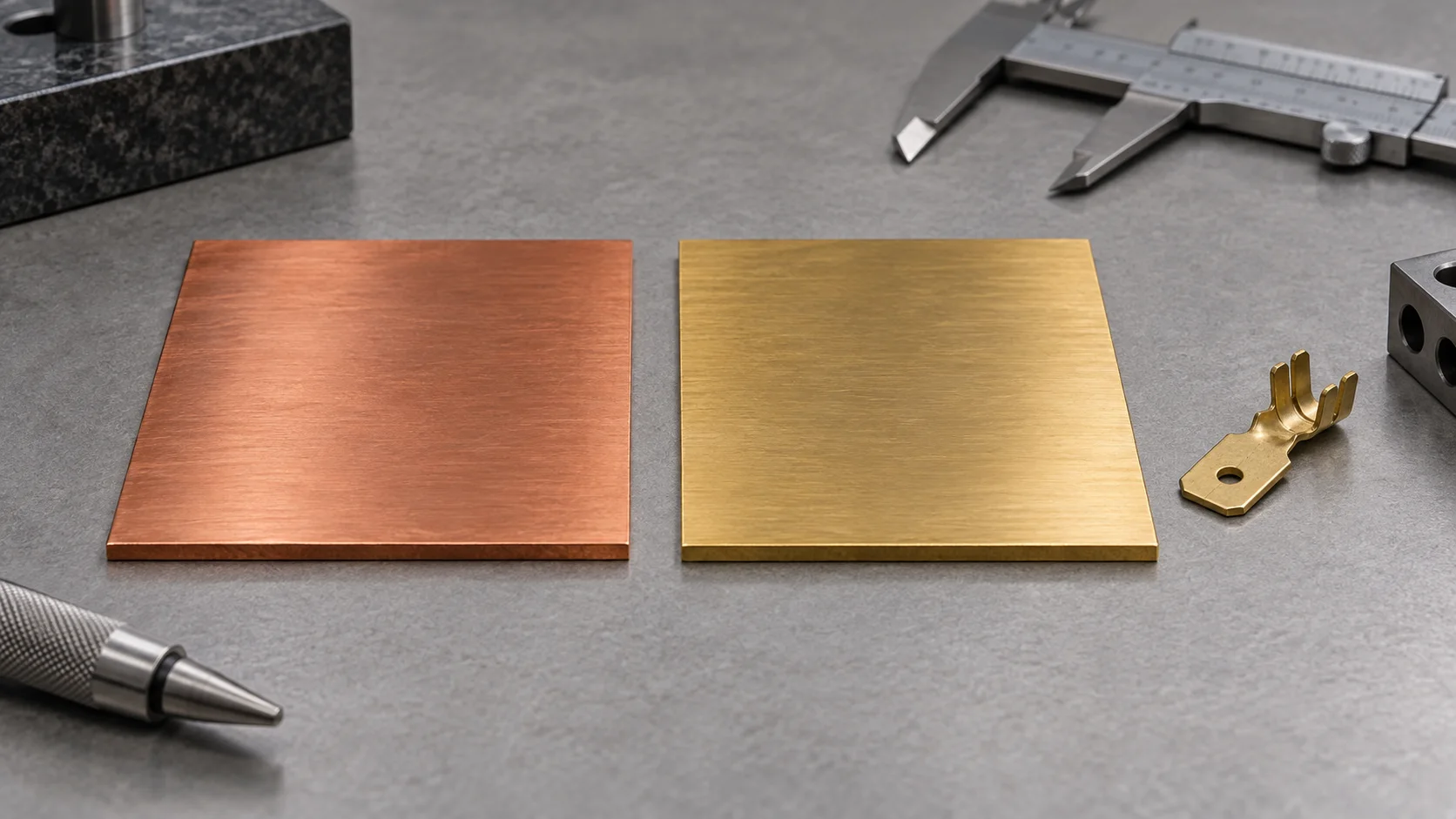
The cover is an AI-generated material concept, not a product composition or test result.