

Quick answer: Select an SMD busbar for an arc-welding inverter by considering ignition peak, welding current, duty cycle, DC-link ripple, airflow and metal dust together. Beyond bar section, validate pad exits, loop area, insulation spacing and reflow quality.
Questions answered on this page
- Why use an SMD busbar in a welding inverter?
- How do ignition pulses and duty cycle affect temperature?
- How should the DC-link loop connect to power modules?
- Which insulation and cooling risks come from metal dust?
- What belongs in post-reflow production inspection?
Application context
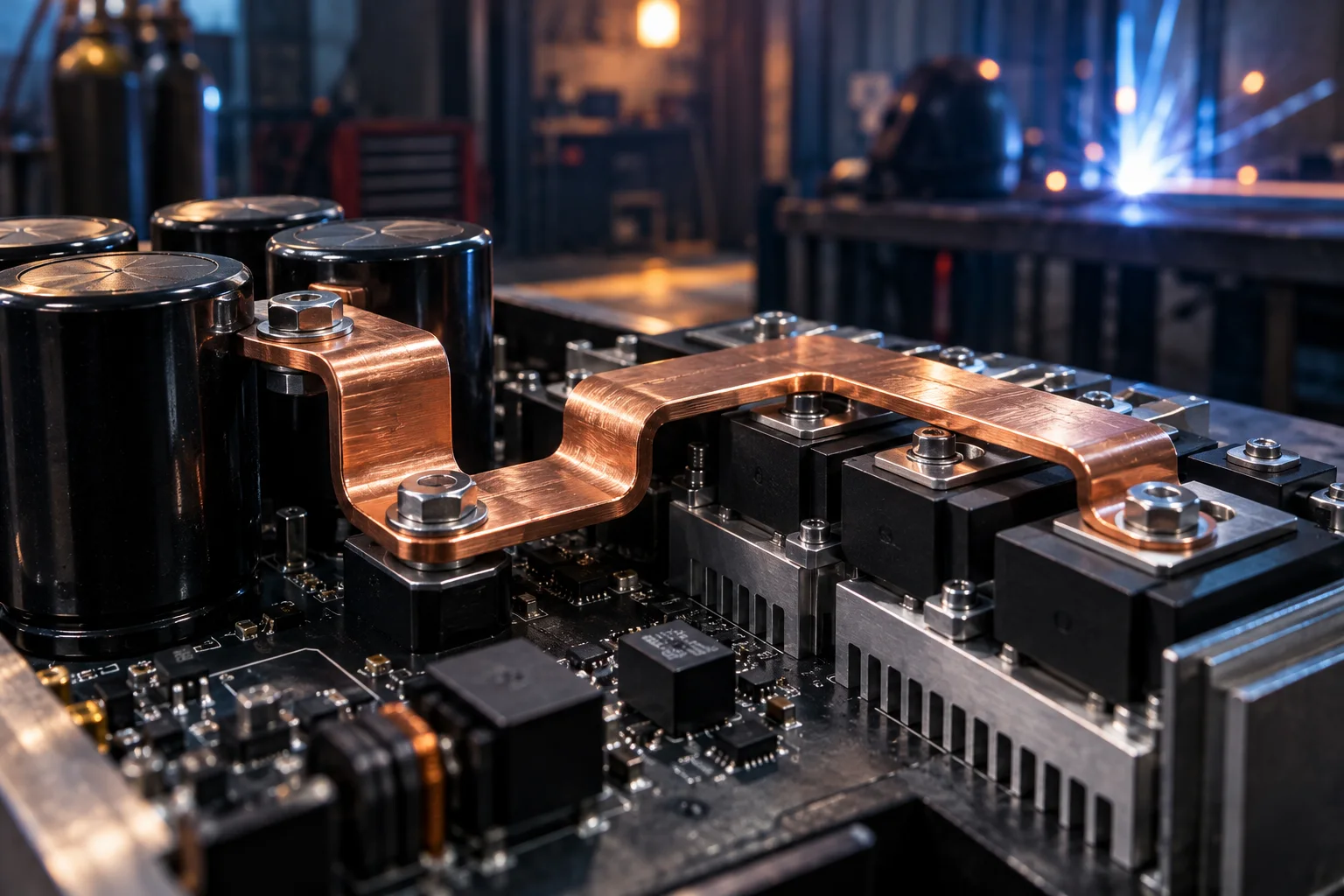
An arc welder rectifies the input and uses DC-link capacitors and a high-frequency inverter to control welding current. An SMD busbar shortens the path between capacitors and switches and reserves predictable space for heat sinks, airflow and insulation. Hongchuan supplies SMD busbars matched to voltage, current range, ignition peak, duty cycle, switching frequency, board copper, pads, airflow and dust protection.
Four control points
| Area | Review | Risk |
|---|---|---|
| DC link | Capacitor exits, positive and return loops, ripple | Drop and parasitics |
| Pad exit | Copper neck-down, inner layers and vias | Local hot spot |
| Insulation | Dust, metal debris, cleaning and spacing | Creepage or short |
| Manufacturing | Stencil, placement, reflow and inspection | Void, offset or poor wetting |
Temperature under pulsed load
Cover idle, ignition, several welding currents and duty cycles, continuous work and maximum ambient temperature. Measure the bar, solder legs, pad exits, vias, capacitor ends and power-module ends while recording ripple and segmented drop. If heat concentrates at the pad exit, inspect neck-down and via reception using this pad-exit guide.
Dust, reflow and durability
Metal dust can block airflow and shorten insulation paths, so validate filtration, cleaning interval, coating boundaries and realistic accumulation. Thick copper absorbs reflow heat; confirm stencil aperture, paste, coplanarity and profile on real boards. After powered operation, thermal cycling, vibration and dust exposure, repeat drop, temperature, insulation and solder-joint checks.
FAQ
Can maximum welding current size the bar?
Not alone. Ignition peak, duty cycle, ripple, pad exit and airflow also matter.
Does conformal coating remove metal-dust risk?
No. Coating boundaries, joints, heat sinks and real accumulation still require validation.
What belongs in an RFQ?
Provide voltage, current, ignition waveform, duty cycle, board copper, pads, airflow and environment. Start with the SMD busbar page.