


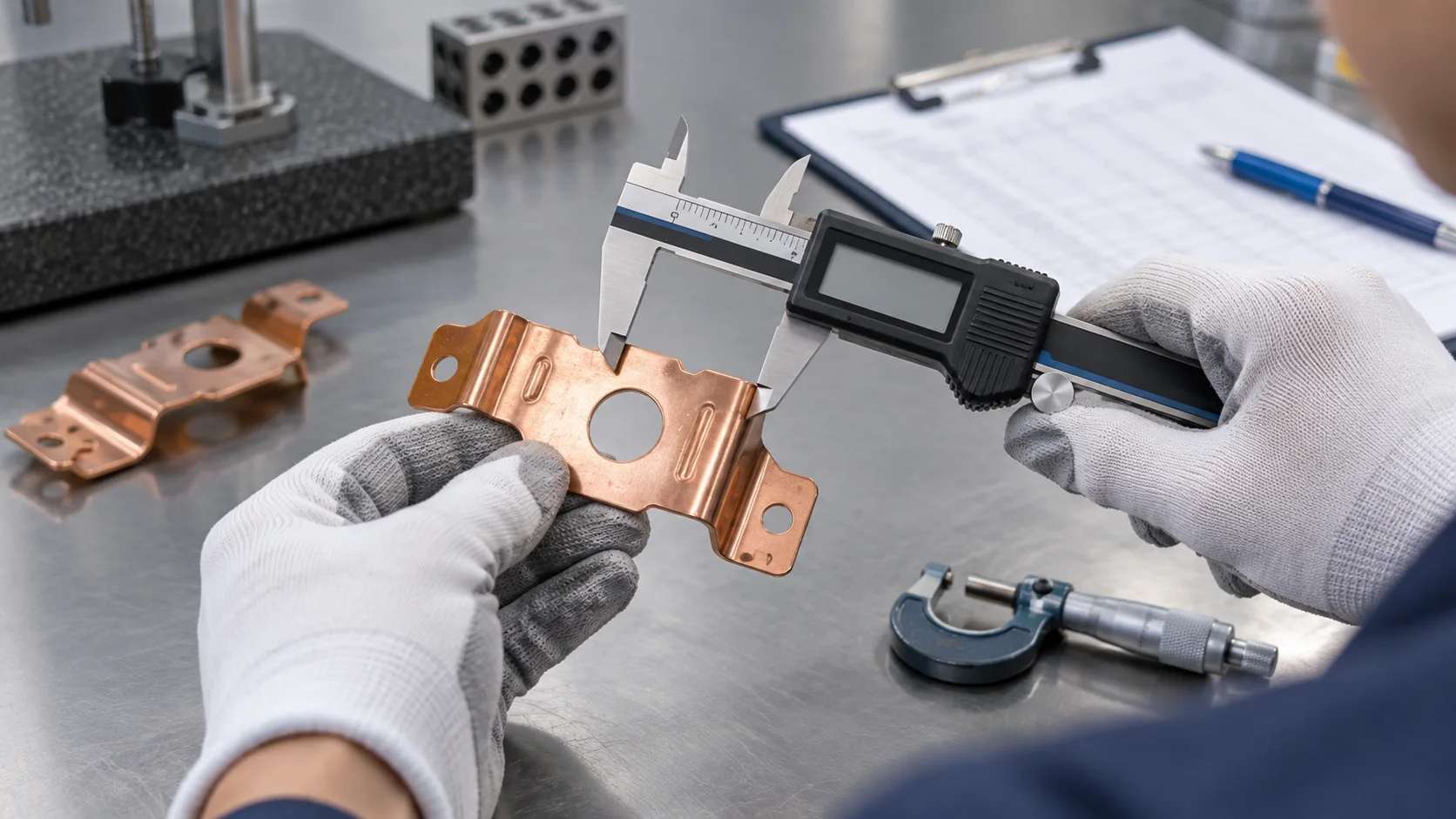
Direct answer Start first-article review by confirming the sample against the controlling drawing revision. Check critical dimensions, datums, material and finish records, then document deviations and their disposition. AS9102C is an aerospace first-article standard; use it for other projects only when the contract or customer requirements call for it.
A first-article record lets both parties discuss the same sample and requirements. It does not prove that every later lot will conform or replace production controls.
Connect the sample to its revision
Identify the part number, sample lot, material lot, process condition and controlled drawing revision. If the 2D print, 3D model or purchase specification is inconsistent, agree which document controls. An accurate measurement against the wrong revision still answers the wrong question.
Inspect dimensions in functional order
Record critical dimensions against drawing or balloon numbers. Begin with assembly interfaces, hole locations, contact faces, bend locations, stock thickness and geometry that controls seating. State the gauge or method. For geometric controls, use the datum system defined on the drawing. ISO 1101 defines a symbol language and interpretation rules; a photo alone is not a dimensional report.
| First-article record | Why it matters |
|---|---|
| Part number and drawing revision | Connect the sample to its acceptance requirements |
| Sample and material lot | Make results traceable to the submitted part |
| Key dimensions and method | Map readings to drawing features and datums |
| Material and finish | Check the supplied condition against the order |
| Deviation and disposition | Record approval for rework, concession or resubmission |
Close deviations in writing
For an out-of-tolerance result, record the actual value, requirement and affected function. An authorized person should decide whether the part is reworked, the drawing is changed or a temporary deviation is approved. A supplier change to material, radius, plating or measurement datum should not be treated as approved merely because the shipment was received.
When an order invokes AS9102C, follow that standard and the customer's process. Other programs may use their own report forms; state dimension scope, sampling, material records and approval roles in the purchasing documents.
Common questions
Does an accepted first article prove stable production?
No. First-article review addresses initial conformance. Later lots still need the agreed process controls and inspection frequency.
Can production start before an out-of-tolerance result is approved?
Follow the contract and quality process, and obtain a documented disposition before treating the deviation as released.
Sources
- SAE AS9102C scope and revision information
- ISO 1101 scope for geometrical tolerance symbols
- SAE dimensional-inspection standards topic
The cover is an AI-generated dimensional-inspection concept, not Hongchuan equipment, a report or certification.