


A “Kgf” entry alone cannot be converted directly into SMT nut torque in N·m. kgf is a force unit; torque also requires a length unit. For complete units, 1 kgf·cm = 0.0980665 N·m and 1 N·cm = 0.01 N·m. Verify whether the value refers to installation or a torque-out test.
Resolve the original label
Retain the source document and ask its issuer to clarify “Torque (Kgf).” Do not guess whether cm or m was omitted. Identical numbers expressed in kgf·cm and kgf·m differ by a factor of 100 in torque. kg alone denotes mass.
NIST's SI explanation identifies N·m as the moment-of-force unit. NIST SP 811 conversion tables give 1 kgf = 9.80665 N and the kgf·m conversion. Combining these with centimeters-to-meters gives the following factors.
| Original unit | Multiply to obtain N·m | Check |
|---|---|---|
| N·m | 1 | Same torque definition |
| N·cm | 0.01 | Convert centimeters |
| kgf·cm | 0.0980665 | Convert force and length |
| kgf·m | 9.80665 | 100 times the kgf·cm factor |
| kgf / Kgf only | No direct torque conversion | Resolve missing information |
Keep a transparent calculation trail
A hypothetical 5 kgf·cm converts to 0.4903325 N·m, or 49.03325 N·cm. By contrast, 5 kgf·m converts to 49.03325 N·m. These examples are not Hongchuan installation limits.
Retain the original value, full unit, converted value and rounding rule. Arithmetic decimal places do not establish measurement precision. Production-tool settings require an approved process range, suitable resolution and calibration.
Units do not establish test equivalence
Check the specimen assembly, load direction, tool connection and failure criterion. Determine whether the nut was soldered to the specified board. A destructive torque-out result is not automatically a screwdriver setpoint. Installation also depends on the actual screw, friction and joint. See torque-out versus tightening torque.
Write unambiguous procurement fields
For an SMT nut enquiry, record test type, original unit, applicable assembly and approved process range separately, with drawing and report revisions. Identify typical values, test results and confirmed process limits. Thread designation and outside diameter are separate fields; a thread size alone does not establish installation torque.
Mark unresolved units for clarification and do not use them to set production tooling. Keep a revision trail instead of replacing ambiguous Kgf entries with guessed kgf·cm values.
FAQ
Is 0.5 N·m equal to 50 N·cm? Yes; this is unit conversion, not an installation recommendation.
Does a web torque value apply to every PCB? No. Verify full units, source and assembly conditions.
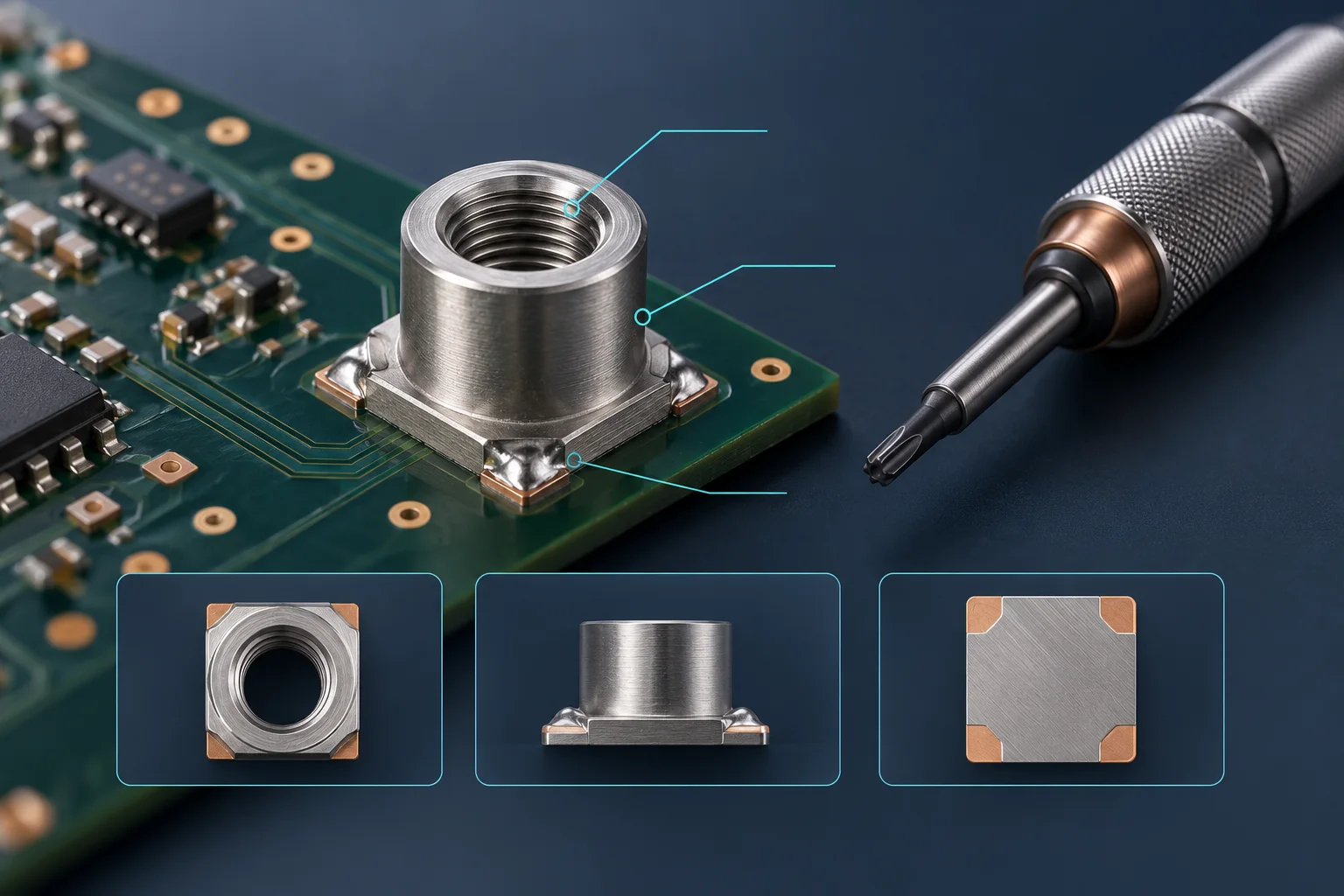
AI-generated nut-and-tool illustration, not a product test. Numerical examples provide no model-specific installation torque rating.