Direct answer Do not use a torque-out value directly as a production screwdriver setting. Torque-out assesses resistance to rotation in a specified mounting arrangement. Assembly tightening concerns the real clamped joint. Confirm the loading method and failure criteria for each.
PEM terminology and product tables separate torque-out, pushout and mating-screw requirements and identify test-board conditions. These references explain terminology; they do not establish Hongchuan product performance.
Read the quantities separately
| Test | Loading | Question |
|---|---|---|
| Torque-out | Specified rotational load | When does the installed fastener rotate or fail? |
| Tightening torque | Screw clamps actual parts | Is adequate clamp achieved without damage? |
| Pushout | Defined axial load | How well is the fastener retained? |
An SMT nut shares load with solder, pads, copper and laminate. Thread size alone does not define the result.
Build a usable validation plan
Request the original board, pad, solder and fixture conditions. Document screw strength, engagement, finish and speed. A screw that strips first reveals a limit of that combination, not necessarily the solder joint. A proposed sequence is to test retention on an agreed coupon, verify tightening with the actual shield and washer, then repeat relevant checks after service or environmental exposure.
Keep lot, drawing revision, process and failure photographs. If copper separates from laminate, a stronger nut alone may not help. Consult the pad-lift inspection guide.
Common questions
Can every M3 nut use one torque?
No. The screw, clamped parts, PCB and solder conditions matter.
Can a fixed fraction of torque-out define production torque?
There is no universal fraction. Validate the actual assembly window.
Sources
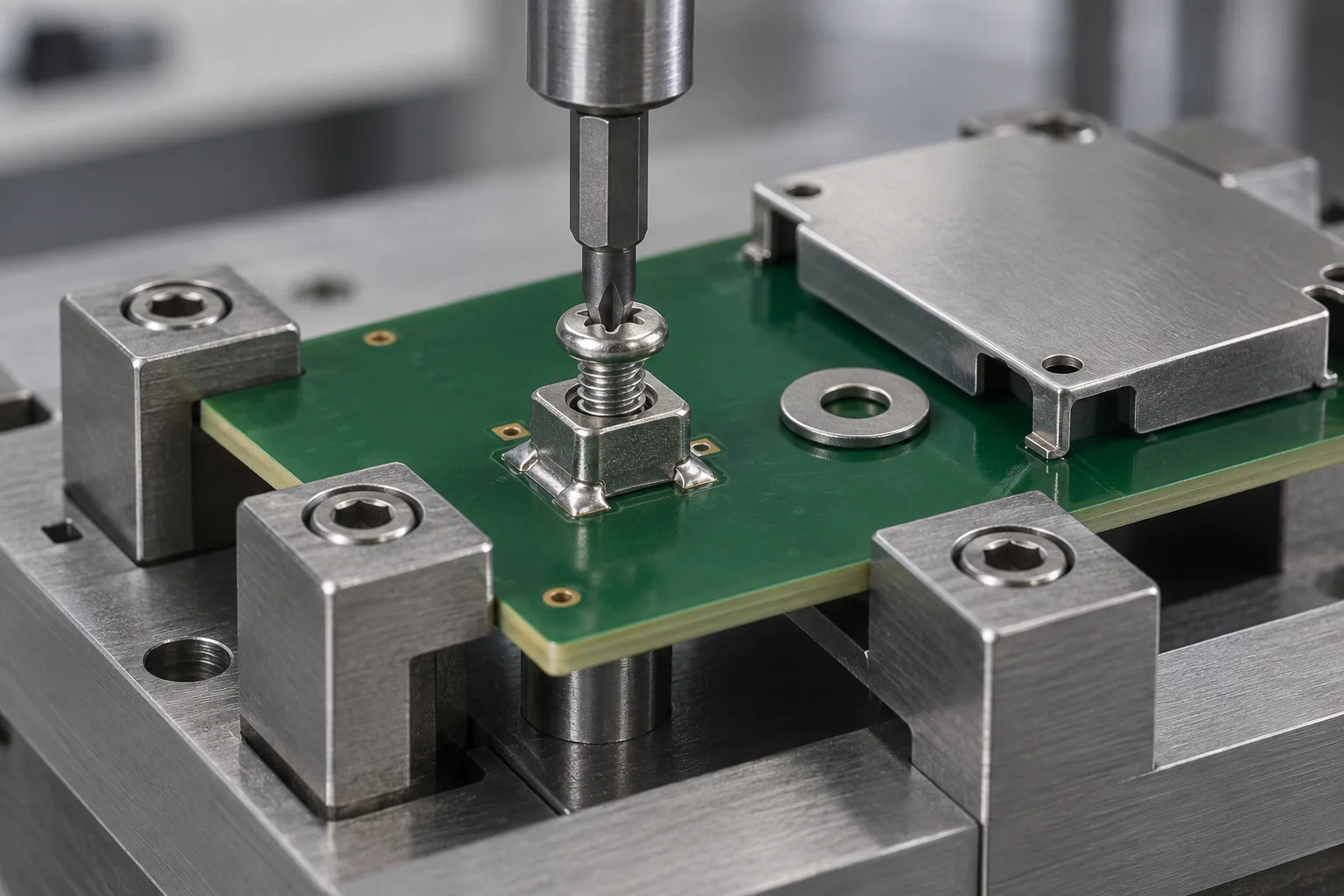
The cover is an AI-generated test concept, not evidence of a completed test.