

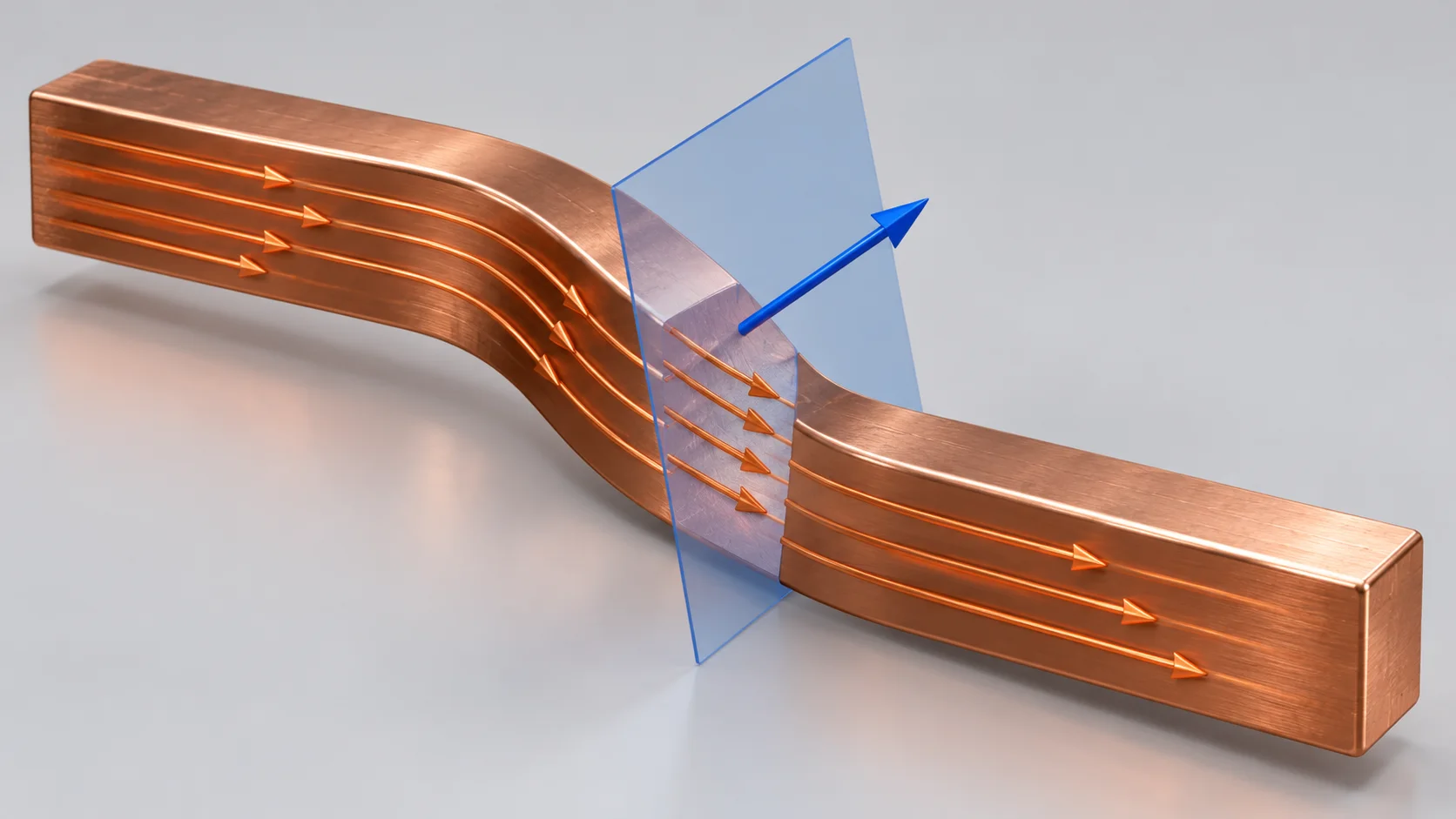
Calculate total current in a PCB busbar simulation by integrating normal current density over the complete section: I=integral of J dot n over area. Multiplying a local peak density by the section area generally does not give that total. Confirm the region, normal direction, component and units first.
Use the component crossing the section
COMSOL explains surface integration of the current-density vector dotted with the unit normal. Its boundary documentation distinguishes inward and outward current. For an oblique section, vector magnitude is not necessarily the normal component; tangential flow does not contribute to net crossing current.
| Quantity | Unit | Interpretation |
|---|---|---|
| Magnitude |J| | A per square m or square mm | Local vector magnitude |
| Normal J dot n | Same density units | Signed crossing component |
| Peak density | Same density units | Maximum in the selected region |
| Area integral | A | Net current through the defined region |
Add two regions
Assume a complete section with 4 square mm at uniform normal density 2 A per square mm and 6 square mm at 3 A per square mm, in the same direction. Total current is 4 times 2 plus 6 times 3, or 26 A. Peak times total area gives 30 A instead. These are hypothetical values, not Hongchuan simulation data or ratings.
Reversing every normal gives minus 26 A for the same physical flow. Opposing flows require signed addition. One A per square mm equals one million A per square m; pair area units accordingly and confirm an output in amperes.
Retain the complete integration region
For a custom PCB copper busbar, retain the section location, selected conducting regions, normal and expression. Exclude holes from conductive area and identify any adjacent conductors. Postprocessing cut planes and geometry boundaries can use different variables; check the actual interface and version.
For a steady DC path with no intervening branch or source/sink, compare complete sections as a conservation check. Numerical acceptance depends on mesh, solution accuracy and project targets. Agreement with input current alone does not validate temperature, joints or local hotspots.
Report totals and local results separately
A useful report includes input current, area, integrated current and peak location and definition. See busbar holes and net section for geometry review. AC phasors and displacement current require their corresponding definitions.
Questions
Can average times area be valid? Yes, when the average is the signed normal area average over that exact region.
Does a correct integral make the peak irrelevant? Total-current and local-concentration assessments address different questions.
Sources
COMSOL total normal flux;COMSOL normal current density
The cover is an AI section-and-direction concept, not measured flow or a computed field. No Hongchuan simulation-service capability or product rating is asserted.