

Quick answer: A copper-aluminum transition busbar near a liquid-cooled battery pack must retain contact area and clamp force after temperature gradients, condensation, vibration and thermal cycling. Review finish, washer pressure, bolt torque, insulation support, drainage and housing load path in addition to section.
Questions answered on this page
- Why does a liquid-cooled pack need a transition busbar?
- How do condensation and temperature difference affect the joint?
- How should washer, finish and torque be selected?
- How can interface, body and support issues be separated?
- What should be rechecked after cycling and humidity?
Application context
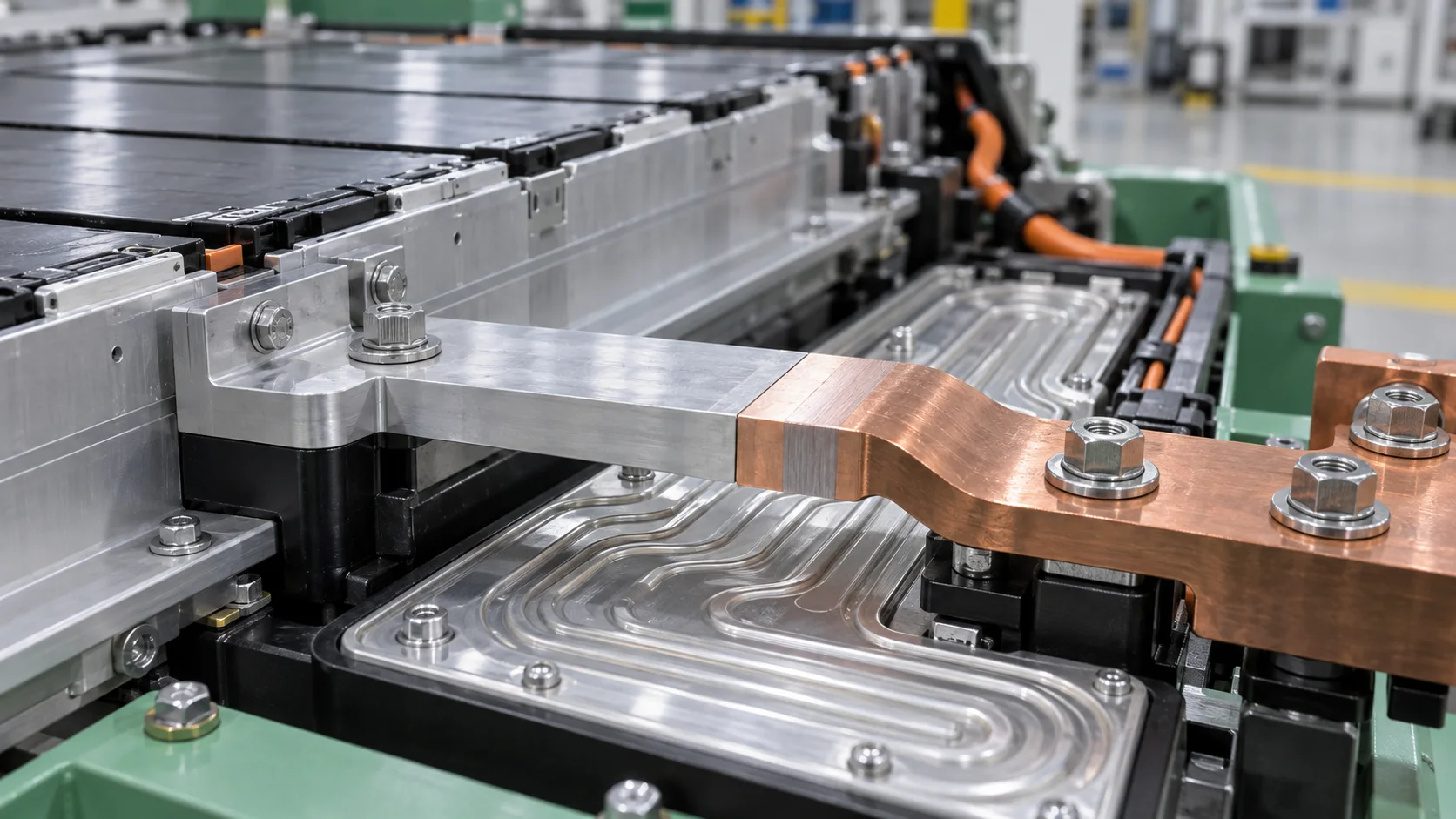
Battery packs may use aluminum module links, housings or rails while external cables, fuses and service interfaces use copper. A transition busbar bridges the materials near coolant plates, seals, insulation and housing supports. Hongchuan supplies copper-aluminum hardware for current, material, thickness, hole, washer, torque, coolant and support requirements.
Risks near the coolant plate
| Risk | Cause | Check |
|---|---|---|
| Contact resistance | Low pressure, oxide or small area | Four-wire drop |
| Thermal stress | Expansion mismatch and gradient | Post-cycle measurement |
| Corrosion | Condensation, contamination and galvanic action | Humidity and appearance |
| Mechanical load | Housing, cable bend and vibration | Torque retention and vibration |
Interface, washer and torque
Review oxide, hardness and expansion difference. Keep the interface flat and free of burrs and oil, and inspect finish after punching and bending. The washer must distribute clamp force while protecting the surface and insulation. Do not count chamfers, burrs or hole edges as effective area. Use the housing or bracket for external cable and busbar load, and provide drainage and service access. See copper-aluminum bolted-joint design.
Thermal and humidity validation
Compare interface drop, copper and aluminum temperatures and insulation before and after exposure under the same current, points and mounting. Inspect washer marks, finish wear, corrosion, loosened bolts and deformation. Copper, aluminum and finishes have different emissivity, so use thermocouples and four-wire checks when needed. For composite interface quality, see copper-aluminum delamination validation.
FAQ
Is section the only selection factor?
No. Pressure, condensation, corrosion, insulation, cable load and thermal cycling also matter.
Is higher torque more reliable?
No. Excess torque can crush aluminum, damage finish, deform insulation or stress the housing.
How should samples be specified?
Provide current, coolant location, materials, hole spacing, thickness, washer, torque and support. Start with the copper-aluminum hardware page.