


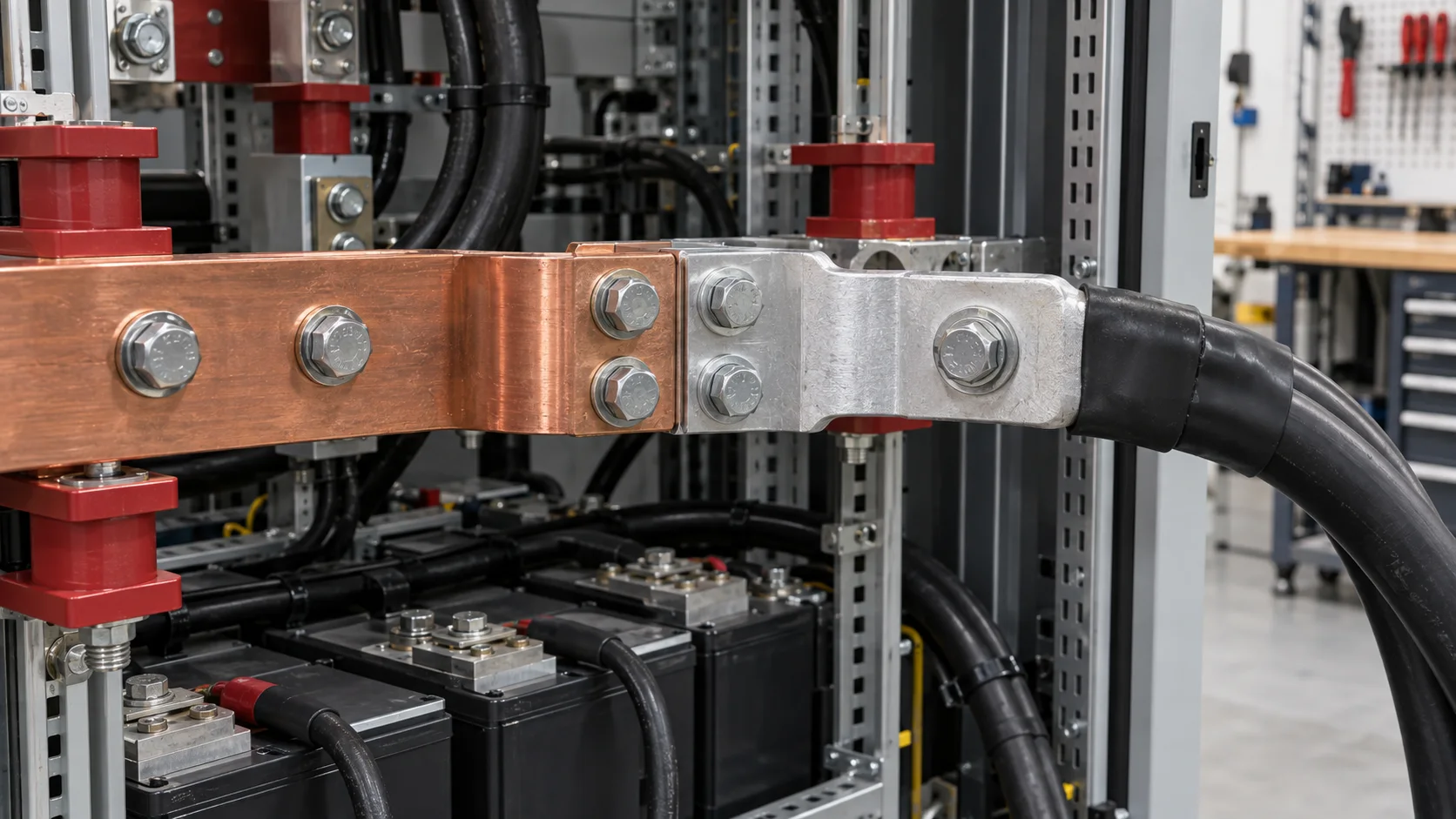
Quick answer: Select copper-aluminum connectors for an industrial UPS battery cabinet by checking float and discharge current, interface, washer and preload, cabinet temperature, support, humidity corrosion and post-service resistance, not capacity or section alone.
Questions answered on this page
- Why use copper-aluminum transition hardware in UPS battery cabinets?
- How do float and discharge loads affect heating?
- How do washers and bolts retain interface pressure?
- How can moisture and galvanic corrosion be reduced?
- How should service checks be repeated?
Application context
Industrial UPS systems connect battery strings, DC buses, inverters and bypass units. Copper bars, aluminum conductors, aluminum housings and copper terminals may coexist. Transition bars or composite connectors address the material change, while the joint needs independent support so cable mass does not hang on the interface. Hongchuan supplies copper-aluminum hardware matched to materials, thickness, pitch, current, bolts, washers, torque and environment.
Five control points
| Point | Review | Risk |
|---|---|---|
| Electrical | Float, discharge peak, ripple and drop | Interface hot spot |
| Interface | Transition, finish, flatness and cleanliness | Rising resistance |
| Preload | Bolt, washer, hole and support | Thermal relaxation |
| Environment | Moisture, condensation, salt and residue | Galvanic corrosion |
| Service | Power-off work, tool access and reassembly | Torque or position shift |
Float, discharge and thermal cycling
Measure copper, aluminum, transition, bolt, washer and insulation support under float, rated discharge, short peak and string-switching states. Before and after thermal cycling compare four-wire resistance at the same current and points, while recording torque marks, movement and bracket condition. Use copper-aluminum composite validation for interface structure.
Washers, corrosion and service
Washers spread load and affect oxide films and preload. On aluminum inspect indentation, hole edges and oxide; on copper and finish inspect wear, contamination and mating materials. Use interface design, sealing, drainage and protection to limit electrolyte entry without coating away the conductive area. Establish resistance and temperature baselines, run float, discharge, thermal and humidity tests, then repeat torque, movement, resistance and appearance checks. Define cleaning, washer replacement, bolt reuse and torque recheck for service.
FAQ
Is section sizing enough?
No. Interface, preload, temperature, corrosion, support and service affect life.
Can thermal cycling be skipped with low initial resistance?
No. Expansion mismatch and preload relaxation may appear later.
How should samples be specified?
Provide materials, section, pitch, current, environment, washer, bolt and torque. Start with the copper-aluminum hardware page.