


How to Design PCB for 100A High Current? Busbar Design Guide
In high-power applications such as energy storage inverters, photovoltaic inverters, and electric vehicle motor controllers, PCBs carrying 100A or higher currents have become standard. Traditional PCB design methods face severe challenges when handling such large currents: copper foil overheating, insufficient current capacity, and pad detachment occur frequently. This article systematically introduces how to enable PCBs to stably carry 100A current through proper copper thickness design, busbar solutions, and thermal management strategies.
1. Limitations of Traditional PCB Current Carrying
Standard PCB copper thickness is typically 1oz (35μm). According to IPC-2221 standard, a 10mm wide copper foil can only carry approximately 3-4A current under 10°C temperature rise. To carry 100A current, theoretically:
| Copper Thickness | Trace Width | Temp Rise | Current Capacity | Feasibility |
|---|---|---|---|---|
| 1oz (35μm) | ~300mm required | 10°C | ~100A | ❌ Not practical |
| 2oz (70μm) | ~180mm required | 10°C | ~100A | ❌ Too large |
| 3oz (105μm) | ~120mm required | 10°C | ~100A | ⚠️ High cost |
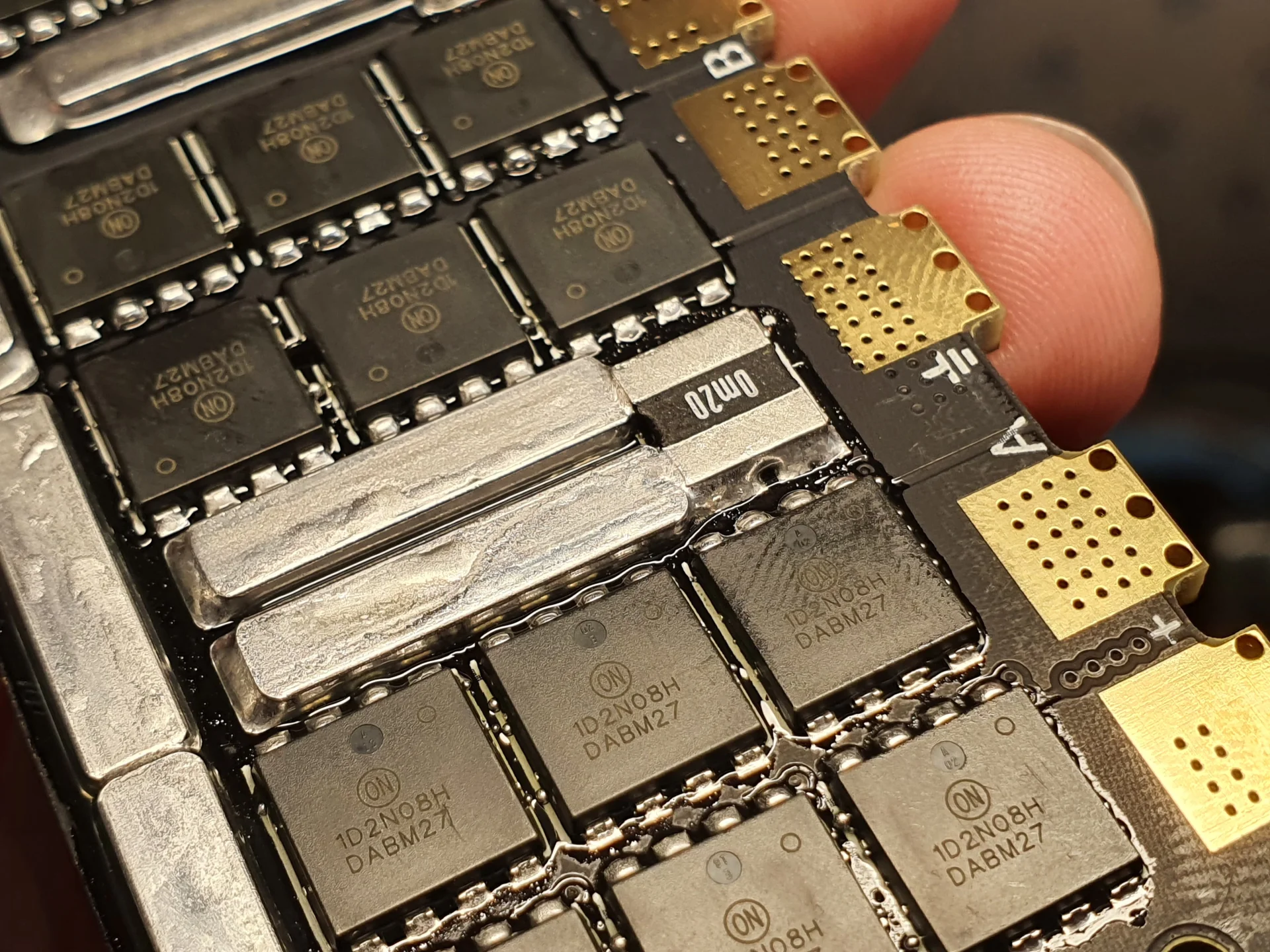
As shown, simply increasing copper thickness and trace width is not the optimal solution, especially in space-constrained applications. More critically, the heat dissipation capability of inner layer copper in multilayer PCBs is far inferior to outer layers, further limiting current carrying capacity. This is why SMT busbars have become the preferred solution for an increasing number of engineers in high-current designs.
2. Three Core Strategies for High Current Design
Strategy 1: Busbar Solution
Busbars are one of the most effective solutions for high current carrying problems. Compared to traditional PCB copper foil, busbars offer the following advantages:
| Comparison | PCB Copper | Busbar | Improvement |
|---|---|---|---|
| Copper Thickness | 1-3oz (35-105μm) | 0.5-3mm | 10-50x |
| Cross-sectional Area | Limited | Flexible design | Significant increase |
| Heat Dissipation | Dependent on substrate | Direct air convection | 3-5x |
| Contact Resistance | Pad connection | Large area soldering | 50%+ reduction |
Hongchuan Precision provides SMT busbars with tape-and-reel packaging that can be directly used on SMT placement machines for efficient automated production. Compared to traditional screw-fixed copper bars, SMT busbars offer lower contact resistance and higher reliability.
Strategy 2: Thermal Management Optimization
High current inevitably generates significant Joule heat (Q=I²Rt). Proper thermal management is key to ensuring stable system operation:
| Thermal Solution | Application | Effect | Cost |
|---|---|---|---|
| Increase copper thickness (3-4oz) | Below 50A | 20-30% temp rise reduction | Low |
| Large copper pour | General solution | Increased dissipation area | Low |
| Thermal via array | Multilayer boards | Inter-layer conduction | Medium |
| SMT busbar | 100A+ | 60%+ temp rise reduction | Medium |
| Active cooling (air/liquid) | 200A+ | Controlled temp rise | High |
Strategy 3: Connection Reliability Design
The reliability of high-current connection points directly affects system lifespan. Traditional screw connections are prone to loosening and oxidation, leading to increased contact resistance, intensified heating, and a vicious cycle.
The SMT busbar solution is recommended, achieving large-area soldered connections through reflow soldering, with the following advantages:
- Large contact area, strong current carrying capability
- Soldered connection, no loosening risk
- Automated production, consistent quality
- Directly compatible with SMT equipment, high production efficiency
3. 100A High Current Design Example
Taking an energy storage inverter project as an example, the PCB needs to carry 120A DC bus current. The design solution is as follows:
| Design Parameter | Solution | Result |
|---|---|---|
| Operating Current | 120A DC | Continuous operation |
| PCB Copper Thickness | 2oz outer layer + SMT busbar | Basic current + main current path |
| Busbar Specification | Pure copper 1.5mm thick, tape-and-reel | SMT automatic placement |
| Temperature Rise Test | 25°C ambient, full load | Temp rise <15°C |
| Reliability Test | 1000 thermal cycles | No solder joint failure |
Compared to traditional copper bar screw connection solutions, this approach improves production efficiency by 80%, reduces contact resistance by 60%, and completely eliminates the reliability risk of screw loosening. For more product information, visit the Product Center.
4. Selection Recommendations and Considerations
When designing PCBs for currents above 100A, follow these selection principles:
| Current Level | Recommended Solution | Key Points |
|---|---|---|
| Below 50A | Increase copper (2-3oz) + large copper pour | Focus on thermal design |
| 50-100A | SMT busbar + 2oz substrate | Select appropriate thickness |
| 100-200A | Thick copper busbar + thermal vias + heatsink | Consider active cooling |
| Above 200A | Laminated busbar + liquid cooling | System-level thermal design |
Note that SMT busbar pad design should follow IPC standards to ensure sufficient soldering area. It is recommended that pad dimensions be 0.3-0.5mm larger than the busbar body to ensure soldering reliability. Custom stampings can provide personalized solutions for specific requirements.
Conclusion
Enabling PCBs to stably carry 100A high current relies on properly selecting current carrying solutions: simply increasing copper thickness is costly and inefficient; the SMT busbar solution balances current carrying capability, thermal performance, and production efficiency, making it the best choice for current high-power applications.
As a professional SMT hardware manufacturer, Hongchuan Precision provides a full range of SMT busbars, SMT nuts, welding terminals, and other products, supporting customized designs to meet various high-current application requirements.