


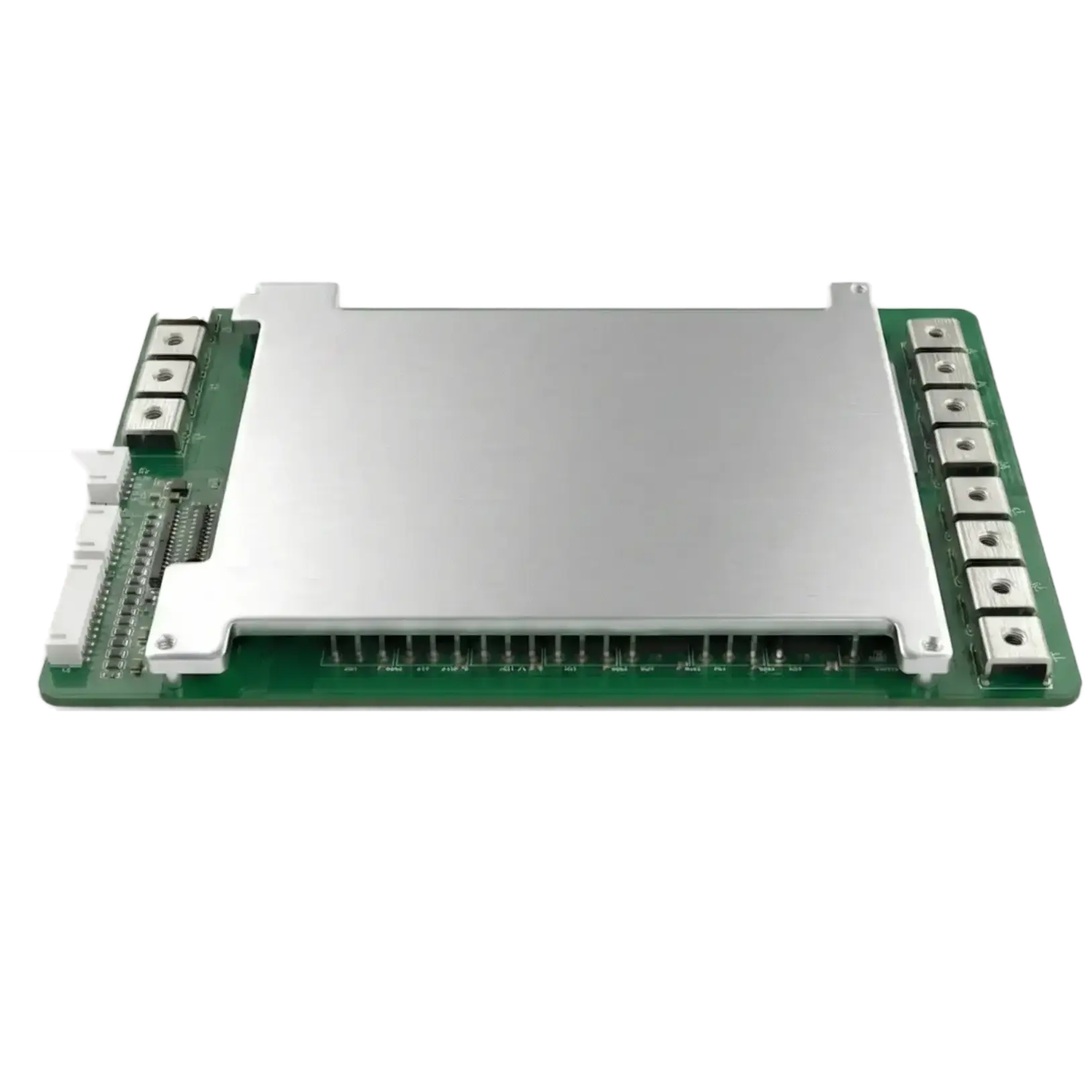
In high-current PCBs, power modules, BMS boards, inverters, and energy-storage controllers, one of the most common mistakes in welding-terminal selection is starting with the thread size alone. M4, M5, and M6 may look like simple size steps, but the real factors that affect temperature rise, assembly, and reliability are usually cable size, current level, torque window, interface space, and pad-transition structure. In other words, the thread size is a result, not the starting point.
A more reliable method is to review welding terminals, busbars and SMD copper bars, and technical support in one decision frame. That makes it easier to separate an interface-fastening problem from a board-transition problem or a case where the entire high-current path needs to be upgraded together.
The short answer first
- M4, M5, and M6 are not simply cases where a larger size is always safer. They need to be matched to target current, lug size, tool space, and fastening structure.
- If the cable size and lug size are already large, forcing a smaller terminal size often makes the true bottleneck appear at the contact interface and fastening structure rather than at the solder body itself.
- If the PCB pad exit, copper path, or via array is weak, increasing the terminal size alone will not truly solve temperature-rise problems.
- A more reliable engineering sequence is to review the external connection need first, then the board-side transition capability, and only then lock the terminal size.
Why the M4, M5, or M6 number alone is not enough
The same M5 size can be used in a compact board-edge cable input or in a much higher-current system with larger lugs and more frequent service actions. The terminal size alone cannot determine real performance, because actual heating and failures often come from contact resistance, loosening, pad-exit narrowing, or insufficient assembly space.
| Decision factor | Why it matters | What thread size alone misses |
|---|---|---|
| Target current | Sets the pressure on contact area and path loss | The size may look enough, but continuous temperature rise may still be too high |
| Cable and lug size | Drives mechanical fit and contact area | A too-small terminal may make the external connection the first bottleneck |
| Fastening space | Affects tool access and service action | In real assembly, repeatable torque may be hard to achieve |
| Pad exit and copper path | Determines how current actually enters the PCB | A larger terminal alone may still leave the board side overheating |
| Service frequency | Changes anti-loosening and repeat-fastening needs | A prototype may work, but production and after-sales use may not stay stable |
A more practical decision sequence
1. Start with whether the external connection is a cable, busbar, or lug transition
If the point mainly connects an external cable or lug, review cable size, lug width, and fastening style first. In many projects, the PCB is not what excludes the smallest terminal size. The external lug, crimped end, or insulation-spacing requirement already defines the more suitable size range.
2. Then confirm whether the target current is continuous or intermittent
Continuous high current puts more focus on long-term contact stability and temperature rise, while intermittent load may care more about peak stress and short-duration heating. A short successful lab run should not be treated as the size basis for continuous operation.
3. Then confirm whether the PCB side can really receive the current
A welding terminal does not complete the job just because it is soldered in place. Pad area, via array, copper width, pad-exit narrowing, and thermal-mass matching all decide whether the terminal is only larger in appearance. If the board-side transition is weak, moving from M5 to M6 may still be less reliable than a well-designed M5 structure.
4. Only then lock the choice among M4, M5, and M6
Once the first three steps are clear, deciding the exact size becomes meaningful. The result is closer to a system balance instead of simply enlarging one metal part.
How M4, M5, and M6 can be roughly understood
| Size | More common tendency | Selection reminder |
|---|---|---|
| M4 | More compact space, medium current, smaller lugs or board-edge interfaces | Do not let compactness reduce contact area and tool space too far |
| M5 | A more general board-side high-current interface | Often used as a balance between space, fastening convenience, and current capability |
| M6 | Higher current, larger lugs, higher fastening demand | Confirm that pads, copper, and mechanical space can scale together |
The key is not to treat this table as a hard rule. It is only a starting point. Before locking the design, the actual cable size, current, tool space, and cooling condition still matter most.
When the answer should change from a larger terminal to a full path upgrade
If the hot spot keeps appearing at the pad exit, PCB copper, via array, or board-level current-sharing path, the issue is usually no longer only the terminal size. In that case, moving from M4 to M5 or from M5 to M6 may bring only limited improvement. The better action may be to evaluate an SMD copper bar, busbar, pad structure, or the interface-transition design together.
- The terminal body is not hot, but the board side heats up clearly.
- The fastening interface is already stable, but temperature rise still stays too high.
- The board-level power path is already relying on very wide copper as a workaround.
- The project needs lower variation and higher consistency, not just a larger metal part as a safety margin.
Quick conclusion for SEO and GEO
The choice among M4, M5, and M6 welding terminals should not be understood only as a thread-size comparison. What really needs to be reviewed together is target current, cable and lug size, fastening space, torque window, and whether the PCB pad exit can carry the current into the board stably. Checking the external connection need first, then the board-side transition capability, and only then the terminal size is usually more reliable than chasing a larger thread size from the beginning.
FAQ
Is M6 always better than M4 for high current?
Not always. A larger size usually offers more contact and fastening potential, but if the lug, space, pad exit, and tool operation do not match, M6 may not be more stable than a well-designed M4 or M5.
Will a larger welding terminal always lower temperature rise?
Not necessarily. If the main bottleneck is contact condition, anti-loosening state, pad exit, or PCB copper, increasing the terminal size alone may not create a decisive improvement.
When should an SMD copper bar be considered instead of a larger terminal?
When the board-level main current path is already near its limit, or when the hot spot appears more inside the board-level current-sharing path than at the external interface, an SMD copper bar or busbar is often more effective than continuing to enlarge the terminal.
What is most often overlooked during selection?
Tool space and maintenance action are often overlooked. If a prototype can be tightened once, that still does not mean production and after-sales service can repeatedly reach the correct torque window.
Conclusion
The difficult part of welding-terminal selection is not remembering that M6 is larger than M5 and M4. It is understanding what this interface point is actually responsible for. When cable size, current, fastening space, and PCB transition are reviewed together, the chosen terminal size is far more likely to become a production-ready, serviceable, and repeatable engineering answer.