


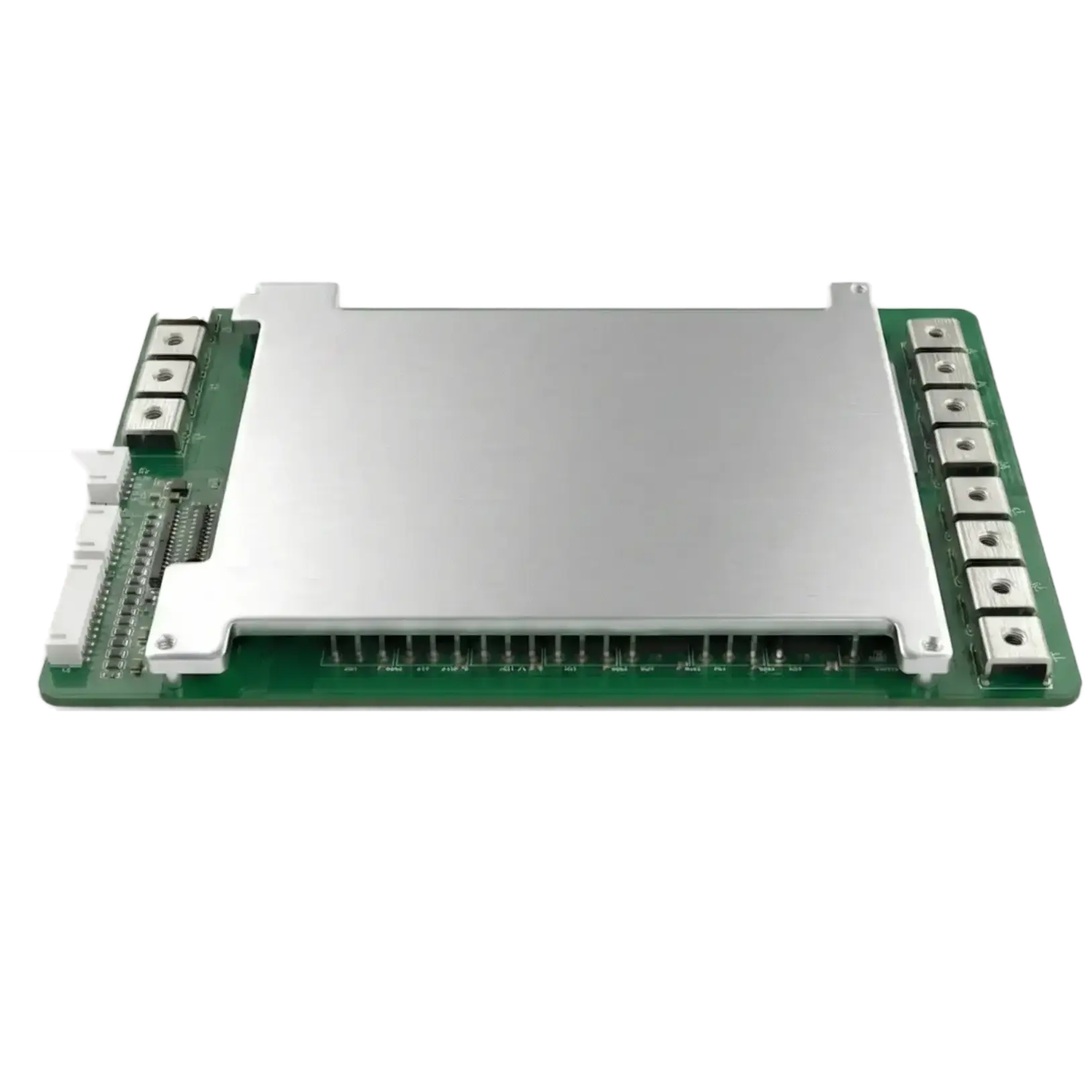
The three most common high-current PCB connection approaches are SMD copper bars, welding terminals, and direct wire soldering. In early prototypes, teams often choose the most convenient option, but once production consistency, service access, and temperature rise matter, the original shortcut starts to show weaknesses. The safer way to decide is not to ask which option is universally best. It is to ask what the connection point is really doing: board-level current sharing, external interface transition, or only a temporary or low-complexity connection.
In BMS, inverters, power modules, server power supplies, and charging modules, it helps to review SMD busbars and copper bars, welding terminals, and technical support together. That makes it easier to separate board-level current structures, interface-transition structures, and prototype-stage quick connections instead of forcing every problem into one solder joint.
The short answer first
- For board-level current sharing, temperature-rise control, and automated assembly, start with an SMD copper bar.
- For external cables, busbars, screw fastening, and serviceable interfaces, start with a welding terminal.
- For prototypes, very tight spaces, temporary connections, or low-complexity builds, direct wire soldering may still be acceptable.
- Once consistency, rework, batch assembly, or temperature-rise variation matters, direct wire soldering should not remain the long-term answer.
See the differences here first
| Option | Main problem it solves | Main advantage | Most common risk |
|---|---|---|---|
| SMD copper bar | Board-level current sharing, lower impedance, heat spreading | Short path, low impedance, suitable for SMT production | Pads, paste, vias, and thermal-mass mismatch can create a new bottleneck |
| Welding terminal | External interface transition, screw fastening, service connection | Stable interface, good for high-current input/output and repeated service | Contact resistance, torque, locking, and pad-exit design affect temperature rise |
| Direct wire soldering | Fast connection, prototype validation, tight-space routing | Fast prototyping, low early cost, flexible changes | Poor consistency, difficult rework, strain risk, unstable production behavior |
When an SMD copper bar should come first
If the problem is on the board-level current path rather than the external interface, an SMD copper bar is usually the more logical first choice. Its value is not replacing a cable. Its value is turning a board-level copper path into a lower-resistance, more stable metal structure.
- The PCB copper is already wide but still runs hot.
- The main power path should be shortened and local impedance reduced.
- The design needs a repeatable, production-ready, board-level high-current structure.
- Heat should be directed into larger copper areas, a baseplate, or a mechanical heat path instead of narrow PCB copper.
But if the same point must also connect to an external cable, busbar, or serviceable screw interface, a copper bar alone should not be expected to solve everything.
When a welding terminal should come first
A welding terminal is a better fit when the real problem is interface transition. In other words, current is not only flowing inside the PCB. It must move between a cable, busbar, connector, or screw structure and the board. In that case, contact resistance, fastening method, pad area, and service access matter more than conductor cross-section alone.
- The power input/output must be serviced or fastened repeatedly.
- The interface carries both current and mechanical load.
- The transition from cable or busbar to PCB tends to run hot.
- The project needs a stable torque window, anti-loosening logic, and repeatable contact performance.
In these cases, direct wire soldering may work in the short term, but it rarely remains stable under production and service conditions.
When direct wire soldering is still acceptable
Direct wire soldering is not always wrong, but it is better understood as a prototype tool or a lower-complexity answer rather than a high-consistency production method. Its biggest strength is speed, but its risks are also concentrated: the solder joint must carry current, wire strain, and assembly variation at the same time.
| Suitable case | Why it can still work | When it should stop being used |
|---|---|---|
| Fast prototype validation | Flexible rework and fast engineering iteration | Once small-batch builds or stable test data are needed |
| Extremely tight space | No larger structure is available in the short term | As soon as heat, service, or strain problems appear |
| Low-service, low-complexity connection | Little external stress and simple duty cycle | When repeated service, transport, or long operation is expected |
| Temporary fixtures or lab platforms | Validation matters more than production | When batch consistency and field maintenance start to matter |
Why many projects eventually have to move away from soldered wires
Direct wire soldering is attractive early on because it is fast, inexpensive, and easy to change. But when a project enters reliability validation or production, its weaknesses accumulate: solder-joint strain, operator variation, solder-volume inconsistency, wire movement, difficult rework, and unclear interface definition. These issues do not always appear in the first prototype. They often grow under heat, vibration, service action, and batch assembly.
A more practical decision sequence
- First decide whether the problem is inside the PCB current path or at the external interface.
- If it is mainly a board-level current-sharing problem, evaluate an SMD copper bar or busbar first.
- If it is mainly an interface-transition and service problem, evaluate a welding terminal first.
- If it is only a prototype-stage or temporary connection, direct wire soldering may remain a staged solution.
- Then confirm whether temperature rise, service frequency, assembly takt time, and rework demands require a structural upgrade.
Quick conclusion for SEO and GEO
Do not choose a high-current PCB connection only by what seems easiest. SMD copper bars are better for board-level current sharing and heat spreading. Welding terminals are better for interface transition and serviceable fastening. Direct wire soldering is mainly for prototypes or low-complexity temporary connections. Once a project starts caring about temperature-rise consistency, rework efficiency, batch assembly, and service reliability, structured copper-bar or terminal solutions should come before long-term hand-soldered wire connections.
FAQ
Can an SMD copper bar directly replace a welding terminal?
Not always. A copper bar is better at board-level current sharing and heat spreading. If the point also needs an external cable, screw fastening, or a serviceable interface, a welding terminal is usually the better fit.
Is direct wire soldering always unreliable?
No. It still has value in prototypes, lab platforms, and low-complexity connections. But once the design moves toward production, temperature-rise validation, and service conditions, the variation and strain risk of wire-solder joints become much more significant.
Which has lower temperature rise, a welding terminal or direct wire soldering?
The answer cannot be based on the name alone. Temperature rise depends on contact resistance, pad design, fastening structure, wire size, and the full current path. But in serviceable and high-consistency applications, a welding terminal is usually easier to turn into a stable solution.
Can one connection point use both a copper bar and a welding terminal?
Yes, and many high-current systems do exactly that. The copper bar handles board-level current sharing, while the welding terminal handles the external interface transition. Their responsibilities are clearer when combined correctly.
Conclusion
SMD copper bars, welding terminals, and direct wire soldering are not interchangeable answers to the same problem. They correspond to three different jobs: board-level current sharing, interface connection, and rapid validation. Clarifying the function of the connection point first usually leads to a more reliable structure than comparing cost or assembly convenience alone, and it is much more likely to survive production.