


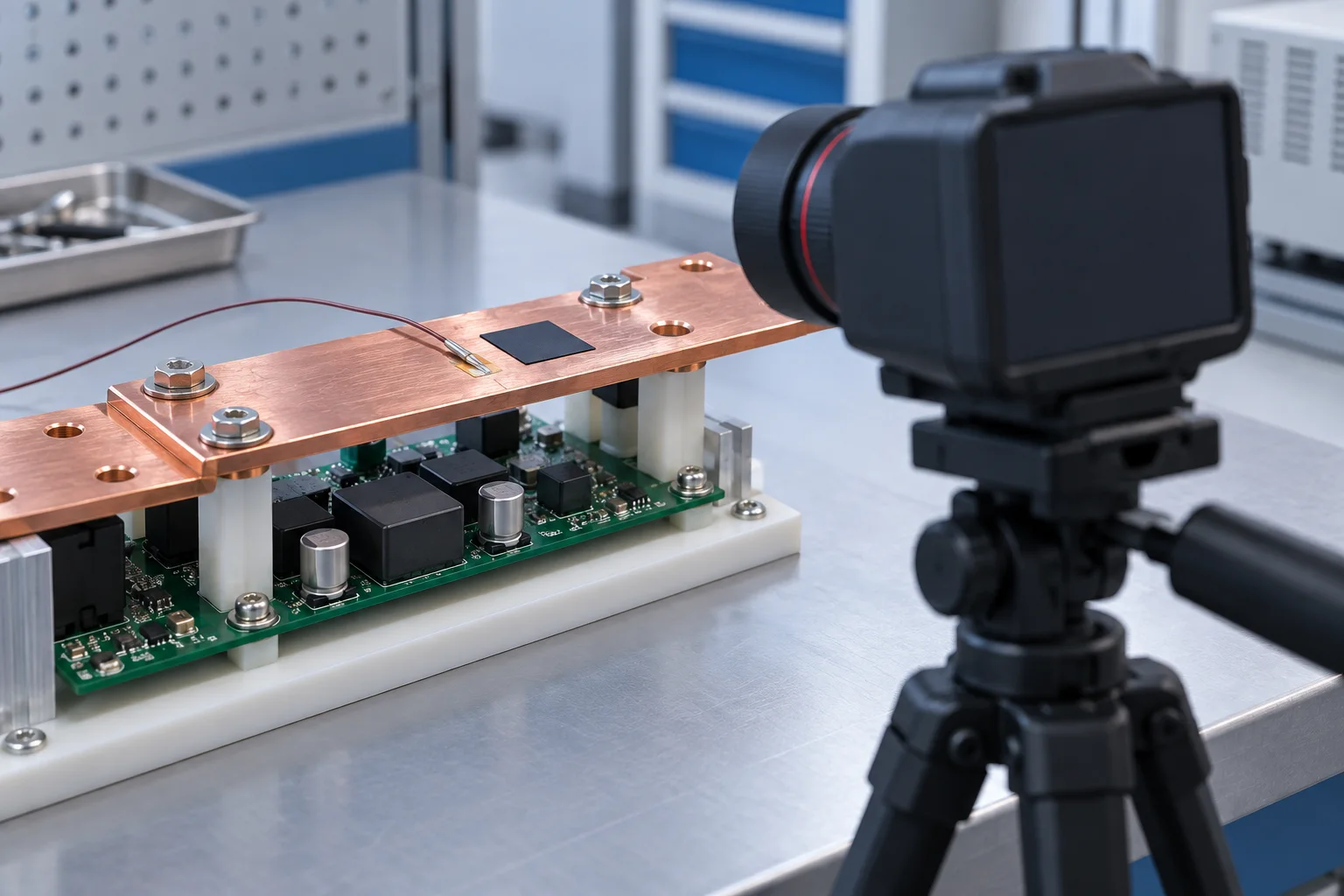
Direct answer Infrared readings on copper and plated terminals require surface-specific checks. Low emissivity makes reflections significant; a measurement spot larger than the solder foot can mix the target with its surroundings. Verify emissivity and cross-check suitable contact measurements before judging temperature rise.
FLIR's guidance discusses shiny copper and characterized high-emissivity materials. Surface condition and wavelength affect emissivity, so one tabulated value cannot represent every busbar.
Check what the camera sees
Bare copper, tin and oxidized regions on an SMD busbar can appear different even at similar temperatures. An apparent hot patch that shifts strongly with viewing angle warrants a reflection check.
| Observation | Check | Verification |
|---|---|---|
| Angle-sensitive reading | Reflection and surface condition | Fixed angle and recorded settings |
| Small foot appears cool | Measurement spot exceeds target | Appropriate lens and distance |
| Copper and solder differ | Different emissivity | Check points separately |
Use a reference point carefully
A characterized patch may be applied to an approved noncontact surface and allowed to reach thermal equilibrium. Document material, location and size. Keep it off electrical joints and assess its effect on cooling. Contact sensors also need a verified attachment method.
Report temperature rise
In a hypothetical example, a 75 °C terminal with a 30 °C local ambient has a 45 K rise. Comparisons require the same current, airflow, points and stabilization criteria. Retain radiometric files and visible-light point photographs. Inspect the bar, feet and copper exit separately using the pad-exit guide.
Common questions
Can one emissivity setting compare every surface?
Quantitative comparisons across different finishes need individual checks.
Should the whole busbar be painted?
Large treatments can alter cooling and assembly. Evaluate a small reference area first.
Sources
The cover is an AI-generated concept, not a measured thermogram or product test record.