

Quick answer: A copper-aluminum transition busbar cannot be approved simply because the bolt is tight. Control real interface area, oxide condition, washer pressure, torque window, insulation and drainage, then repeat contact-resistance and temperature measurements after powering, thermal cycling, humidity and vibration. Separate interface, bolt and busbar-body drop before choosing a new material, washer, torque or structure.
Questions answered on this page
- Why use copper-aluminum transition bars in battery clusters?
- How should washers and finishes be selected?
- What do low or excessive torque cause?
- How can oxide, corrosion, pressure and section problems be separated?
- How should post-cycle resistance rise be investigated?
Application context
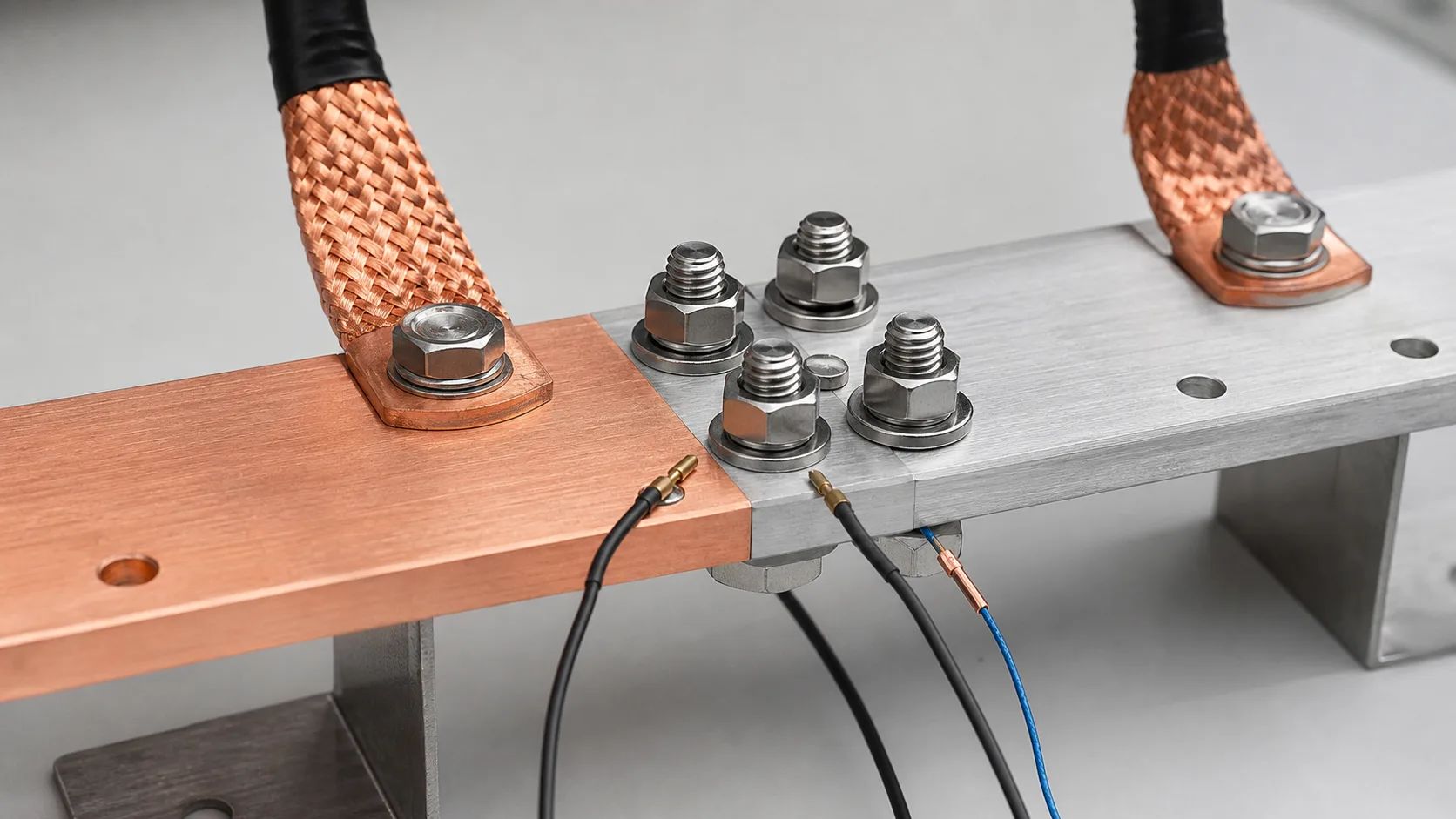
Energy-storage clusters, DC combiner boxes, PCS battery sides, battery packs and cabinet buses may transition between aluminum bars, cell connectors, copper bars and external cables. Hongchuan supplies copper-aluminum transition hardware, SMD busbars, PCB welding terminals and fastening hardware.
Separate electrical, mechanical and environmental paths
| Path | Parts | Failure |
|---|---|---|
| Electrical | Copper, aluminum, interface, bolt and external bar | Drop, rise and resistance |
| Mechanical | Bolt, washer, bracket and enclosure | Loosening and deformation |
| Environmental | Finish, seal, insulation and drainage | Oxide, corrosion and contamination |
Interface and washer design
Aluminum oxide is resistive, and copper and aluminum differ in hardness and thermal expansion. Confirm flatness, burrs, contamination, finish continuity, transition width and drainage. A washer should distribute pressure, protect the finish and retain clamp force after cycling, not only provide locking. See copper-aluminum bolted-joint design.
Torque window
Low torque reduces real contact area and promotes micro-motion and oxidation. Excess torque can crush aluminum, damage finish, bend the bar or deform insulation. Production documents should include bolt, material pair, lubrication, target range, tool calibration and rework rules. Correlate torque with resistance instead of treating torque as an electrical result.
Segmented drop and temperature
At the same current, measure copper body, aluminum body, both interface sides, bolt/washer contact and external bar. High interface drop plus high temperature points to area, pressure or finish. High body temperature points to section, length or cooling. Post-cycle increase points to preload loss, fretting, corrosion or deformation. Because copper, aluminum and plating have different emissivity, thermal imaging should be supported by thermocouples or calibrated contact measurements. For interface strength see copper-aluminum peel-strength validation.
Environment and production
After thermal cycling, humidity, condensation or vibration, inspect corrosion products, pressure marks, bolts, finish and insulation. Compare resistance, temperature and torque retention before and after the same current and measurement points. Release should include design, assembly, electrical, environment and pilot-production checks.
FAQ
Does higher torque always improve reliability?
No. The window must protect aluminum, finish and insulation while providing stable pressure.
How can corrosion be separated from low pressure?
Correlate appearance, pressure marks, resistance, temperature and pre/post-cycle results rather than using one visual check.
Can Hongchuan provide samples?
Yes. Match current, material pair, holes, thickness, finish, washer and torque. See the copper-aluminum connection product page.