

Read 8.8 and A2-70 mating-screw designations within their respective systems. Class 8.8 describes steel screw mechanical properties; A2-70 combines a stainless steel designation with a property class. Numerical labels alone do not approve interchangeability or establish allowable tightening torque for an SMT nut, solder joint and PCB assembly.
Separate steel designation and mechanical properties
Bossard's ISO 898-1 screw table and REYHER's fastener information use separate fields for steel screws, stainless screws and nuts. An 8.8 class does not fully identify alloy or corrosion protection. In A2-70, A denotes the austenitic group, 2 the associated steel grade category and 70 its property class.
For stainless screws within the applicable scope, class 70 relates to a minimum tensile strength of 700 N/mm², or 700 MPa. A2 is not one uniquely specified chemical grade, and screw tensile strength is not nut proof load. Obtain complete item identity, standard edition and supplier evidence.
Nominal class values are not the whole table
Class 8.8 has nominal tensile strength 800 MPa and nominal yield ratio 0.8, corresponding to nominal stress at 0.2% non-proportional elongation of 640 MPa. Bossard's table separately lists minimum values and diameter scopes. Do not copy these nominal numbers as complete acceptance requirements for every size.
| Designation or field | Information provided | Still required |
|---|---|---|
| Steel screw 8.8 | Mechanical property class | Size scope, tests and product standard |
| Stainless screw A2-70 | Steel category and property class | Full material and delivery evidence |
| Nut properties | Applicable nut requirements | Thickness, geometry and engagement conditions |
| Board assembly capability | Actual assembly validation | Nut base, solder, PCB and support |
Stress under proof load, stress at 0.2% non-proportional elongation and tensile strength are distinct fields. Public supplier references explain interpretation; they do not replace the contract's standard edition or batch results.
Match the thread and the complete load path
Confirm nominal thread diameter, pitch, length, head and engagement against the mating drawings. A higher screw class does not authorize a torque increase. Friction, finish, lubrication and preload strategy matter, and the solder or PCB may limit the connection first.
A stainless substitution requires controlled review of materials, assembly and maintenance. Keep old and new fastener identities. The ability to thread into the same opening does not establish interchangeability.
Specify screws and nuts separately
For SMT nuts, list the screw standard, class, thread and surface condition separately from the nut drawing and PCB installation. Outside diameter is not thread size. Do not assign an 8.8 label to an unverified Hongchuan nut.
Stainless screw galling and thread checks address assembly anomalies. Preserve the original state for investigation.
Common questions
Is 8.8 simply one grade above A2-70? The systems differ; compare complete applicable requirements before substitution.
Does a head marking prove acceptance? It supports identification alongside supplier evidence and the agreed inspection.
References
Bossard steel screw properties, January 2025; REYHER steel and stainless fastener information.
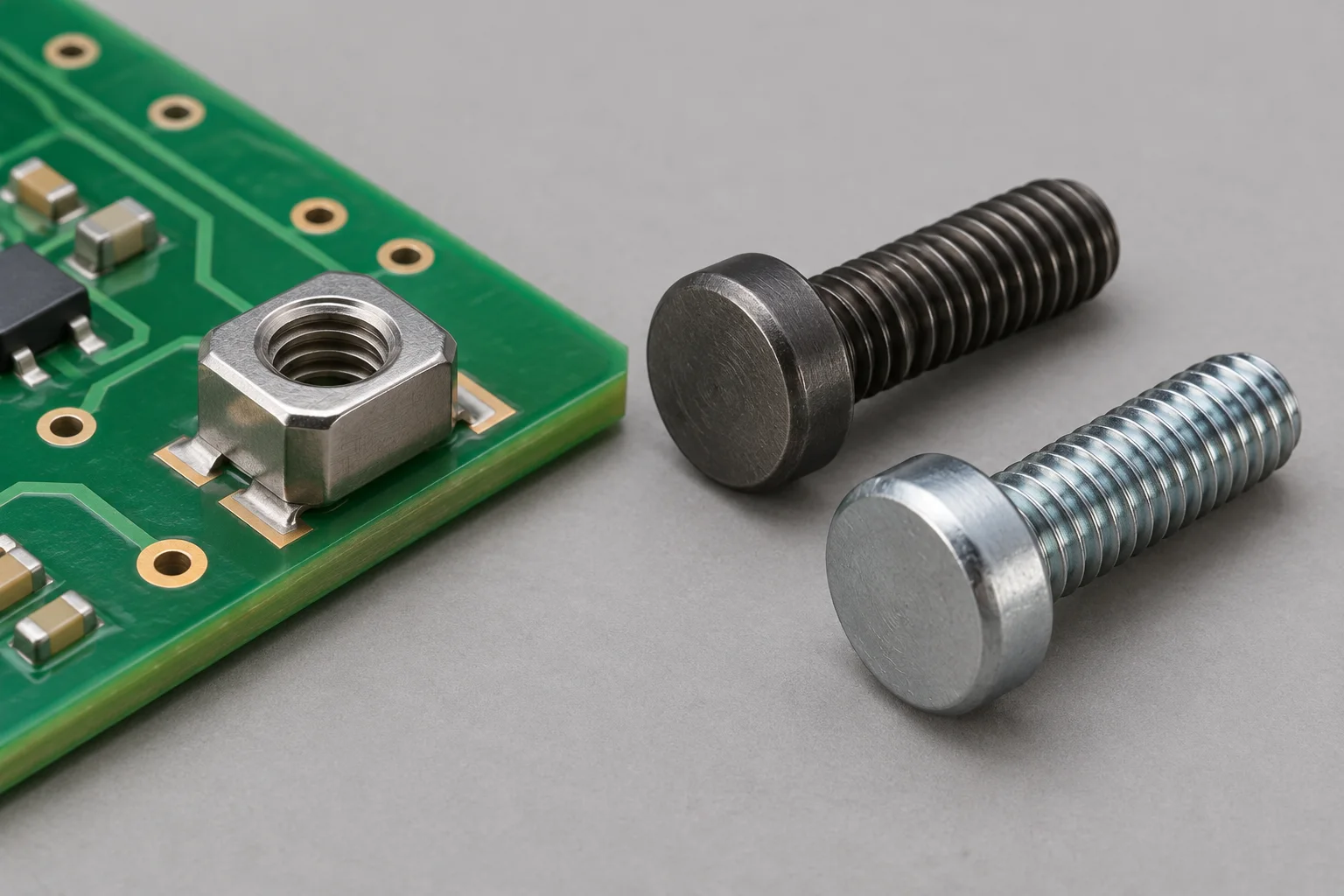
The cover is an AI concept. Color does not identify material or class. No supply of the illustrated screws, Hongchuan nut class or assembly torque is claimed.