

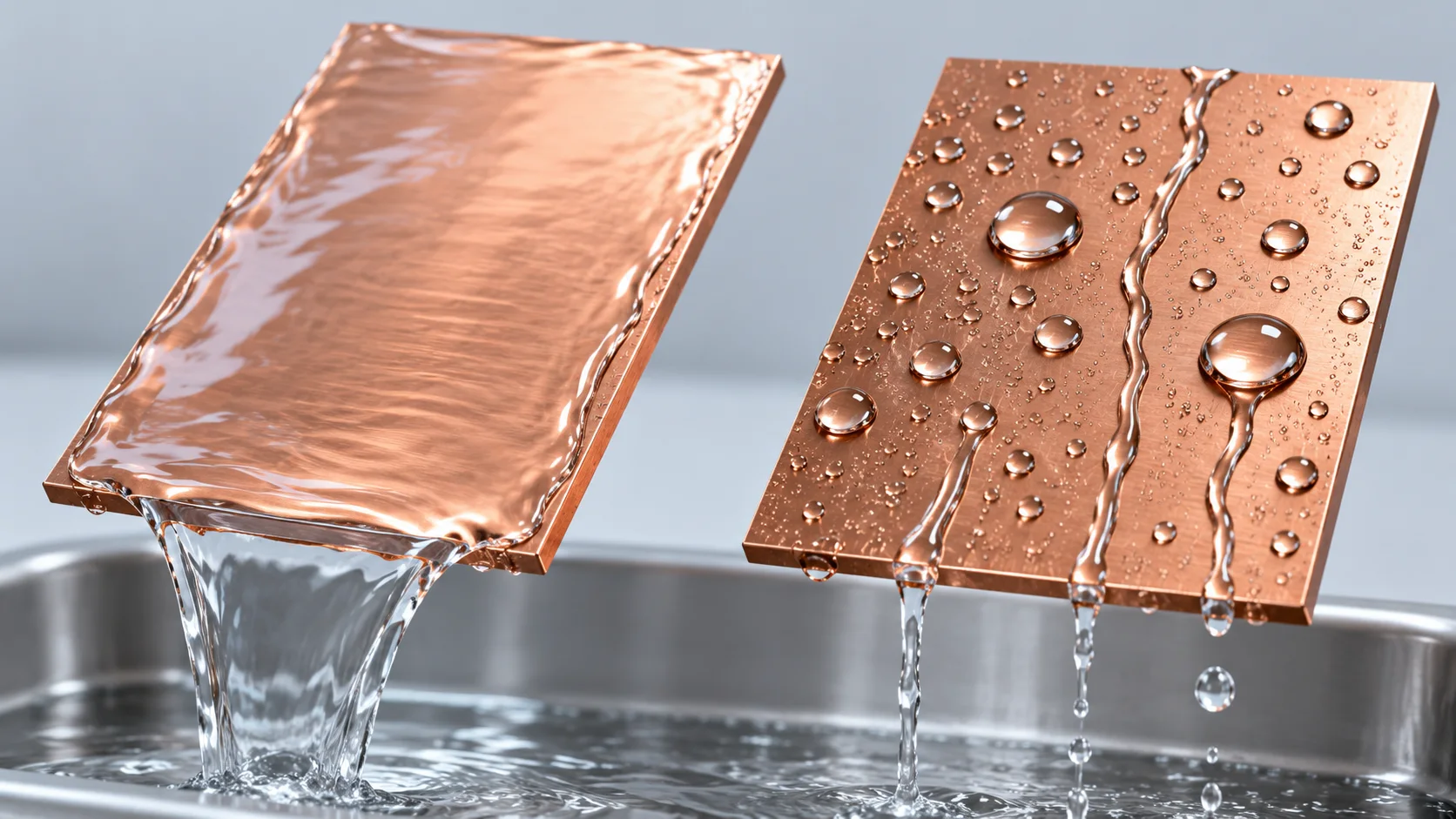
An unbroken water film on a copper busbar provides an observation for screening hydrophobic surface contamination. It does not independently establish ionic cleanliness, solderability or plating conformity. Use an approved method on a suitable unassembled metal specimen or witness coupon, with controlled water quality and drying.
What the observation covers
The public scope of ASTM F22-21 concerns hydrophobic surface films. Brighton Science describes a qualitative observation of water sheeting continuously or breaking into rivulets and beads. That observation does not identify a contaminant or report its mass.
Water wetting and solder wetting involve different materials and conditions. A continuous water film cannot be entered as a solderability pass. This article uses the public standard scope and does not claim verified access to the full procedure or its operating details.
| Observation | Record | Still evaluate |
|---|---|---|
| Continuous film | No evident break under the stated conditions | Ionic residues, plating and solderability |
| Local beads or rivulets | Location, area, repeatability and surface condition | Contaminant identity and substrate effects |
| Variation within a lot | Handling zones and cleaning batches | Method repeatability and contamination distribution |
| Change after cleaning | Comparable before-and-after observations | Suitability for the intended next process |
Define the specimen before the test
A practical review record should identify bare copper or the exact finish, cleaning process, sampling area and delay before observation. Retain temperature in degrees C, time in s or min and area in appropriate units such as square mm. Set actual conditions through the approved method. No universal observation time or contact-angle limit is proposed here.
Brighton Science cautions that water quality or drying can contaminate sensitive surfaces. Decide specimen disposition before starting. If an investigation needs the original condition, retain an untouched sample and photographs before cleaning. This discussion does not recommend applying water to an assembled PCB.
Connect the result to the end use
For a soldered PCB copper busbar, an unusual water-break result can trigger an investigation followed by the surface analysis and solderability checks required by the project. Coating or bonding needs validation for that specific surface system. The Brighton paper quantitative comparison used composite material; its contamination results are not copper busbar acceptance limits.
For assembly residues, see flux residue and cleaning checks. Keep ionic-risk evidence and water-film observations associated with their respective methods and samples.
Questions
Does an unbroken film mean zero contamination? Report the observation under its test conditions. A qualitative screen cannot establish the absence of every contaminant.
Do beads identify oil? Surface condition, method and analytical evidence are needed to identify the cause.
Sources
ASTM F22-21 public scope;Brighton Science water-break technical paper.
The cover is an AI water-film illustration, not a Hongchuan cleanliness test. It does not define a universal acceptance threshold or an assembled-board cleaning process.