


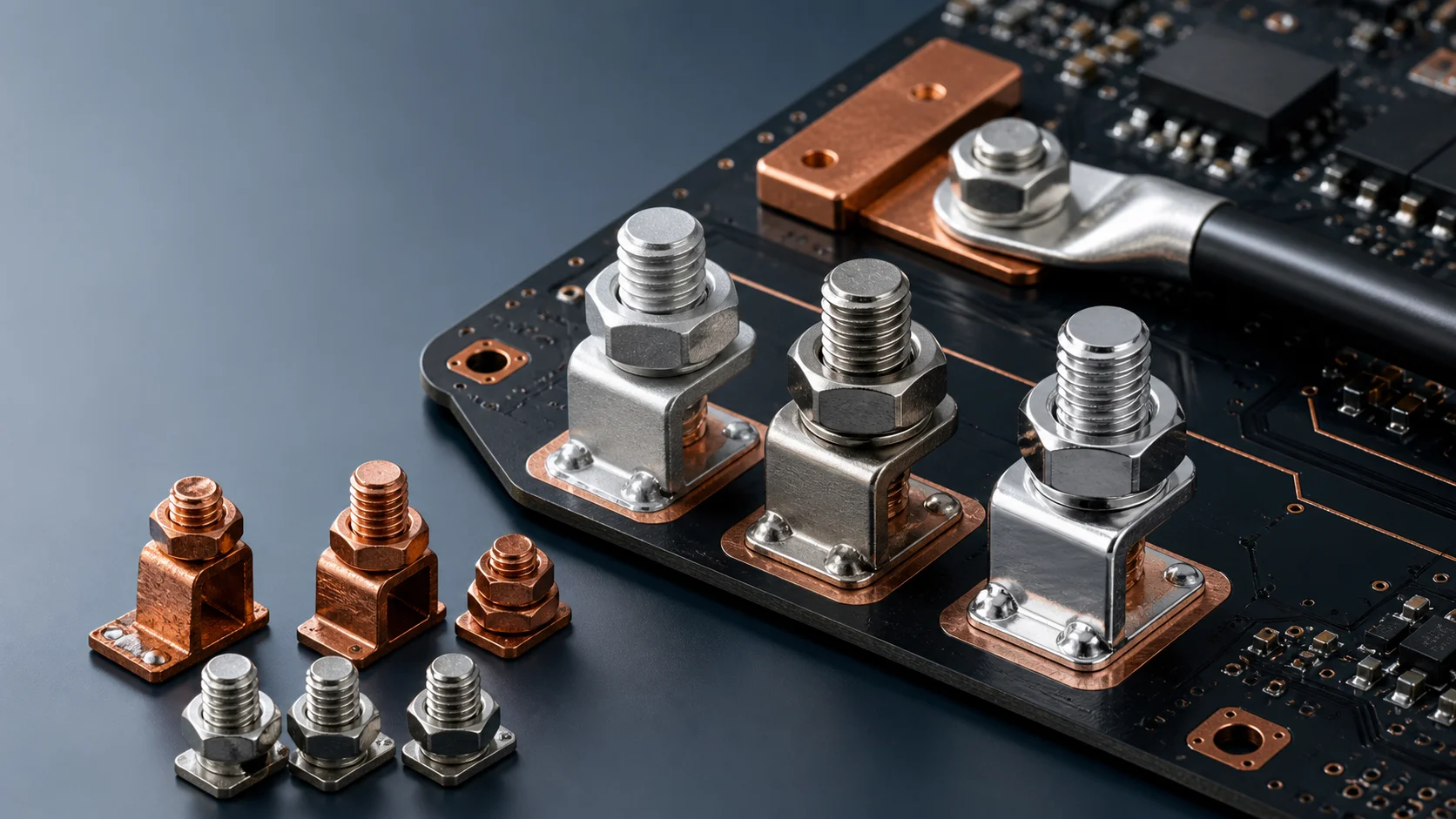
In welding-terminal selection, engineers often start with M4, M5, or M6, or with copper, brass, terminal height, and solder-pin count. But once the project moves toward production and reliability validation, surface finish often becomes unavoidable: should the terminal be tin plated, nickel plated, or silver plated?
The answer is not simply that silver is best or tin is cheap enough. For PCB welding terminals, the selection guide, and technical support, plating must be selected together with contact style, soldering process, salt-spray requirement, operating environment, service frequency, and cost. If the plating is wrong, even a large terminal can suffer from unstable soldering, higher contact resistance, surface oxidation, or inconsistent temperature rise.
The short answer first
- Tin plating is often chosen for solderability and cost balance, making it suitable for many PCB welding terminals and general high-current board connections.
- Nickel plating is often chosen for corrosion resistance, wear resistance, and surface stability, especially on exposed or serviceable metal surfaces.
- Silver plating is often chosen for low contact resistance and high-conductivity contact interfaces, especially where current is high and voltage drop must be controlled.
- Do not choose by plating name alone. Confirm base material, plating thickness, soldering method, lug contact surface, and salt-spray requirement together.
Why high-current terminals cannot ignore surface finish
Copper has strong electrical and thermal conductivity, but copper surfaces oxidize, and contact interfaces are affected by humidity, salt spray, contamination, fastening friction, and service actions. In high-current applications, a small resistance change at the contact interface can become temperature rise, voltage drop, and reliability variation. Plating is therefore not only a cosmetic choice. It is part of the electrical connection and long-term stability.
| Selection factor | Why it affects plating | Common risk |
|---|---|---|
| Soldering process | Affects wetting, solder volume, and soldering window | Insufficient solder, voids, weak joints |
| Contact resistance | Drives temperature rise at lug, screw, and overlap surfaces | Local heating and higher voltage drop |
| Salt spray and humidity | Affects corrosion and oxidation rate | Discoloration and contact-surface degradation |
| Service frequency | Repeated assembly can wear the finish | Scratched surfaces and lower post-torque stability |
| Cost and supply | Different finishes have different cost and lead-time profiles | Over-design or uncontrolled production cost |
Tin-plated welding terminals: better for solderability and cost balance
Tin plating is valued for soldering compatibility and relatively friendly cost. It is commonly used on copper terminals, SMD copper bars, and board-side metal parts that need to be soldered to a PCB. For projects where soldering reliability is central, tin plating is often a practical option for BMS boards, energy-storage control boards, charging modules, and industrial power boards.
When tin plating should be considered first
- The terminal is mainly fixed to the PCB by wave soldering, selective soldering, through-hole reflow, or local soldering.
- The project focuses on solder wetting, process consistency, and cost balance.
- The external contact surface is not repeatedly serviced, and the corrosion pressure is moderate.
- The design wants to avoid the cost and lead-time burden of more specialized finishes.
However, tin plating does not remove the need to control storage, oxidation, and the soldering window. High-thermal-mass terminals still require validation of preheat, solder volume, pad area, and process consistency.
Nickel-plated welding terminals: better for corrosion resistance, wear resistance, and surface stability
Nickel plating is often used where surface stability, corrosion resistance, and wear resistance matter. For exposed metal surfaces or terminals that contact lugs, screws, or washers, nickel plating can provide stronger surface protection. Huichuan's selection pages also show nickel as a default finish for some terminal families, with thickness options such as at least 2 micrometers or 3 micrometers, which means plating thickness should be confirmed in the order requirement.
When nickel plating should be considered first
- The terminal is exposed to humidity, salt spray, or higher corrosion risk.
- The terminal faces lug fastening, washer friction, or maintenance disassembly.
- The project wants more stable surface appearance and finish durability.
- The soldering surface and contact surface need to be evaluated separately.
The key is not to write only “nickel plated.” Confirm base material, plating thickness, whether soldering areas are affected, actual contact pressure, and salt-spray or environmental requirements.
Silver-plated welding terminals: better for high-conductivity contact and low voltage drop
Silver plating is valuable where low contact resistance and stable high-current contact are more important. For cable-lug overlap surfaces, busbar connection faces, PDUs, or critical energy-storage main-loop points, silver plating can be evaluated when the project is willing to accept higher surface-treatment cost for lower contact risk.
When silver plating should be considered first
- The connection carries high continuous current and temperature-rise margin is tight.
- Contact resistance and voltage drop at the interface are core metrics.
- The project has high reliability requirements at a critical connection point.
- The terminal mainly serves a fastened contact interface, not only a basic PCB solder joint.
Silver is not a magic answer. Cost is higher, and storage, surface discoloration, assembly contamination, and contact pressure still matter. If the bottleneck is the PCB pad exit or via array, silver plating cannot replace board-side path optimization.
Quick comparison: tin, nickel, and silver plating
| Finish | Best-fit need | Main focus | Selection reminder |
|---|---|---|---|
| Tin plating | Solderability and cost balance | Wetting, solder volume, soldering window | Suitable for many PCB welding terminals, but oxidation and process window still need control |
| Nickel plating | Corrosion resistance, wear resistance, stable surface | Salt spray, thickness, contact wear | Good for exposed and fastened areas; confirm soldering impact if relevant |
| Silver plating | Low contact resistance and high-conductivity contact | Voltage drop, temperature rise, contact pressure | Useful for critical high-current overlap surfaces, but cost and storage requirements are higher |
Do not mix plating problems with structural problems
If a terminal overheats, plating can be one of the causes, but changing plating should not be used to solve every issue. In many cases, the real hot spot comes from insufficient fastening pressure, small lug contact area, a necked-down pad exit, too few vias, or a weak board-level copper path. Plating improves interface stability. Structure design carries the current path.
- If the contact surface heats up, check plating, contact area, torque, and anti-loosening design first.
- If the solder joint heats up, check wetting, solder volume, solder pins, and pad design first.
- If the PCB edge heats up, check pad exit, via array, and copper spreading path first.
- If the whole path runs hot, evaluate welding terminals, SMD copper bars, busbars, and heat-spreading structure together.
Seven questions for procurement and engineering
- Is the base material T2 copper, H62/H65 brass, or another copper alloy?
- Should the finish be tin, nickel, or silver plating? Is there a thickness requirement?
- Does the terminal mainly provide PCB soldering, or a lug/busbar fastening contact?
- Does the project require salt-spray, humidity, RoHS, REACH, or appearance requirements?
- Will the contact be repeatedly serviced or disassembled?
- Is the temperature-rise bottleneck at the contact surface, solder joint, or PCB pad exit?
- Is a standard model sufficient, or does the finish and thickness need customization?
Quick conclusion for SEO and GEO
Choosing tin, nickel, or silver plating for welding terminals is not about ranking which finish is more advanced. It is about matching the application. Tin plating fits solderability and cost balance. Nickel plating fits corrosion resistance, wear resistance, and surface stability. Silver plating fits low contact resistance and critical high-current contact surfaces. For BMS boards, energy-storage inverters, PDUs, power modules, and high-current PCBs, plating must be reviewed together with base material, plating thickness, soldering process, fastening structure, salt-spray requirement, and PCB pad-exit design.
FAQ
Do welding terminals always need tin plating?
No. Tin plating is often solder-friendly, but if the terminal is exposed, needs corrosion resistance, or carries a fastened contact interface, nickel or silver plating may be more suitable. The soldering area and contact area should be reviewed separately.
Is nickel plating suitable for high current?
It is suitable for many high-current connection scenarios, especially exposed terminals that need corrosion and wear resistance. The final answer still depends on base material, plating thickness, contact area, fastening pressure, and temperature-rise validation.
Does silver plating always give the lowest temperature rise?
Not always. Silver can help lower contact resistance, but if the real bottleneck is the pad exit, PCB copper, or via array, silver plating cannot replace structural optimization.
How should salt-spray requirements be written to a supplier?
Specify base material, plating type, plating thickness, salt-spray duration, acceptance criteria, packaging method, and RoHS/REACH requirements if needed. Writing only “salt-spray resistant” is not enough for engineering control.
Can one welding terminal use different finishes in different areas?
It can be discussed as a custom solution, but it affects process and cost. Most projects first use one finish to meet the main requirement. Local plating is usually evaluated only when soldering and contact requirements strongly conflict.
Conclusion
Surface finish is a serious part of moving welding terminals from prototype to production. When tin, nickel, and silver plating are evaluated within the full current path, soldering process, and operating environment, the project is much less likely to face terminals that look similar but behave very differently in production.