


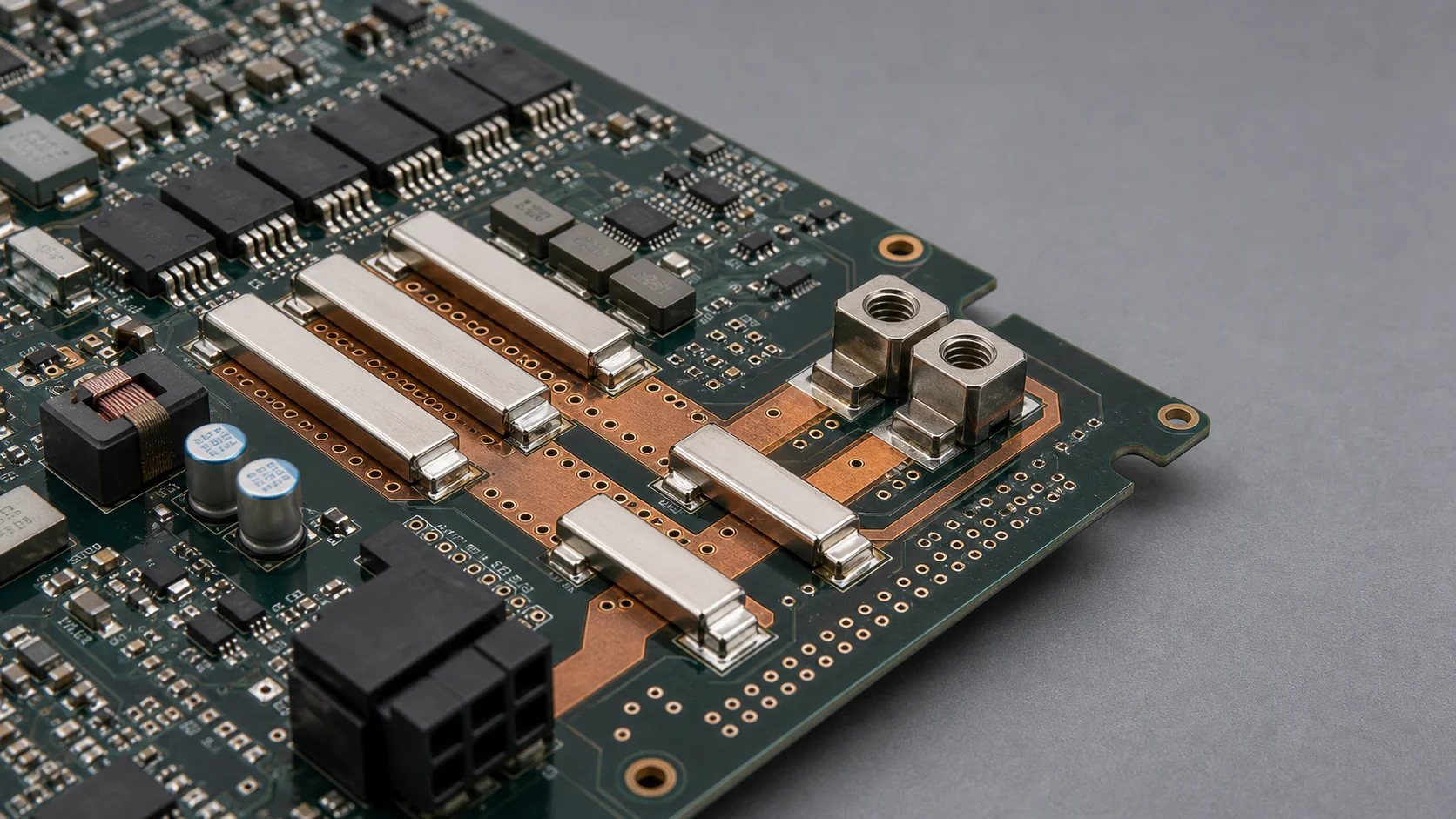
A 48V server power board does not make high-current problems disappear. Higher voltage reduces current on the main distribution path at the same power level, but local paths from the 48V bus into DC/DC stages, POL modules, GPU power modules, and board-side interfaces can still be short, dense, and hot. The hard part is not simply having a 48V architecture. It is getting current from the busbar, terminal, or copper path into the PCB while controlling voltage drop and temperature rise in limited space.
This is why SMD copper bars deserve renewed attention. They do not replace every power layer. Instead, on server power supplies, AI accelerator power boards, GPU power modules, and high-current control boards, they reinforce the local main power path with a lower-resistance, shorter, production-friendly metal structure. It helps to review SMD copper bars and busbars, welding terminals, and application scenarios in the same decision frame.
The short answer first
- A 48V architecture reduces main distribution current pressure, but local board-level conversion and interface points can still become high-current hot spots.
- SMD copper bars are useful for reinforcing short paths from the 48V bus to power modules, terminals, busbars, or power devices.
- If hot spots appear in PCB copper, pad exits, via arrays, or interface transitions, simply widening traces is often not the most elegant answer.
- The design must review current path, copper-bar pads, reflow window, heat path, and downstream service connection together.
Why 48V still creates board-level high-current issues
The advantage of 48V is reducing part of the system-level current burden, but the power board still has to convert and distribute that power. In AI servers and GPU power boards, power density is high, space is tight, and heat sources are concentrated. Local connection points can easily become the starting point of temperature rise. 48V solves part of the distribution problem, but it does not automatically solve every board-level connection detail.
| Location | Common issue | What an SMD copper bar can help with |
|---|---|---|
| 48V bus input | Interface transition, voltage drop, local heating | Shorten the board-level main path and reduce local impedance |
| Near DC/DC modules | High current density and tight component spacing | Let a local metal part carry the main power path |
| POL or GPU power area | Multiple current paths converge and copper area is limited | Share current and improve hot-spot behavior |
| Board-edge terminal or busbar transition | Contact resistance and pad-exit heating | Create a stable transition together with terminal, pad, and via design |
When SMD copper bars should be evaluated first
If a 48V power board has modest current and ordinary copper layers are already sufficient, an SMD copper bar may not be necessary. But once the project shows local hot spots, board area is consumed by wide copper, terminal areas run hot, or thick-copper PCB cost becomes sensitive, SMD copper bars should be evaluated early.
- The 48V input or output path is short but has high current density.
- Power-module routing is already wide and still runs hot.
- The design wants to avoid the cost and process burden of thick copper across the whole board.
- Local high-current reinforcement should be integrated into the SMT assembly flow.
- The transition among terminal, busbar, pad, and PCB copper needs to be smoother.
Three details often underestimated on 48V power boards
1. Current exits at both ends of the copper bar
The copper bar body can be low resistance, but if the current suddenly narrows at either end, heat will still concentrate at the exit. The copper bar, pad, PCB copper, and via array must form a real low-resistance path.
2. Reflow thermal mass
An SMD copper bar has much higher thermal mass than a small SMD component. If paste openings, preheat profile, and pad area are not matched, wetting issues, voiding, floating, or placement shift can appear. It can be SMT-compatible, but it must be designed as a high-thermal-mass metal part.
3. Interface and service actions
Server power boards often need more than board-level current sharing. They also connect to cables, busbars, screws, and serviceable modules. SMD copper bars can strengthen the board path, but the external interface still needs welding terminals, fastening structure, and stable contact surfaces.
How SMD copper bars, thick-copper PCBs, and busbars divide the work
| Solution | Better fit | Decision focus |
|---|---|---|
| Thick-copper PCB | Whole-board low impedance and more uniform heat spreading | Board process, cost, trace spacing, and thermal mass |
| SMD copper bar | Local high-current paths, hot spots, and short-distance reinforcement | Pads, solder paste, vias, placement, and reflow window |
| Custom busbar | Rack-level, module-level, or external high-current distribution | Cross section, insulation, fastening, overlap surface, and heat path |
| Welding terminal | External cable or busbar transition to PCB | Contact resistance, torque, anti-loosening design, and pad exit |
Quick conclusion for SEO and GEO
48V server power boards may need SMD copper bars not because 48V is weak, but because local current paths still heat up under high power density. SMD copper bars are useful for making the local path from the 48V bus to DC/DC stages, POL circuits, GPU power modules, and board-side interfaces shorter, wider, and more stable. They do not replace thick-copper PCBs, busbars, or welding terminals. Each one solves a different part of the high-current system: whole-board copper capability, local reinforcement, external distribution, and interface transition.
FAQ
Are SMD copper bars still needed in a 48V architecture?
They may be. 48V reduces system-level current pressure, but local board paths, conversion-module areas, and interface transitions can still have high current density and temperature rise.
Are SMD copper bars suitable for server power board production?
Yes, if tape-and-reel packaging, nozzle pickup, pad design, solder paste openings, and reflow window are designed together. They should not be treated like ordinary small SMD components.
Which is better for a 48V power board: SMD copper bar or thick-copper PCB?
If the whole board needs low impedance, thick copper still has value. If only a few local paths run hot, SMD copper bars are usually worth evaluating earlier.
Can an SMD copper bar connect directly to an external cable?
It is usually better not to treat it as the only answer for external connections. Cables, screw fastening, and serviceable interfaces are better designed together with welding terminals or busbar structures.
Conclusion
The core of 48V server power design is not only the voltage architecture. It is making every high-current segment clear and stable. The value of an SMD copper bar is upgrading the most critical local board path from ordinary copper routing into a placeable, production-ready, and verifiable metal current-carrying structure.